Hugging Face Brings Native PyTorch Support to Google TPUs as AWS Pushes Trainium Compatibility
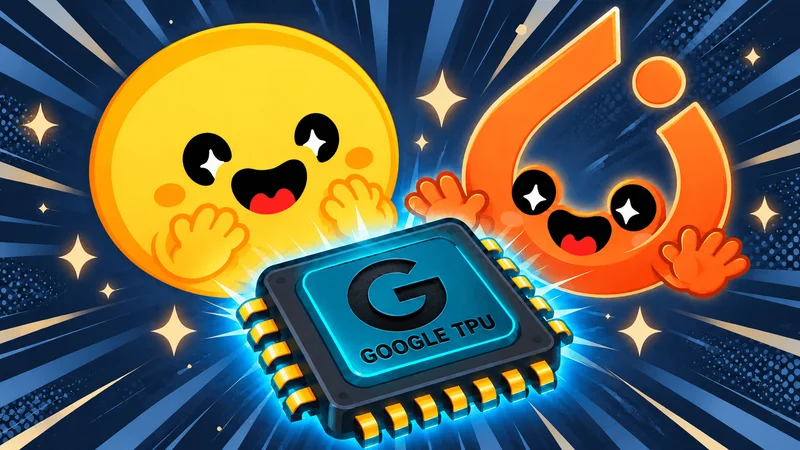
Image: Hugging Face Blog
Main Takeaway
Hugging Face is adding native PyTorch support for Google TPUs through TorchTPU, while AWS advances TorchNeuron to make Trainium easier for model developers.
Jump to Key PointsSummary
Native PyTorch reaches TPUs
Hugging Face is bringing native PyTorch support to Google Cloud TPUs through TorchTPU, allowing developers to treat TPU hardware as another PyTorch device. The change targets a long-standing friction point: running PyTorch models on TPUs traditionally required porting code to torch_xla or learning JAX.
TorchTPU extends that support across Hugging Face Transformers, Diffusers and Kernels. The company says developers can select models from the Hugging Face Hub, move them to a TPU, and work within familiar PyTorch workflows. A separate Hugging Face Daily Papers listing describes the effort as running native PyTorch on TPUs with zero code changes, reinforcing the project’s focus on lowering migration costs.
Hugging Face broadens accelerator access
The TPU announcement fits a wider Hugging Face effort to make its model ecosystem portable across specialized AI hardware. Native backend support matters because hardware access alone doesn't guarantee usable software support, especially for teams that build around PyTorch APIs, Trainer workflows and shared Hub models.
Transformers, Diffusers and Kernels are central to that strategy. Supporting those components directly gives developers a common software surface across different accelerators, while preserving access to models and tools already distributed through the Hub. The result is a more uniform path from experimentation to deployment, although hardware-specific performance and feature coverage remain practical questions for teams testing production workloads.
AWS answers with TorchNeuron
AWS is pursuing a parallel route for Trainium with TorchNeuron, a native PyTorch backend that connects Hugging Face models to the company’s custom AI chips. Hugging Face says Transformers, Diffusers and Kernels support Trainium through the new backend, while AWS describes Trainium as an accelerator platform for training and inference.
TorchNeuron builds on AWS Neuron, the software stack for Trainium and Inferentia. AWS documentation covers native PyTorch support, model training and Hugging Face Trainer workflows, including a BERT fine-tuning example for the MRPC task. Those integrations give developers an established path for adapting PyTorch code and familiar training APIs to AWS hardware.
Software becomes the competitive front
The competing releases place compiler and framework compatibility at the center of the accelerator market. Nvidia's CUDA ecosystem has long made software portability a major part of its advantage, so Google and Amazon are addressing a similar adoption barrier by reducing the amount of specialized code developers must learn or maintain.
Amazon's Trainium push has drawn attention because a smoother PyTorch experience directly targets Nvidia's software lead, GeekWire reported. AWS also promotes Trainium for large-scale AI workloads, while Hugging Face's partnership helps connect that infrastructure to an open model community. Google benefits from the same dynamic with TorchTPU, giving TPU users a native route into widely used PyTorch tooling.
What developers will test next
Developers will judge TorchTPU and TorchNeuron by more than installation simplicity. They will compare model coverage, training stability, inference speed, memory behavior, debugging tools and the amount of code that still requires accelerator-specific changes.
AWS documentation and re:Post examples show that Trainium already supports practical Hugging Face workflows, including large-language-model training and Trainer-based fine-tuning. A GitHub issue tracking TRL on AWS Trainium points to the continuing work needed for broader ecosystem support. TPU developers face a similar test as TorchTPU expands beyond the initial native integrations.
A wider choice of AI infrastructure
Native PyTorch backends make specialized chips easier to evaluate, which strengthens competition among Google TPUs, AWS Trainium and Nvidia GPUs. For developers, the immediate benefit is a smaller software gap between hardware platforms and a clearer way to reuse open models across them.
The broader shift is toward accelerator choice being decided inside familiar frameworks rather than through entirely separate programming models. Hugging Face supplies the model and application layer, while Google and AWS supply competing hardware and backend stacks. If the integrations mature, teams can compare cost and performance with less code rewiring, putting pressure on providers to compete on the full developer experience.
Key Points
Hugging Face brings native PyTorch execution to Google TPUs through TorchTPU and familiar model libraries.
TorchTPU supports Transformers, Diffusers and Kernels without requiring developers to learn JAX.
AWS TorchNeuron connects PyTorch and Hugging Face workloads to Trainium through the Neuron software stack.
Native accelerator backends intensify competition with Nvidia's CUDA-centered developer ecosystem.
Developers will compare hardware support using performance, model coverage, cost and workflow compatibility.
Questions Answered
Hugging Face TorchTPU is a native PyTorch backend for Google TPUs. It lets developers use TPU hardware as a PyTorch device and run Hugging Face Transformers, Diffusers and Kernels.
TorchTPU lets Hugging Face developers run PyTorch workloads on TPUs without switching to JAX. The project also addresses workflows that previously required torch_xla or other TPU-specific adaptations.
AWS TorchNeuron is a native PyTorch backend for AWS Trainium chips. It works with AWS Neuron and supports Hugging Face model and training workflows, including Trainer-based fine-tuning.
TorchTPU and TorchNeuron make Google and AWS accelerators easier to use from PyTorch. That reduces one barrier to evaluating alternatives to Nvidia GPUs and increases competition around software compatibility.
Developers will evaluate model coverage, performance, stability, memory use, debugging and library support on TorchTPU and TorchNeuron. Support for additional Hugging Face tools, including TRL, will also shape adoption.
Source Reliability
45% of sources are highly trusted · Avg reliability: 71
 Aws.amazon
 Aboutamazon
Go deeper with Organic Intel
Simple AI systems for your life, work, and business. Each one includes copyable prompts, guides, and downloadable resources.
Explore Systems