Guggenheim's Schwartz: US Power Grid Bottleneck Could Cede AI Lead to China
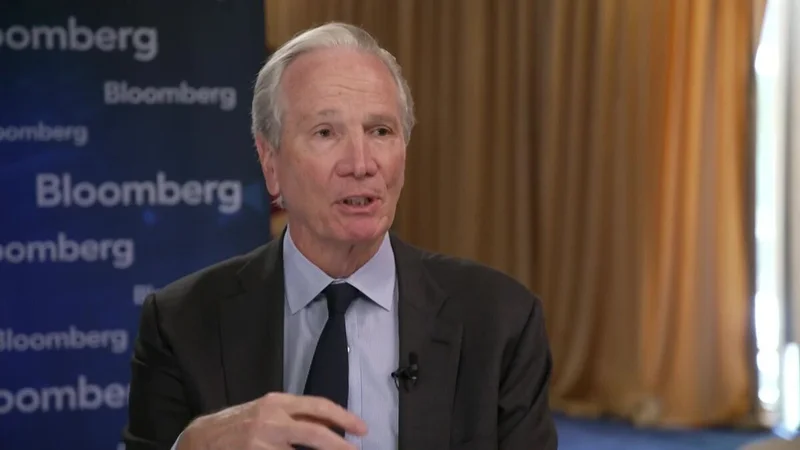
Image: Bloomberg AI
Main Takeaway
Guggenheim's Alan Schwartz warns at Milken that America's aging electrical grid is the single biggest threat to keeping pace with Beijing in the AI race.
Jump to Key PointsSummary
The blunt warning from Beverly Hills
Alan Schwartz, executive chair of Guggenheim Capital, told Bloomberg at the Milken Institute Global Conference that the United States is on track to lose its artificial-intelligence edge to China. The culprit, he said, is not talent or capital but a creaking electrical grid that can't deliver the gigawatts new data centers need.
Schwartz framed the problem starkly: every week another hyperscaler announces a 500 MW or 1 GW campus, yet utilities are still citing interconnection queues stretching five to seven years. He argued that without a crash program to upgrade transmission and generation, the country will watch AI leadership slip away even as it invents the models themselves.
Why power is the new silicon
The numbers are brutal. Goldman Sachs research, circulated separately at the same conference, projects that US electricity demand from data centers will triple by 2030. That single category could consume 12 percent of the nation’s entire power supply, up from four percent today.
Grid operators already run emergency alerts during summer peaks. Adding AI workloads on top of electrification of transport and heat pumps pushes reserve margins into negative territory in at least six ISO regions. Schwartz noted that China’s state-directed grid expansion is moving faster than any private utility can manage under US regulatory constraints.
What this means for hyperscalers
Microsoft, Google, Amazon and Meta have all warned investors that power availability, not GPU supply, may cap their build-outs. Meta paused two US data-center projects in 2024 after utilities said new transmission wouldn’t come online until 2029. Google is now routing two-thirds of its 2026-2028 expansion to Québec and Scandinavia where hydro and nuclear provide firm, carbon-free power.
Schwartz predicted a wave of near-shoring to Canada and Mexico, not for labor costs but for electrons. He expects joint ventures between US tech giants and foreign state utilities, a reversal of the 1990s outsourcing playbook.
The policy window is closing
The Federal Energy Regulatory Commission has a backlog of 2,000 GW of generation and storage waiting to connect. A typical solar-plus-storage project now waits 42 months for a grid study that used to take 18. Congress has authorized $20 billion for transmission build-out, but that covers less than five percent of the lines the Department of Energy says are needed.
Schwartz called for treating grid modernization as a national-security issue, akin to the 1950s interstate highway program. He floated the idea of a federal AI Power Act that would fast-track permits for data-center corridors, funded by a dedicated bond issue. Without such action, he warned, the US will import AI services the same way it now imports semiconductors.
Second-order shocks for the startup ecosystem
If the hyperscalers can’t secure domestic power, venture capital will follow them offshore. Schwartz noted that Canadian provinces are already offering 15-year power purchase agreements at 3-4 cents per kWh, undercutting PJM and ERCOT by half. That pulls not only server farms but also the lattice of chip suppliers, cooling vendors and construction crews.
Early-stage AI labs that rely on cloud credits may find their preferred regions throttled by capacity caps. He expects a premium market for “grid-adjacent” real estate, brownfield sites already served by high-voltage transmission, to emerge within 18 months, pricing out smaller players.
What happens next
Schwartz gave a six-to-nine-month timeline for policy clarity. If Congress adjourns this summer without addressing permitting reform, he said, the hyperscalers will accelerate overseas commitments that lock in supply chains for a decade. He predicted a flurry of joint announcements at COP29 in November, pairing US software firms with Canadian hydro utilities and Middle Eastern sovereign wealth funds.
For builders and founders, the takeaway is blunt: treat power procurement as the first step in site selection, not the last. Schwartz advised any AI startup raising Series B or beyond to budget for a dedicated substation and to hire a transmission lawyer before a head of security.
The bigger picture
The power bottleneck is a rare issue uniting climate activists and defense hawks. Clean-energy groups want the same transmission upgrades to connect solar and wind; national-security hawks fear Chinese dominance in AI. Schwartz argued that this coalition gives the next administration, of either party, a once-in-a-generation chance to pass big infrastructure legislation. Whether it acts before the grid says “no” is the trillion-dollar question now facing Silicon Valley.
Key Points
Guggenheim’s Alan Schwartz warns the US could lose AI leadership to China due to grid bottlenecks rather than talent or capital gaps.
Goldman Sachs forecasts US data-center electricity demand will triple by 2030, eating 12 percent of total national supply.
Meta and Google have already paused or rerouted multi-gigawatt expansions because utilities quote 5-7 year interconnection delays.
FERC has 2,000 GW of generation and storage stuck in queue, with grid-study wait times doubling to 42 months for renewables.
Schwartz urges Congress to pass an “AI Power Act” within six to nine months or watch hyperscalers commit long-term to overseas grids.
Questions Answered
Goldman Sachs projects US data-center demand will triple to roughly 12 percent of the nation’s total electricity supply, up from about four percent today.
Google is routing two-thirds of its 2026-2028 expansion to Québec and Scandinavia; Meta paused two US campuses after utilities said new transmission wouldn’t arrive until 2029.
FERC reports 2,000 GW in the interconnection queue, and a typical solar-plus-storage project now waits 42 months for a grid study—double the time it took five years ago.
He calls for an “AI Power Act” that treats grid modernization like 1950s interstate highways: federal bonds to fund transmission, fast-tracked permitting for data-center corridors, and national-security priority status.
Schwartz says Congress has six to nine months before hyperscalers lock in long-term overseas power contracts that dictate supply-chain geography for the next decade.
Source Reliability
100% of sources are highly trusted · Avg reliability: 89
Go deeper with Organic Intel
Simple AI systems for your life, work, and business. Each one includes copyable prompts, guides, and downloadable resources.
Explore Systems