China Blocks Meta's $2 Billion Manus AI Deal in Strategic Tech Clampdown
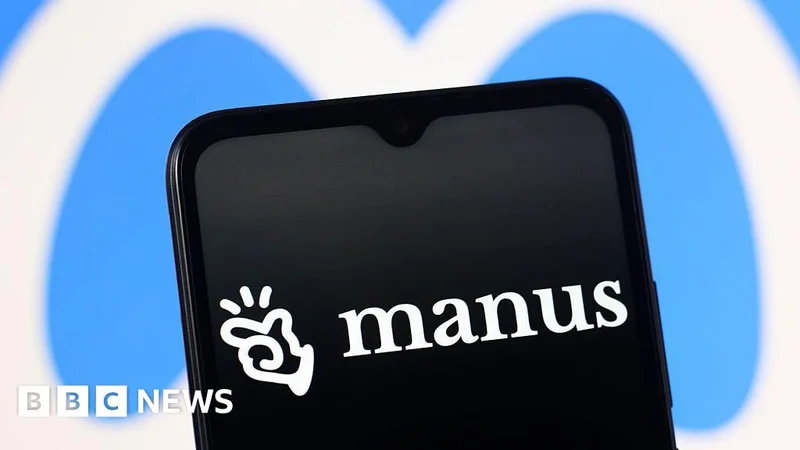
Image: Bbc
Main Takeaway
Beijing's unprecedented veto of Meta's Manus acquisition signals new era of Chinese control over AI tech, even for offshore startups.
Jump to Key PointsSummary
China's state planner has torpedoed Meta's $2 billion acquisition of AI startup Manus, marking a dramatic escalation in the global AI arms race. The National Development and Reform Commission (NDRC) ordered both parties to unwind the deal four months after it was sealed in December 2025, sending shockwaves through Silicon Valley and Singapore's tech corridors.
According to Bloomberg AI, Manus had already relocated from Beijing to Singapore in an apparent attempt to sidestep Chinese oversight. That strategy failed spectacularly. The startup, which builds AI agents capable of complex task automation, was founded by Chinese nationals and initially developed its core technology within China.
The move represents Beijing's most aggressive intervention yet in cross-border AI deals. Reuters reports this sets a chilling precedent for any Chinese-founded startup seeking foreign investment, regardless of where they incorporate. The message is clear: strategic AI capabilities remain under Beijing's thumb, even when companies flee offshore.
Meta's acquisition was meant to bolster its AI agent capabilities across Facebook, Instagram, and WhatsApp. Manus had gained prominence as China's answer to DeepSeek, with state media initially celebrating it as a domestic success story before its Singapore pivot soured relations with regulators.
What this means for Chinese AI startups
Chinese founders now face an impossible choice: access global capital markets or retain operational freedom. The Manus case proves that relocating to Singapore, traditionally a safe harbor for Chinese tech firms, no longer guarantees immunity from Beijing's reach.
Channel News Asia reports regulators used an obscure national security provision to retroactively review the deal, despite Manus's Singapore incorporation. This creates what analysts call a "regulatory moat" around Chinese AI talent and technology, trapping innovation within national borders.
The ruling effectively nationalizes Manus's AI capabilities without compensation. The startup must now either find domestic buyers or face operational restrictions that could cripple its business model. Other Chinese-founded AI companies with foreign investment are reportedly scrambling to assess their exposure.
Investors are already recalibrating risk models. Foreign venture capital firms are quietly shelving term sheets for Chinese AI startups, while domestic investors sense an opportunity to acquire distressed assets at fire-sale prices.
Impact on global AI development
This intervention fractures the global AI ecosystem into competing spheres of influence. American companies lose access to Chinese AI talent and datasets, while Chinese startups lose pathways to global markets and capital.
The decision accelerates what Foreign Policy calls "AI bifurcation", the splitting of artificial intelligence development into distinct US-led and China-led spheres. Meta must now build comparable AI agent capabilities organically, likely taking 18-24 months longer than planned.
European regulators are watching closely. The EU has similar concerns about AI sovereignty and may follow China's lead in blocking strategic acquisitions. This could trigger a wave of protectionist measures across major economies, slowing overall AI advancement.
Smaller AI hubs like Singapore, Israel, and Canada face existential questions. Their traditional role as neutral ground for Chinese-American collaboration is evaporating. Singapore's Economic Development Board is reportedly drafting new guidelines for AI startups with Chinese connections.
Meta's strategic recalculation
Zuckerberg's AI ambitions just hit a brick wall. The Manus acquisition was supposed to leapfrog Meta's AI agent capabilities to compete with OpenAI's GPT agents and Google's Gemini ecosystem. Now they're back to square one.
According to CNBC, Meta had already begun integrating Manus technology into its Ray-Ban smart glasses and WhatsApp Business platforms. Those projects face indefinite delays while the company rebuilds from scratch or seeks alternative acquisitions.
The failure also complicates Meta's broader AI strategy. The company has invested heavily in AI infrastructure but lacks cutting-edge agent capabilities. Chinese-born AI talent, previously a key recruitment target, now becomes radioactive for US tech giants.
Meta's stock barely budged on the news, suggesting investors view this as a China-specific risk rather than broader execution concerns. But behind closed doors, the company's M&A team is reportedly reevaluating every potential acquisition for Chinese exposure.
China's broader tech calculus
Beijing just demonstrated it values AI sovereignty over foreign investment. The $2 billion price tag wasn't enough to offset concerns about core AI capabilities falling into American hands.
This aligns with China's broader strategy of restricting semiconductor exports and limiting foreign access to Chinese AI models. The Manus veto extends these principles to software, creating comprehensive technology transfer barriers.
Chinese regulators are sending a deliberate signal to Silicon Valley: strategic AI sectors are off-limits for acquisition. This could actually accelerate domestic Chinese AI development, as startups must scale within China rather than selling out to foreign buyers.
The move also serves domestic political purposes. With US-China tech tensions escalating, Beijing can frame the veto as protecting national interests against American "tech hegemony." State media has already begun portraying Manus as a patriotic holdout against foreign takeover.
What happens next
Expect a chilling effect on Chinese AI startup valuations. Cross-border M&A deals involving Chinese founders are effectively dead, regardless of corporate structure. Venture capital will flow toward purely domestic or non-Chinese teams.
Manus faces an uncertain future. The company must either find domestic Chinese buyers at a fraction of Meta's offer or attempt to continue independently while navigating regulatory restrictions. Some analysts predict eventual state-backed acquisition.
Meta will likely pivot toward acquiring European or Israeli AI agent startups, though these markets can't fully replicate Chinese technical capabilities. The company may also accelerate internal R&D, potentially partnering with US national labs for sensitive AI research.
The broader tech cold war just got colder. Similar interventions are probable in biotech, quantum computing, and other strategic sectors. Startups worldwide must now choose sides in the US-China tech divide, with profound implications for global innovation.
Key Points
China's NDRC used national security provisions to retroactively block Meta's $2B acquisition of Singapore-based AI startup Manus
The veto applies despite Manus's offshore incorporation, establishing Beijing's reach over Chinese-founded AI technology
Meta loses immediate access to advanced AI agent capabilities, delaying integration across Facebook, Instagram, and WhatsApp platforms
Chinese AI startups now face impossible choice between global capital access and operational freedom
Decision accelerates global AI bifurcation into competing US and China development spheres
Questions Answered
Despite Manus incorporating in Singapore, the company was founded by Chinese nationals and developed its core AI technology in Beijing. China's regulators used national security provisions to assert jurisdiction over 'strategic AI capabilities' regardless of corporate location.
Manus builds AI agents capable of complex task automation across multiple domains. The technology was seen as strategically important for China's AI sovereignty, with state media previously comparing it to breakthrough systems like DeepSeek.
Any Chinese-founded startup now faces potential veto of foreign acquisitions, regardless of where they incorporate. This dramatically reduces valuations and forces founders to choose between domestic scaling or permanent foreign relocation.
Meta must either build AI agent capabilities internally through R&D (18-24 month timeline) or acquire non-Chinese startups in Europe or Israel. The company is reportedly reevaluating all potential acquisitions for Chinese exposure.
Yes. The EU and other major economies are studying China's approach and may implement similar AI sovereignty measures. This could trigger global protectionist policies around strategic AI technology.
Manus must either find domestic Chinese buyers at reduced valuations, continue independently under regulatory constraints, or face potential state-backed acquisition. The company's global expansion plans are effectively terminated.
Source Reliability
67% of sources are highly trusted · Avg reliability: 83
Go deeper with Organic Intel
Simple AI systems for your life, work, and business. Each one includes copyable prompts, guides, and downloadable resources.
Explore Systems