Google DeepMind’s Gemini Robotics 2 Gives Humanoid Bots Whole-Body Control and Dexterity
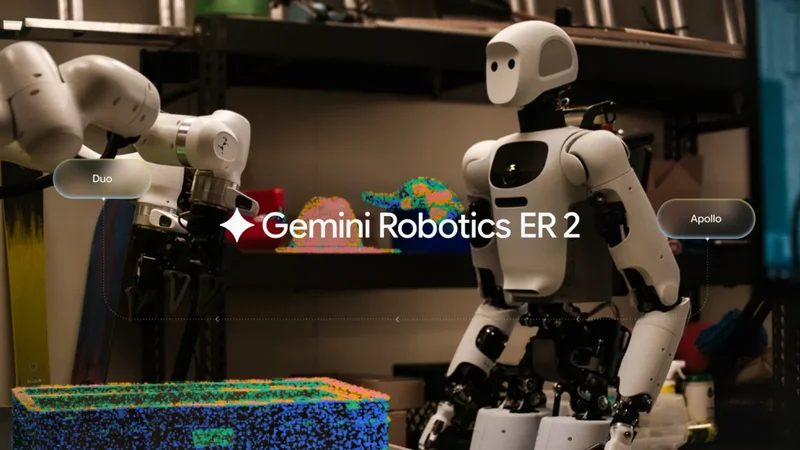
Image: Ars Technica AI
Main Takeaway
Google DeepMind unveiled Gemini Robotics 2, an AI model that controls entire humanoid robots from feet to fingertips to screw in lightbulbs, tie trash bags, and even slam dunk without cloud connectivity.
Jump to Key PointsSummary
What Gemini Robotics 2 actually does differently
Google DeepMind released Gemini Robotics 2, a new artificial intelligence model that coordinates an entire humanoid robot’s body, from its feet to its fingertips. The Verge reports that the previous model focused on controlling a humanoid’s upper body, while the new version supports whole-body motions. Wired notes the system combines several different AI models into a single system capable of dexterous tasks like screwing in lightbulbs and tying trash bags.
Ars Technica confirms that Gemini Robotics 2 includes three models, though only one is publicly available right now. The system enables continuous learning, meaning robots can improve at tasks over time without explicit reprogramming. Bloomberg adds that the model marks Google’s latest effort to expand into physical artificial general intelligence, or physical AGI.
How the on-device model changes deployment
A parallel release, Gemini Robotics On-Device, runs directly on robot hardware without cloud connectivity. Foxnews reports that this model brings Gemini’s advanced reasoning and control capabilities into physical robots with better privacy and faster responses, requiring minimal training data. Aimagazine explains that the on-device vision-language-action model enables autonomous robots to operate without internet connectivity at all.
The practical implications are significant. Robots can now work in remote locations, secure facilities, or any environment where cloud latency or connectivity would be a dealbreaker. Ultralytics notes that this multimodal intelligence boosts adaptability and dexterity while enabling seamless human interaction. The shift to edge computing for robotics removes a major dependency that has held back real-world deployment.
The leap from narrow automation to generalist robots
Most robots today are pre-programmed for narrow, repetitive task sequences. Hacker News AI, citing DeepMind’s official announcement, explains that Gemini Robotics 2 teaches robots intelligent whole-body control, fine dexterity, and teamwork. The model can adapt to new physical tasks without explicit training for each one.
The Independent describes a demonstration where a robot figured out how to slam dunk a basketball autonomously. Another demo showed robots performing household chores that required spatial reasoning and object manipulation. Plainconcepts positions this as a shift from factory robots that prioritize task efficiency to machines that can interact with humans in both industrial and domestic settings.
Why physical AGI raises the stakes
Wired frames this release as a significant jump into physical AGI, and warns that putting AI into the real world comes with risks. A robot that can tie trash bags can also cause physical harm if its reasoning fails. Ars Technica reports that Google has built in safety mechanisms, but the article does not detail their scope or limitations.
The Verge notes that the model now supports whole-body motions, which expands the surface area for potential failures. A misstep by a humanoid robot is not a server error. It is a physical event with real-world consequences. Google’s approach to safety will define how quickly regulators and enterprises feel comfortable deploying these systems.
The competitive landscape for embodied AI
Google’s move positions it against Tesla’s Optimus, Figure AI, and other humanoid robot companies racing to pair hardware with capable AI brains. Bloomberg AI frames the announcement as Google’s latest effort to embed its AI into physical machines, directly challenging competitors who have focused on the hardware side.
Ars Technica reports that only one of three Gemini Robotics 2 models is publicly available, which suggests Google is holding back capabilities for strategic partners or internal testing. The Verge AI notes that the previous model already controlled upper-body movements, and this version represents a major architectural shift toward full-body coordination. The robotics industry now has a clear signal that Google intends to be the intelligence layer for humanoid robots, not just a software provider.
What happens next for developers and enterprise
Google DeepMind is opening access to Gemini Robotics 2 through partnerships with robotics companies and apptronik, among others. Foxnews reports that the on-device model is designed for fast, reliable performance in real-world conditions. Aimagazine confirms that manufacturers are pursuing integration strategies to weave this technology into workflows for efficiency, safety, and economic gains.
Keywordsearch outlines the broader potential impact, describing how the vision-language-action model enables robots to comprehend, plan, and act with remarkable dexterity. The immediate next step is wider testing and integration. The longer-term trajectory points toward home assistant humanoids that can perform tasks without any prior training, as The independent describes. Whether that arrives in 2027 or 2030 depends on safety validation and hardware cost curves, but the software capability is now demonstrated.
Key Points
Google DeepMind launched Gemini Robotics 2 with full-body humanoid robot control from feet to fingertips.
Gemini Robotics On-Device runs robot AI without cloud connectivity, enabling faster response and privacy.
The model performs dexterous tasks like screwing in lightbulbs and tying trash bags without task-specific training.
Only one of three Gemini Robotics 2 models is publicly available, suggesting a phased rollout strategy.
Physical AGI introduces real-world safety risks that Google says it is addressing with built-in safeguards.
Questions Answered
Gemini Robotics 2 is Google DeepMind's AI model that controls entire humanoid robots with whole-body coordination. It combines vision, language, and action capabilities to perform dexterous tasks like screwing in lightbulbs and tying trash bags without task-specific training.
Yes, Gemini Robotics On-Device runs directly on robot hardware without cloud connectivity. This enables faster response times, better privacy, and operation in remote or secure environments where internet access is not available.
The previous Gemini Robotics model focused on controlling a humanoid robot's upper body. Gemini Robotics 2 adds full-body motion control from feet to fingertips and includes three models, though only one is publicly available right now.
Demonstrations show robots screwing in lightbulbs, tying trash bags, slam dunking a basketball, and performing other everyday tasks that require spatial reasoning and fine motor control, all without prior training on those specific tasks.
Physical robots with full-body control introduce real-world risks, since a coordination failure could cause physical harm. Google has built in safety mechanisms, but the full implementation details have not been disclosed.
Source Reliability
43% of sources are established · Avg reliability: 67
Go deeper with Organic Intel
Simple AI systems for your life, work, and business. Each one includes copyable prompts, guides, and downloadable resources.
Explore Systems