Google Builds Gemini Student Hub Around Research, Practice and Connected Study Tools
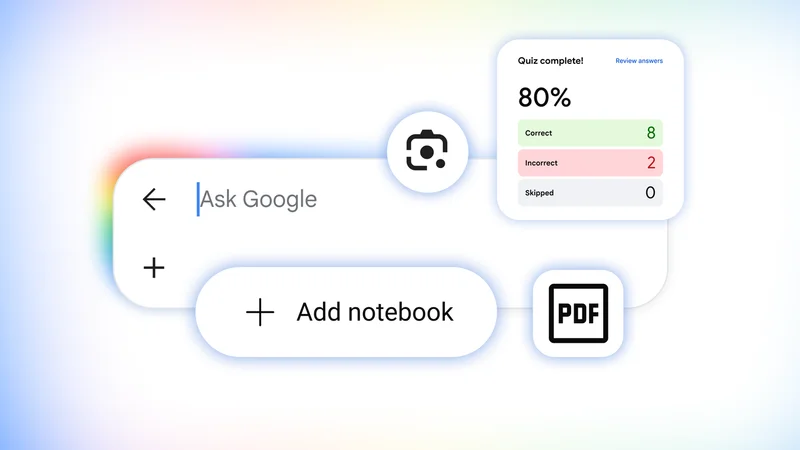
Image: Google AI Blog
Main Takeaway
Google is adding a dedicated student hub to Gemini with study notebooks, flashcards, quizzes, research tools and deadline tracking for the new school year.
Jump to Key PointsSummary
Google targets the student workflow
Google is adding a dedicated student hub to Gemini that brings research, note-taking, flashcards, practice quizzes and study organization into one workspace. The rollout, announced on August 19, positions Gemini as a daily academic assistant as students return to school, according to Google’s product announcements and coverage from TechCrunch AI and The Verge AI.
The hub is designed around the full study cycle rather than a single question-and-answer exchange. Students can collect material in study notebooks, turn concepts into practice activities, and organize assignments or test dates. The move puts Google directly alongside OpenAI, Knowt and Gauth, which already offer AI-supported learning and revision features.
Study notebooks become central
Study notebooks give students a place to gather research and build structured learning materials inside Gemini. The notebooks now support graphs and images, expanding them beyond text summaries and making them more useful for subjects that depend on visual explanation, according to The Verge AI and Google’s student-focused product pages.
Google’s broader Search rollout connects that notebook experience with tools for understanding difficult subjects. Students can generate interactive visuals, 3D simulations and custom learning tools for complex topics, while Gemini can help transform source material into flashcards or quizzes. The combination reflects Google’s strength in Search and its effort to keep students inside a connected set of products instead of sending them between separate study apps.
Practice tools aim at active learning
The new features emphasize practice, not just generated explanations. Gemini can create customized quizzes and flashcards, giving students ways to test recall after reviewing a topic. Search also adds tools for tackling tricky subjects and preparing for standardized tests, according to Google AI Blog’s product announcement and TechCrunch AI’s account of the launch.
That design matters because students often need help identifying gaps in understanding, not merely producing a polished summary. Interactive visuals and simulations can demonstrate a process, while quizzes expose weak spots and create a repeatable study routine. Google is also promoting Read Along and other student tools, although the available descriptions provide fewer details about how those features connect to the new hub.
Research gets a connected layer
Gemini’s Deep Research feature adds a research-assistant layer to the student offering. It is intended to help users investigate a topic and organize findings, while the student hub provides a place to continue working with that material through notes and study exercises. Google’s own Gemini pages present Deep Research as a personal research assistant, and the company’s student messaging centers connected AI tools.
The connection gives Gemini a broader role in schoolwork, from finding information to turning it into study material. It also raises the usual academic questions around source quality, attribution and overreliance on generated work. Google labels some generative AI content as experimental, and students still need to check evidence and follow school rules before submitting AI-assisted work.
Google’s education competition
The student hub is part of Google’s larger push to make Gemini the assistant students open first for learning. TechCrunch AI frames the launch as a competitive response to OpenAI and education-focused services such as Knowt and Gauth, while The Verge AI places the announcement in the back-to-school product cycle.
Google has an advantage in combining Gemini with Search, calendars and other services that students already use. Deadline tracking and connected study notebooks make the offering more useful for planning, while generated quizzes and simulations give it a more specialized academic identity. The result is a product strategy that joins general-purpose AI with school-specific workflows, rather than treating tutoring as a standalone chatbot feature.
What students should expect next
Students can expect Gemini’s hub to serve as a central starting point for organizing research, studying concepts and preparing for tests. Google’s announcements cover notebooks, flashcards, quizzes, visual learning tools, simulations, Deep Research and deadline organization, although availability and feature access can vary by product and account.
The rollout also sets a higher bar for AI study products. Success will depend on whether students find the generated materials accurate, useful and easy to verify, not simply on how many tools Google places in one interface. As the school year begins, Gemini will compete on workflow: helping students move from a question to credible research, practice and a planned study session.
Key Points
Google Gemini is adding a student hub for research, flashcards, quizzes and study planning.
Gemini study notebooks now organize research with support for graphs, images and learning materials.
Google Search can generate interactive visuals, 3D simulations and custom tools for difficult subjects.
Deep Research connects Gemini’s research assistance with broader student study workflows.
Google is competing with OpenAI, Knowt and Gauth for AI-powered learning and revision.
Questions Answered
Google Gemini’s student hub is a centralized workspace for research, study notebooks, flashcards, practice quizzes and academic organization. It is designed to support students across research, revision and test preparation.
Google Gemini study notebooks let students collect research and organize learning materials, including graphs and images. Students can use the material to create flashcards and practice quizzes.
Google Gemini can create customized practice quizzes for students. The feature is intended to help learners test recall and identify gaps after studying a topic.
Google Search supports student learning with AI-generated interactive visuals, 3D simulations and custom tools for complex subjects. Google also promotes Search features for classwork and standardized-test preparation.
Google Gemini includes Deep Research, which is presented as a personal research assistant. Students can connect research activity with notebooks and other study materials, while still checking sources and citations.
Source Reliability
57% of sources are highly trusted · Avg reliability: 73
Go deeper with Organic Intel
Simple AI systems for your life, work, and business. Each one includes copyable prompts, guides, and downloadable resources.
Explore Systems