Google AI Mode Gets App Integrations, Turning Search Into a Task Engine
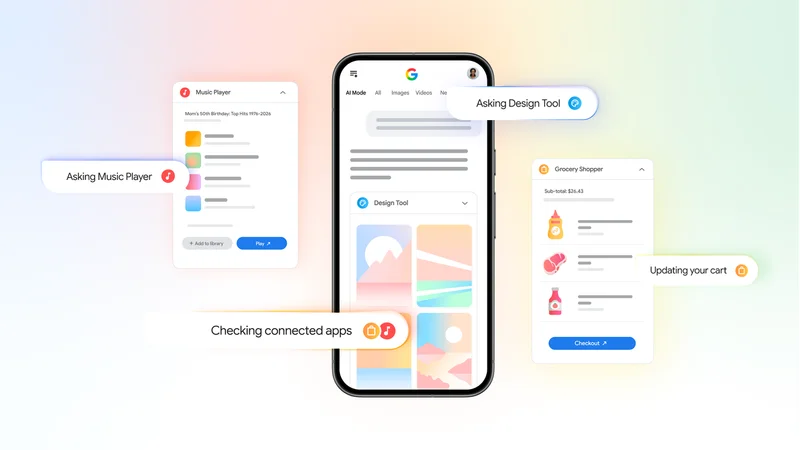
Image: Google AI Blog
Main Takeaway
Google announced AI Mode can now link with Instacart, Canva, and YouTube to complete tasks like shopping and design directly inside search results.
Jump to Key PointsSummary
How the new app connections work
Google is turning AI Mode from a question-answering tool into something that gets things done. As of July 2026, users can link their Instacart, Canva, and YouTube accounts directly inside AI Mode, letting the conversational search interface take action on their behalf. According to the company's official blog post, if you're planning a barbecue and using AI Mode to build a grocery list, connecting Instacart means the ingredients get added straight to your cart without switching tabs.
TechCrunch reports that the integrations go beyond shopping. With Canva linked, AI Mode can generate social media graphics or invitation designs based on your prompts and drop them into your Canva workspace. YouTube integration lets the system pull relevant video content into answers or save videos to playlists. The connections are opt-in and secured through Google's account linking framework, the same approach the company uses for Gemini app extensions.
What this signals about Google's competitive strategy
The app integrations aren't happening in a vacuum. OpenAI's ChatGPT already supports extensions for DoorDash, Spotify, and Uber. Anthropic's Claude offers Connectors that plug into third-party services. Google is playing catch-up on this front, but it's doing so from a position of enormous distribution advantage. AI Mode launched in the US in March 2025 and has since expanded to nearly 200 countries across 98 languages, according to Hitechnectar. That reach gives Google a user base no rival can match right now.
TechCrunch frames the update as Google betting that users will lean on AI Mode more heavily for planning and shopping, two categories with clear commercial upside. Lifehacker notes that Google already integrated its Shopping Graph into AI Mode last November, letting the system surface product links. The Instacart tie-in closes the loop: find what you need, then buy it without leaving search. For Google, that means more time on its properties and more transaction data flowing through its pipes.
The shopping assistant that sometimes needs coaxing
Lifehacker's testing last November revealed an awkward truth about Google's shopping AI: it doesn't always know when to show product links. The Shopping Graph data is there, but getting the AI to actually surface it can require specific phrasing. Michelle Ehrhardt wrote that users might need to explicitly ask for product recommendations or pricing before AI Mode pulls from the shopping database, rather than the system intuitively recognizing a purchase intent query.
This quirk matters now that Instacart is in the mix. If AI Mode doesn't reliably detect when someone wants to buy groceries versus just research recipes, the cart-adding feature becomes less seamless than Google's barbecue planning demo suggests. The company hasn't publicly addressed whether the new integrations include improved intent detection, but the official blog post emphasizes that users control when apps are connected and can disconnect them anytime.
Where AI Mode fits in the broader search overhaul
AI Mode is the most significant change to Google Search in a decade, Hitechnectar argues, and it's part of a layered AI strategy. At the top of a standard results page, AI Overviews already provide quick summaries with source links for verification. Scroll past those and you get traditional web links. AI Mode is the third layer: a dedicated tab that opens a full conversational interface where you can go back and forth, refine queries, and now take action through connected apps.
Avidopenaccess points out that AI Overviews include citations so users can check accuracy, a design choice that carries over to AI Mode's linked sources. The educational technology publication notes that for high-stakes questions, clicking through to original sources remains essential because AI summaries can be wrong. Google's own blog labels AI Mode's generative output as experimental, a disclaimer that sits somewhat awkwardly next to the new ability to spend real money through Instacart.
How to enable it and what to watch for
AI Mode appears as a tab in Google Search results for users in supported regions. Hitechnectar's guide explains that clicking the tab switches from standard results to the conversational interface. There's no separate app to install; it lives inside the existing Google Search experience on both desktop and mobile. PopSci's coverage from November 2025 noted that users who prefer traditional search can simply avoid clicking the AI Mode tab, though AI Overviews at the top of results are harder to dodge.
PopSci also flagged a practical concern: AI-generated search answers sometimes pull from sources that are themselves AI-generated, creating a compounding accuracy problem. With app integrations adding financial transactions to the mix, the stakes for reliability tick upward. Google hasn't detailed specific safeguards for the connected app features beyond stating that linking is secure and user-controlled.
What happens next
The initial app lineup is small: Instacart, Canva, and YouTube. But the pattern is clear. Google's Gemini app already connects to a wider set of services, and TechCrunch expects that portfolio to migrate into AI Mode over time. The official blog post frames this week's US rollout as a starting point, not a finished product. If the integrations drive measurable engagement, expect rapid expansion to more commerce and productivity apps.
For competitors, the pressure is on distribution. ChatGPT and Claude have app integrations too, but neither sits inside the world's dominant search engine. Google's challenge is execution: making the app connections feel natural enough that users actually adopt them, rather than treating AI Mode as a curiosity they try once and abandon. The barbecue demo is polished. Real-world usage will determine whether the plumbing holds up.
Key Points
Google AI Mode now connects to Instacart, Canva, and YouTube for in-search task completion.
The integrations let users add groceries to carts, generate designs, and access video content without leaving search.
The rollout positions Google against ChatGPT and Claude, both of which already offer third-party app connections.
AI Mode has reached nearly 200 countries and 98 languages since its US launch in March 2025.
Google previously integrated Shopping Graph data into AI Mode, though product link surfacing can be inconsistent.
Questions Answered
At launch, Google supports connecting Instacart, Canva, and YouTube accounts to AI Mode. Instacart lets you add grocery items directly to your cart, Canva generates designs based on prompts, and YouTube surfaces relevant videos or saves them to playlists. Google says more apps will be added over time.
AI Mode appears as a dedicated tab in Google Search results on desktop and mobile in supported regions. Click the tab to switch from standard results to the conversational interface. No separate app installation is required, and the feature is available in nearly 200 countries as of 2026.
Google says the app connections use the same secure account linking framework as Gemini app extensions. Users must opt in to connect each service and can disconnect them at any time. Google hasn't detailed additional safeguards specific to financial transactions made through the integrations.
ChatGPT supports extensions for DoorDash, Spotify, and Uber, while Claude offers Connectors for third-party services. Google's AI Mode integrations are newer but benefit from Google Search's massive distribution, reaching nearly 200 countries. The initial app lineup is smaller but expected to expand.
Yes. AI Mode is a separate tab you can choose to click or ignore. However, AI Overviews, which are summary boxes that appear at the top of standard search results, are harder to avoid. Users who want traditional search only can scroll past the AI Overviews to reach the standard web links.
Not always. Lifehacker's testing found that while Google's Shopping Graph data is integrated into AI Mode, the system sometimes requires very specific phrasing before it surfaces product links or pricing. Google hasn't confirmed whether the new Instacart integration includes improved purchase-intent detection.
Source Reliability
33% of sources are highly trusted · Avg reliability: 74
Go deeper with Organic Intel
Simple AI systems for your life, work, and business. Each one includes copyable prompts, guides, and downloadable resources.
Explore Systems