BNY CEO Robin Vince Bets on AI as 'Capacity Creator' with 140 Digital Employees and OpenAI Partnership
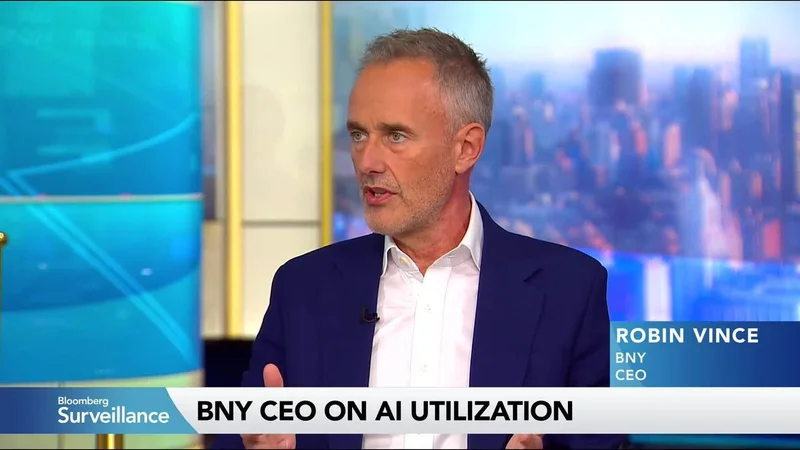
Image: Bloomberg AI
Main Takeaway
BNY CEO Robin Vince calls AI a capacity creator, not a job destroyer, as the bank deploys 140 digital employees and partners with OpenAI on its Eliza platform.
Jump to Key PointsSummary
Why AI is a jobs creator at BNY
Robin Vince, CEO at BNY, rejects the narrative that AI destroys employment. He argues the technology functions as a capacity creator that lets the bank redirect savings into growth areas. During a panel at the Milken Institute's 2026 global conference, Vince said, "I think when you can save in one place, it allows you to be able to do more." This framing positions AI as a reinvestment tool rather than a cost-cutting weapon.
The numbers back his optimism. BNY reports that its efforts to increase revenue per employee are accelerating with AI assistance. With 47,000 human employees, the bank is measuring success not by headcount reduction but by output efficiency. Vince's stance places BNY in a small group of financial institutions publicly defending AI's role in workforce expansion rather than contraction.
How BNY built its digital workforce
BNY now operates approximately 140 AI-powered agents that function alongside human staff. These digital employees handle tasks across operations, with managers learning to supervise hybrid teams of people and machines. The bank's workforce has been trained to build their own agents, pushing AI capability deep into the organization rather than keeping it siloed in technical departments.
This agentic approach sits atop a substantial hardware foundation. In March 2024, BNY became the first major bank to deploy an NVIDIA DGX SuperPOD with DGX H100 systems, giving it dedicated supercomputing capacity for financial AI workloads. The installation, completed with NVIDIA Professional Services, provides the infrastructure needed to train and run models at scale without relying on shared cloud resources.
The OpenAI partnership behind Eliza
BNY's enterprise AI platform, called Eliza, entered its second generation in 2025 and now reaches nearly every staff member. The bank struck a multiyear strategic partnership with OpenAI to embed advanced generative models, including reasoning capabilities and Deep Research-style tools, directly into Eliza's architecture. The collaboration centers on BNY's stated maxim: "AI is for everyone, everywhere, everything at BNY."
This integration goes beyond chatbot deployment. BNY is weaving generative capabilities into core banking processes, allowing employees to interact with financial data through natural language interfaces. The OpenAI deal gives BNY early access to model improvements while letting it maintain proprietary data controls through its own infrastructure.
What this means for banking competition
BNY's AI investments have attracted investor attention. The bank's shares jumped 65% as its AI hiring push accelerated, according to Yahoo Finance data. This market response signals that Wall Street is rewarding tangible AI deployment over vague technology commitments. BNY's 240-year history gives it institutional credibility that newer fintech competitors lack, but its technology bets must now deliver measurable returns.
The competitive pressure extends across custody banking and asset servicing. Competitors including State Street, JPMorgan Chase, and Citigroup are pursuing their own AI strategies, though with varying public commitment levels. BNY's early supercomputing investment and OpenAI partnership give it temporary differentiation, but the window for advantage is narrowing as AI infrastructure becomes commoditized.
Where BNY is placing its next bets
CEO Robin Vince describes himself as an "AI optimist" with a five-year roadmap for technology integration. Beyond operational efficiency, BNY is maintaining parallel investment in digital assets, positioning as an enabler and partner rather than issuing its own stablecoins. This dual-track approach, AI plus digital assets, reflects Vince's view that banks must innovate boldly or risk obsolescence.
The risk calculus is explicit. Vince has acknowledged that innovation carries dangers, but argues that doing nothing poses greater threats. For a 241-year-old institution, this represents a significant cultural shift. Whether BNY can maintain its technological edge while managing the operational complexity of 140 digital employees and a hybrid human-machine workforce will test whether Vince's optimism translates into sustained competitive advantage.
What happens next for financial AI
BNY's transformation offers a template for legacy institutions wrestling with AI adoption. The bank's approach, combining proprietary infrastructure, strategic vendor partnerships, and workforce reskilling, suggests that successful financial AI requires all three elements. Institutions that rely solely on cloud APIs without internal capability building may find themselves locked into shallow implementations.
The next 18 months will reveal whether BNY's revenue-per-employee gains continue and how competitors respond. If the digital employee model scales beyond 140 agents, it could reshape staffing models across financial services. For now, BNY's experiment remains closely watched as a bellwether for whether AI in banking lives up to its capacity-creating promise.
Key Points
BNY operates 140 AI-powered digital employees alongside 47,000 human staff
CEO Robin Vince calls AI a capacity creator that enables reinvestment and growth
BNY deployed first NVIDIA DGX SuperPOD among major banks in March 2024
Multiyear OpenAI partnership embeds generative AI into Eliza platform
Bank shares jumped 65% as AI hiring push accelerated
Questions Answered
Vince means AI savings in one area free resources for investment and growth elsewhere, expanding what the bank can accomplish rather than simply cutting costs.
BNY currently operates approximately 140 AI-powered digital employees that work alongside human staff in hybrid teams.
The platform is called Eliza, now in its second generation, and it integrates OpenAI's generative models for nearly all staff.
BNY deployed an NVIDIA DGX SuperPOD with DGX H100 systems, making it the first major bank with this dedicated supercomputing infrastructure.
BNY shares jumped 65% as the bank accelerated its AI hiring push and demonstrated tangible technology deployment.
BNY focuses on enabling and partnering on digital assets rather than issuing its own stablecoins, running this in parallel with its AI investments.
Source Reliability
44% of sources are established · Avg reliability: 71
Go deeper with Organic Intel
Simple AI systems for your life, work, and business. Each one includes copyable prompts, guides, and downloadable resources.
Explore Systems