Kalshi Deploys AI Agent 'Harrison' to Stress-Test Prediction Market Contracts
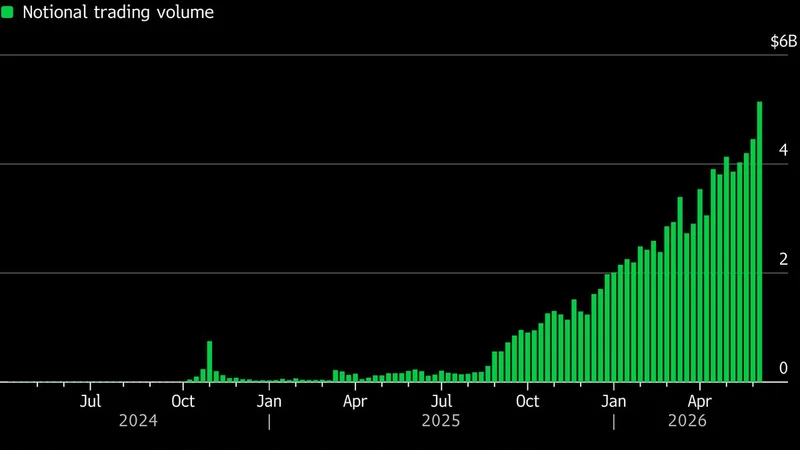
Image: Bloomberg AI
Main Takeaway
Kalshi built an AI agent named Harrison on Anthropic's Claude to flag risks and refine contract wording for its $22 billion prediction market.
Jump to Key PointsSummary
What Harrison does for Kalshi's contracts
Kalshi has deployed an internal AI agent called Harrison to design, review, and stress-test the wording of its prediction market contracts. The tool, built on Anthropic's Claude, analyzes contract language for ambiguities, flags potential risks before markets go live, and proposes new listings based on emerging events. It also monitors news cycles and competitor activity to help Kalshi stay ahead of market-moving developments.
The agent addresses what sources describe as some of the thorniest operational challenges the regulated exchange faces. Prediction markets depend on precise contract language; vague definitions about what constitutes a win or loss can trigger disputes when millions of dollars are at stake. Harrison's role is to catch these edge cases before traders do, reducing the risk of post-trade conflicts and regulatory scrutiny.
Why contract wording matters at scale
Kalshi's platform now handles billions of dollars in monthly trading volume across political elections, sports outcomes, entertainment events, and economic indicators. At that scale, even minor ambiguities in contract terms can cascade into major operational headaches, trader complaints, and potential legal exposure. The company processes millions of daily transactions, each requiring unambiguous settlement criteria.
Co-founder Luana Lopes Lara has emphasized that Harrison helps identify vulnerabilities in advance, according to Odaily. This proactive approach matters because prediction markets operate under the watch of the Commodity Futures Trading Commission, which demands rigorous market integrity standards. A single poorly worded contract that sparks widespread disputes could damage both Kalshi's regulatory standing and its reputation among institutional and retail traders alike.
How Harrison fits into Kalshi's growth strategy
The AI agent represents more than a quality-control tool; it is embedded in Kalshi's rapid scaling efforts. A company spokesperson told Roic that Harrison is a key part of the scaling strategy, helping ensure market integrity as the platform expands beyond its origins into increasingly diverse and complex event categories. The tool supports faster listing of new markets while maintaining the precision that regulated exchanges require.
Kalshi's trajectory has been steep. The company has grown from a niche financial experiment to a platform with a reported $22 billion valuation, fueled partly by surging interest in election betting and celebrity-linked markets. That growth brings operational complexity. Manual contract review cannot scale linearly with trading volume, especially as Kalshi lists markets on faster-moving, more subjective events. Harrison automates the bottleneck.
The broader signal for prediction markets and AI
Kalshi's deployment of Harrison reflects a wider pattern: financial exchanges and regulated marketplaces turning to AI agents not just for customer service but for core operational functions. The move comes as prediction markets gain legitimacy, with Kalshi having won key regulatory battles to operate in the United States. Competitors like Polymarket, which operates offshore, face different constraints but similar operational challenges around contract clarity.
The choice of Anthropic's Claude as the underlying model is notable. Kalshi did not build its own foundation model; it bolted operational tooling onto an existing, commercially available system. This suggests a pragmatic path for other regulated entities looking to integrate AI without the cost and complexity of custom model development. It also raises questions about how other prediction market operators, and traditional derivatives exchanges more broadly, will respond.
What happens next for Kalshi and its competitors
The success of Harrison will likely be measured by dispute rates, time-to-market for new contracts, and regulatory feedback rather than public metrics. Kalshi has not disclosed technical details about Harrison's architecture or error rates, so its effectiveness remains an internal benchmark for now. Rivals will be watching closely; operational efficiency at scale is a genuine competitive moat in prediction markets.
For traders and market observers, the deeper question is whether AI-assisted contract design can fully eliminate the edge cases that make prediction markets volatile. Events evolve, language shifts, and human ingenuity in finding loopholes typically outpaces automated detection. Harrison may reduce the frequency of ambiguities, but the adversarial nature of high-stakes betting means the challenge is ongoing. Kalshi's bet is that Claude-powered review keeps it ahead of the curve.
Key Points
Kalshi built an AI agent named Harrison on Anthropic's Claude to review contracts.
Harrison flags risks, suggests listings, and monitors news and competitors.
The tool addresses contract ambiguity as trading volume scales to billions monthly.
Kalshi operates under CFTC regulation, requiring precise market settlement criteria.
The deployment signals broader AI integration into regulated exchange operations.
Questions Answered
Harrison designs, reviews, and stress-tests prediction market contracts for Kalshi. It flags risks, suggests new listings, and monitors news and competitors.
Kalshi uses AI to handle scaling challenges as monthly trading volume reaches billions of dollars. Manual review cannot keep pace with the volume and complexity of new event contracts.
No, Harrison is built on Anthropic's Claude. Kalshi did not develop a custom foundation model but instead created operational tooling on top of an existing commercial system.
Harrison reduces contract ambiguities that can trigger trader disputes and regulatory scrutiny. The CFTC demands rigorous market integrity standards that precise contract language supports.
Kalshi lists markets on political elections, sports events, entertainment outcomes like celebrity news, and economic indicators. The diversity of events increases contract complexity.
Source Reliability
33% of sources are trusted · Avg reliability: 66
Go deeper with Organic Intel
Simple AI systems for your life, work, and business. Each one includes copyable prompts, guides, and downloadable resources.
Explore Systems