Anthropic Connects Claude to Bank Accounts for Spending Analysis, Challenging ChatGPT in Personal Finance
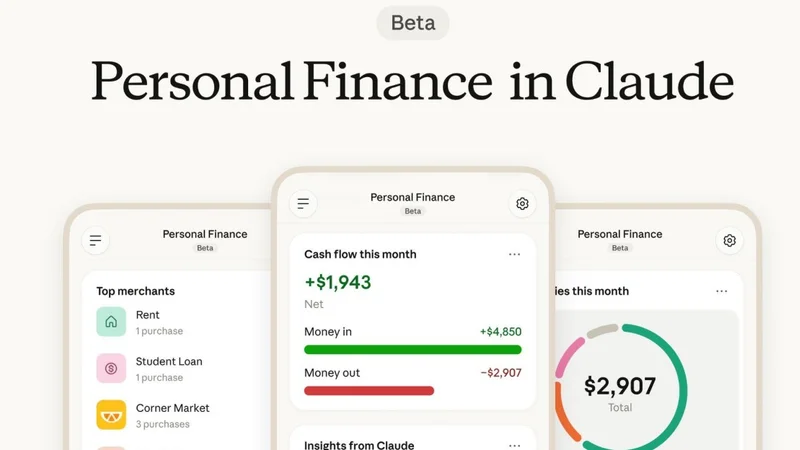
Image: The Verge AI
Main Takeaway
Anthropic’s Claude now connects to U.S. bank and card accounts through Plaid, giving paid subscribers read-only spending analysis, transaction explanations, and budget guidance.
Jump to Key PointsSummary
Claude enters personal finance
Anthropic has launched Personal Finance, a Claude feature that connects users’ bank and credit card accounts through Plaid and answers questions about their money. The beta began rolling out in the United States on November 5 to subscribers on Claude Pro, Max, and Ultra plans.
Claude can total transactions across connected accounts, group spending into categories such as rent, utilities, food, and shopping, and explain where money went during a given period. Users can also ask whether spending is running above income, what bills remain before payday, or how much they could save each month. The rollout places Claude inside a category that has quickly moved from budgeting software toward conversational financial assistance.
What Claude can see
Personal Finance has read-only access, so Claude can't move, manage, or invest a user's money. Plaid handles the connection, which means Claude doesn't receive banking passwords and banks don't have to authorize an unvetted bot to navigate accounts directly.
The data exposed to Claude still includes sensitive financial information: a bank's name, account names and types, the last four digits of account numbers, balances, credit limits, and up to 2 years of transaction history. Anthropic says conversations held in the Personal Finance hub aren't used to train its models. That privacy boundary addresses one concern, while the breadth of transaction data creates another: users are handing an AI a detailed record of their financial lives in exchange for convenience.
From summaries to financial signals
Claude's tool goes beyond a monthly spending chart by examining connected transactions for duplicate charges, unexpected fees, and bills that have been rising over time. It can compare current spending with previous patterns, answer follow-up questions such as whether a category is unusually high, and calculate how much interest a user paid over the past year.
The feature also translates financial language into everyday terms. Claude can explain concepts such as annual percentage rate, then apply calculations to a user's balances or transactions. Anthropic frames the product as an aid for understanding money rather than a replacement for a financial adviser, and says it isn't designed to provide investment advice. That distinction matters because the feature can analyze financial conditions without being authorized to execute transactions or recommend investments.
ChatGPT sets the competitive context
Anthropic's launch follows OpenAI's introduction of similar ChatGPT financial-account tools in May. Both products use Plaid to connect accounts, allowing users to ask natural-language questions about spending and longer-term financial planning. Claude's arrival gives paid chatbot users a second major AI option for turning account data into conversational answers.
Anthropic is differentiating its pitch around plain-language explanations and the absence of ads, sponsored recommendations, proprietary credit cards, loans, or savings accounts. That positioning presents Claude as a neutral interpreter of a user's existing financial data. It also reflects a wider battle to make general-purpose assistants useful in high-trust areas where users expect both convenience and clear limits.
Trust becomes the product test
The central test for Personal Finance is whether users trust Claude with two years of transaction history. Read-only permissions reduce the risk of unauthorized transfers, while Plaid keeps login credentials outside Claude's view. Data access remains consequential, however, because balances, debts, spending habits, and account relationships can reveal a detailed portrait of a household.
Anthropic's decision not to use Personal Finance conversations for model training gives the feature a specific privacy safeguard. Users still need to evaluate the connected-account permissions and the quality of Claude's interpretations, especially when transactions are miscategorized or a financial question involves consequences beyond a spending summary. The product provides information and calculations, but it doesn't replace regulated advice.
Anthropic plans a broader finance role
Personal Finance is positioned as an opening step in Anthropic's expansion of Claude into specialized services. The company said it wants to work alongside licensed professionals and regulated financial firms on larger money decisions, inviting banks, wealth managers, and financial services companies to help shape future versions.
For now, the product remains a U.S. beta limited to paid plans and focused on analysis. Its next phase will depend on user adoption, privacy expectations, account coverage, and how accurately Claude handles real-world financial records. The competition with ChatGPT gives consumers an immediate choice, while financial institutions face growing pressure to decide how conversational AI should access customer data.
Key Points
Anthropic launched Claude Personal Finance for read-only bank and credit card account analysis through Plaid.
Claude categorizes spending, explains financial terms, flags unusual charges, and estimates bills and savings.
Personal Finance exposes balances, credit limits, account details, and up to 2 years of transaction history.
Anthropic says Personal Finance conversations aren't used for model training and Claude can't move users' money.
The beta gives Claude a direct competitor to OpenAI's ChatGPT personal finance tools launched in May.
Questions Answered
Anthropic Claude Personal Finance is a tool that analyzes connected bank and credit card accounts through Plaid. It answers questions about spending, balances, bills, savings, and financial terminology.
Anthropic Claude Personal Finance can't move, manage, or invest a user's money. Its account access is read-only and limited to financial information needed for analysis.
Anthropic Claude can access connected institutions' names, account names and types, last four account digits, balances, credit limits, and up to 2 years of transaction history. Anthropic says Personal Finance conversations aren't used to train its models.
Anthropic Claude and OpenAI ChatGPT both connect financial accounts through Plaid and answer questions about spending and planning. Claude emphasizes everyday-language explanations, no ads or sponsored recommendations, and no proprietary financial products.
Anthropic Claude Personal Finance is rolling out in beta in the United States to Pro, Max, and Ultra subscribers. The feature is currently focused on account analysis rather than transactions, investments, or regulated financial advice.
Source Reliability
29% of sources are trusted · Avg reliability: 57
Go deeper with Organic Intel
Simple AI systems for your life, work, and business. Each one includes copyable prompts, guides, and downloadable resources.
Explore Systems