Amazon in Talks to Sell Custom AI Chips, Targeting Nvidia's $50 Billion Market
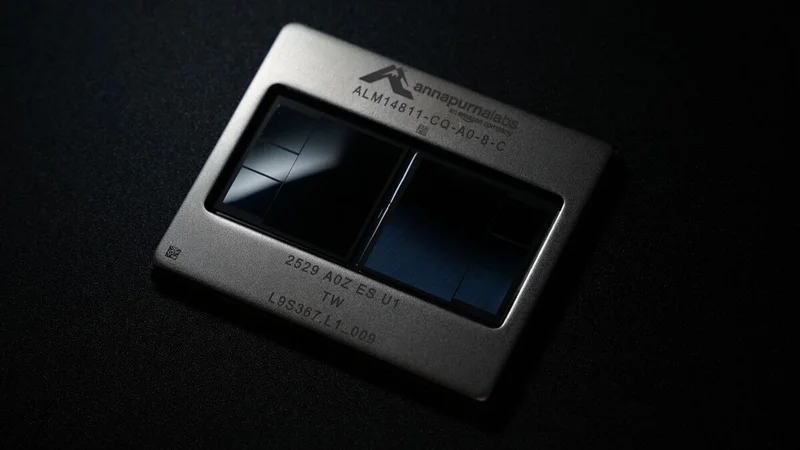
Image: Bloomberg AI
Main Takeaway
Amazon is negotiating to sell its Trainium AI chips to outside data centers, a direct challenge to Nvidia's dominance in AI accelerator markets.
Jump to Key PointsSummary
Why Amazon is pushing into chip sales
Amazon Web Services is negotiating to sell its custom Trainium AI chips to companies outside its own cloud, a move that would transform how AI hardware reaches the market. AWS AI chief Peter DeSantis confirmed the talks to Bloomberg but declined to name potential buyers. The shift represents more than a product decision; it signals that Amazon sees its silicon as competitive enough to stand alone in the open market.
CEO Andy Jassy has framed this as a $50 billion opportunity, according to TechCrunch. That figure suggests Amazon expects meaningful share of a market Nvidia has controlled almost absolutely. Selling chips directly rather than only renting them through AWS instances changes the economics for buyers and the competitive dynamics for everyone else.
The timing matters. Cloud customers have complained for years about Nvidia chip costs and availability. Amazon is betting some would rather own hardware from a cloud provider than wait in Nvidia's queue.
How this stacks against Google and Microsoft
Amazon is not alone among cloud giants building custom AI silicon. Google has offered its TPUs to external customers for years, though primarily through cloud rental rather than outright sale. The New York Times notes that both Amazon and Google are now eating into Nvidia's AI chip supremacy, suggesting the competitive pressure is broadening beyond any single rival.
Microsoft has taken a different path, deepening its partnership with Nvidia while developing its own Maia chips for internal use. Amazon's decision to sell chips directly, if completed, would put it closer to Google's model but with AWS's commercial infrastructure behind it. Ars Technica reports that Amazon has been working to reduce its dependence on Nvidia, a goal shared across the major clouds.
The convergence is striking: three companies that once bought Nvidia chips by the truckload are now designing around them.
What Trainium offers data center buyers
Trainium is Amazon's training-focused AI accelerator, designed to handle the heavy compute loads of building large language models and other neural networks. Unlike Nvidia's general-purpose GPUs, Trainium is optimized specifically for machine learning workloads, which Amazon argues delivers better price-performance for training tasks.
The chip has existed since 2020 but was previously available only through AWS instances. Selling it directly would let companies run Trainium in their own facilities, potentially cutting cloud rental costs for heavy users. Finance.yahoo reported that Amazon released new AI chip variants alongside this push, suggesting the product line is maturing.
Whether buyers will bite depends on software support. Nvidia's moat is CUDA, its programming ecosystem that has become the default for AI development. Amazon has built its own Neuron SDK, but adoption outside AWS remains limited.
The threat to Nvidia's business model
Nvidia's data center revenue topped $25 billion in quarterly reports, driven by GPU sales that command premium pricing and high margins. Amazon's entry as a direct chip seller threatens that structure from an unexpected angle: a customer turned competitor with its own manufacturing relationships.
Business Insider quotes Jassy saying a new shift has started in chip dominance. The comment reads as more than typical executive optimism. When a top-three cloud provider with AWS's scale decides to compete in your core market, the strategic implications are serious even if near-term sales are small.
Nvidia still leads in performance benchmarks and developer mindshare. But Amazon's move introduces price pressure and alternative supply that did not exist at scale before. For data center operators, even a credible second source strengthens negotiating position.
What happens next for the AI chip market
The talks could still collapse or produce limited pilot programs rather than broad availability. DeSantis's refusal to name buyers suggests discussions are early. Yet the direction is clear: Amazon intends to be a chip vendor, not merely a chip consumer.
Success would likely trigger responses. Microsoft might accelerate Maia commercialization. Google could expand TPU sales terms. Nvidia would almost certainly sharpen pricing or accelerate its own roadmap. The New York Times framing, that Amazon and Google are jointly eroding Nvidia's position, hints at a multi-year realignment rather than a single product cycle.
For enterprise buyers, more competition means more options. Whether it translates to lower total costs depends on software maturity, support quality, and whether these custom chips perform as advertised outside their creators' optimized environments. The next 12 months will reveal if Amazon's silicon can survive without AWS's protective wrapper.
Key Points
Amazon negotiates to sell Trainium AI chips directly to external data center operators
AWS chief Peter DeSantis confirmed talks but did not name potential buyers
CEO Andy Jassy frames the chip sales opportunity at $50 billion in value
Move follows Google and Microsoft developing their own AI silicon alternatives
Direct chip sales would challenge Nvidia's pricing power and market dominance
Questions Answered
Amazon is currently in talks to sell its Trainium AI chips, but no deals have been finalized. AWS AI chief Peter DeSantis confirmed active negotiations with potential buyers, though he declined to identify which companies are involved.
Selling chips directly lets Amazon capture value from customers who prefer owning hardware over cloud rental, and it expands the addressable market beyond AWS users. CEO Andy Jassy has estimated this represents a $50 billion opportunity, suggesting significant revenue potential outside the existing cloud model.
Trainium is optimized specifically for machine learning training workloads rather than general-purpose GPU computing, which Amazon claims delivers better price-performance for training tasks. However, Nvidia maintains advantages in software ecosystem maturity through CUDA and broader developer adoption.
Success would require competitive performance on standard benchmarks, robust software support through Amazon's Neuron SDK, reliable supply, and pricing that undercuts Nvidia's premium. The chips must also prove effective outside AWS's carefully optimized cloud environment.
Google has offered TPUs through cloud rental for years and competes directly in custom silicon. Microsoft has developed Maia chips but continues its deep Nvidia partnership. Amazon's direct sales model would most closely parallel Google's approach if fully implemented.
Source Reliability
40% of sources are highly trusted · Avg reliability: 76
Go deeper with Organic Intel
Simple AI systems for your life, work, and business. Each one includes copyable prompts, guides, and downloadable resources.
Explore Systems