Alphabet's $80 Billion AI Equity Raise Lands a $10 Billion Berkshire Anchor
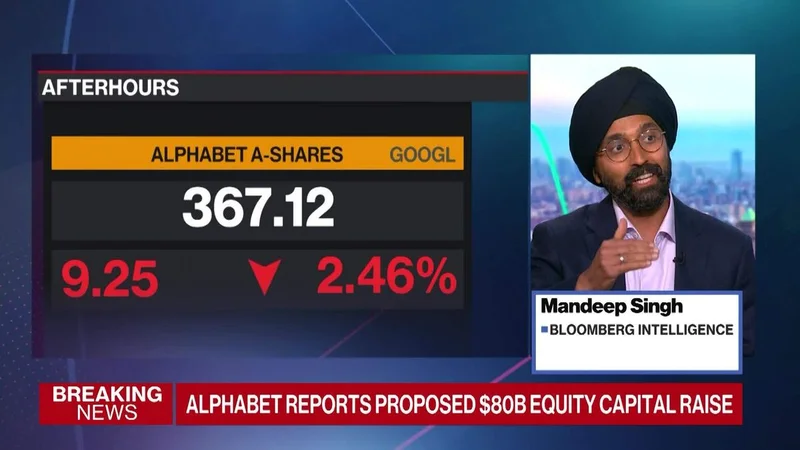
Image: Bloomberg AI
Main Takeaway
Alphabet will raise $80 billion in equity, including a $10 billion investment from Berkshire Hathaway, to fund AI infrastructure as demand outstrips supply.
Jump to Key PointsSummary
Why Alphabet is tapping equity markets now
Alphabet Inc., Google's parent company, announced plans on Monday to raise $80 billion in equity capital to bankroll its artificial intelligence infrastructure ambitions. The company will sell stock for general corporate purposes, specifically scaling AI infrastructure and global compute, according to a corporate statement. The decision reflects a straightforward supply-and-demand problem: Alphabet's enterprise and consumer AI services are so popular the company can't keep up. Alphabet said demand for its AI solutions is exceeding available supply, an acknowledgment that even one of the world's most capitalized companies needs outside money to sustain the pace.
The raise marks one of the largest equity offerings in tech history and signals that the AI arms race is far from cooling. Mandeep Singh of Bloomberg Intelligence noted the capital will pay for ambitious spending plans. Alphabet's move comes as rivals face growing investor scrutiny over returns, yet Google is doubling down rather than pulling back.
The Berkshire Hathaway factor
Warren Buffett's Berkshire Hathaway is anchoring the offering with a $10 billion stock purchase, a deal that gives Alphabet's raise a seal of approval from one of the world's most disciplined investors. Bloomberg reports the investment is part of the broader $80 billion equity package. Berkshire's involvement is notable because the conglomerate has historically avoided big tech bets, preferring railroads, insurance, and consumer staples.
Sherwood notes that while concerns over share dilution sent the stock down slightly in after-hours trading, the Berkshire anchor provides credibility that a standalone raise might lack. The partnership suggests Alphabet wanted more than just cash: it wanted a long-term, patient capital partner during a period of intense spending. For Berkshire, the bet signals a conviction that AI infrastructure is not a speculative bubble but a durable capital allocation opportunity.
The spending trajectory that got us here
Alphabet's AI spending has escalated dramatically over the past eighteen months. In February 2025, CEO Sundar Pichai told investors the company expected to invest roughly $75 billion in capital expenditures that year, according to CNBC. By July, Observer reported that figure had climbed to $85 billion as the company accelerated its buildout. In February 2026, MIT Sloan Management Review documented plans to nearly double capital expenditure to a range of $175 billion to $185 billion, one of the largest corporate spending commitments ever.
Quantilus frames the $75 billion 2025 figure as a reaffirmation of Alphabet's commitment despite tariff tensions and broader economic uncertainty. Pichai has consistently emphasized the scale of the opportunity, telling investors the company will continue investing in people, talent, and compute to capture it. The $80 billion equity raise is the financial mechanism to turn those spending pledges into physical data centers and chip deployments.
Market reaction and dilution concerns
Google stock dipped in late trading following the announcement, according to Investors Business Daily. The reaction is textbook: equity raises dilute existing shareholders, and an $80 billion offering is large enough to give any investor pause, even with a growth narrative behind it. Sherwood confirmed the after-hours decline, tying it directly to dilution fears.
Yet the selloff was modest, suggesting the market is weighing the long-term AI opportunity against the near-term share count increase. Yahoo Finance framed the raise alongside Alphabet's cloud surge as a potential inflection point rather than a red flag. The key question for investors is whether the infrastructure being built will generate returns that justify the dilution. Alphabet is betting the answer is yes, and Berkshire Hathaway's $10 billion vote of confidence gives that bet institutional weight.
What this means for the AI infrastructure race
Alphabet's raise resets expectations for what it costs to compete at the frontier of AI. When a company generating over $400 billion in annual revenue, as MIT Sloan Management Review noted, still needs to tap equity markets for $80 billion, the capital requirements are staggering. This puts pressure on competitors like Microsoft, Amazon, and Meta, all of whom are spending tens of billions on their own AI data center buildouts.
The raise also signals that Alphabet sees the AI demand curve steepening, not flattening. If the company's own cash flow were sufficient, it wouldn't dilute shareholders. The fact that it's going to the equity market anyway suggests leadership believes the window for capturing AI market share is finite and the cost of moving too slowly exceeds the cost of dilution. Mandeep Singh of Bloomberg Intelligence characterized the spending plans as ambitious, a description that undersells the scale of the commitment.
Where the money goes
Alphabet's statement specified the funds will pay for scaling AI infrastructure and global compute. In practice, that means data centers packed with Nvidia GPUs and Google's own tensor processing units, fiber optic networks, and the energy infrastructure to power it all. The Gemini model family, Google's flagship AI system, is a primary beneficiary of this expansion, as Quantilus notes.
The raise also covers talent acquisition and research compute, areas where competition with OpenAI, Anthropic, and others is fierce. Pichai has framed AI as an opportunity as big as the internet itself, and the spending pattern backs that rhetoric. The $80 billion is not a one-time splurge but part of a multi-year capital deployment that will reshape Alphabet's balance sheet and competitive posture for the next decade.
What happens next
The equity offering will proceed through standard channels, with the Berkshire Hathaway tranche providing an early anchor. Investors will watch for pricing details and the final allocation between institutional and other buyers. More importantly, the market will scrutinize Alphabet's next earnings report for signs that the AI infrastructure investment is translating into revenue growth in Google Cloud and advertising.
If the bet pays off, Alphabet solidifies its position as the dominant AI infrastructure provider alongside Microsoft and Amazon. If returns lag, the dilution will become a lasting drag on shareholder value. The Berkshire partnership adds a layer of accountability: Buffett's team doesn't make $10 billion bets without a clear thesis on long-term value creation. The AI industry now watches to see whether Alphabet's $80 billion gamble sets the template for how Big Tech funds the next phase of artificial intelligence, or stands as a cautionary tale of spending ahead of demand.
Key Points
Alphabet will raise $80 billion through equity offerings to fund AI infrastructure expansion.
Berkshire Hathaway is anchoring the raise with a $10 billion stock purchase, a rare big-tech bet.
Demand for Alphabet's AI services is exceeding available supply, driving the capital need.
Alphabet's AI capex has escalated from $75 billion in 2025 to a projected $185 billion in 2026.
Google stock dipped modestly after-hours on dilution concerns despite the growth narrative.
Questions Answered
Alphabet says demand for its AI solutions and services from enterprises and consumers exceeds available supply. The equity raise funds the data centers, chips, and global compute infrastructure needed to close that gap.
Berkshire Hathaway is investing $10 billion as an anchor partner in the equity offering. The deal gives Alphabet a credible, long-term investor and signals Buffett's conviction in AI infrastructure as a durable capital allocation.
Google stock dipped slightly in after-hours trading due to dilution concerns. The decline was modest, suggesting investors are weighing the long-term AI opportunity against the near-term increase in share count.
Alphabet planned roughly $75 billion in capex for 2025, raised to $85 billion by mid-year, and projected $175-185 billion for 2026. The trajectory reflects an accelerating commitment to AI infrastructure.
The funds are designated for scaling AI infrastructure and global compute, including data centers, Nvidia GPUs, Google's own TPUs, networking, energy infrastructure, and talent acquisition for AI research and development.
Source Reliability
43% of sources are highly trusted · Avg reliability: 70
Go deeper with Organic Intel
Simple AI systems for your life, work, and business. Each one includes copyable prompts, guides, and downloadable resources.
Explore Systems