Young Americans Turn Against AI as Job Loss Fears Reshape Views of Workplace Technology
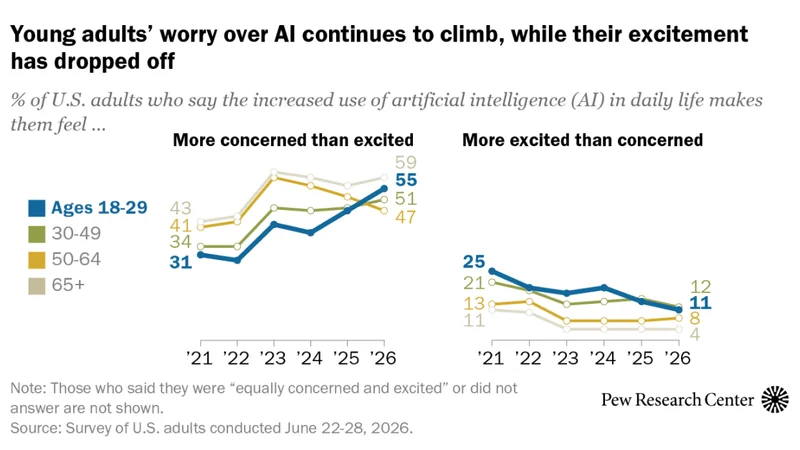
Image: Hacker News AI
Main Takeaway
Pew Research Center finds young Americans are growing more concerned about AI, with rising fears that workplace automation will eliminate jobs.
Jump to Key PointsSummary
Young workers lose faith in AI
Young Americans are becoming more wary of artificial intelligence as concern about job losses rises, a shift that marks a sharp challenge to the technology’s earlier promise of opportunity. Pew Research Center’s June 22-28, 2026 survey found that roughly half of US adults feel more concerned than excited about AI’s growing role in daily life, while unease among younger adults has continued to climb.
The change is especially significant for people entering the workforce during a period of rapid automation. Their first encounters with AI are taking place alongside layoffs, changing entry-level roles, and employer experiments with software that can write, analyze, design, and answer customer questions. Coverage from Bloomberg AI, Axios, and The Washington Post all centers on the same generational shift: younger Americans are becoming less optimistic as AI moves from a distant innovation into a factor in career planning.
Job security drives the anxiety
Fear of losing work is the central reason young adults are turning against AI. The Pew survey links rising concern about artificial intelligence with worry that businesses will use it to reduce staffing or eliminate jobs, particularly in fields where early-career employees perform routine analytical, administrative, or creative tasks.
That anxiety reflects a difficult entry point into professional life. Young workers often depend on junior positions to build experience, yet those roles contain many tasks that AI systems can already perform or accelerate. Articles from Hacker News AI, Courthousenews, and Aa.com describe the trend as a broad increase in wariness, while the National University compilation and Tenet’s statistics article place the discussion within a wider debate over projected employment disruption. Those secondary pieces offer context, but the survey provides the clearest evidence of changing public sentiment.
A generational trust gap
The growing skepticism among people under 30 creates a generational divide over who benefits from AI. Older Americans also express concern, but younger adults face the most immediate exposure to hiring decisions shaped by automated tools and to career paths that are still being redesigned.
The Washington Post and Axios frame the change as fading optimism rather than simple rejection. Young adults remain familiar with AI’s consumer uses, but convenience has not erased concerns about control, fairness, or economic security. Pew’s workplace findings reinforce that distinction: people can accept AI as useful while still opposing how employers deploy it. Research focused on youth perceptions of AI and employment reaches a similar conclusion, connecting attitudes toward the technology to expectations about future work and personal opportunity.
Employers face a trust problem
Companies adopting AI now face a workforce that wants clearer evidence of how the technology will affect jobs, pay, and advancement. A productivity announcement alone does little to address fears that efficiency gains will flow to shareholders while workers absorb the cost through fewer openings or weaker bargaining power.
The public response raises practical questions for employers: whether AI replaces roles or changes them, which workers receive training, and who reviews automated decisions. Survey coverage from Bloomberg AI, Hacker News AI, and Pew Research Center indicates that workplace policy will shape public acceptance as much as the tools themselves. Employers that explain deployment plans, preserve meaningful human oversight, and invest in training have a clearer path to reducing resistance. The debate also puts pressure on schools and policymakers to prepare workers for altered job requirements rather than treating AI literacy as a narrow technical skill.
What happens next
The next phase of the AI debate will turn on visible workplace outcomes. If companies use AI to remove entry-level jobs, young adults’ skepticism will gain a direct economic foundation. If firms use it to expand output while creating new pathways into skilled work, confidence has room to recover.
For now, the survey points to a public mood shaped by uncertainty over who captures AI’s gains. The statistics collections from National University and Tenet show how widely job-displacement claims circulate, while the youth-employment research highlights the importance of expectations, not only measured labor-market effects. The central test for technology companies and employers is credibility: workers want concrete answers about career access, training, and job security before they embrace AI at work.
Key Points
Young Americans are growing more concerned about AI as workplace job-loss fears intensify.
Pew’s 2026 survey shows roughly half of US adults feel more concerned than excited about AI.
Entry-level workers face anxiety because AI can perform many junior administrative and creative tasks.
Employers must explain AI deployment, training plans, and effects on staffing to rebuild trust.
Youth attitudes toward AI increasingly depend on career access, economic security, and workplace outcomes.
Questions Answered
Young Americans are becoming more concerned about AI because they fear workplace automation will eliminate jobs and reduce entry-level opportunities. Their skepticism is rising as employers deploy AI for tasks traditionally assigned to junior workers.
Pew Research Center found that about half of US adults feel more concerned than excited about AI’s growing role in daily life. The June 22-28, 2026 survey also found that concern among young adults continued to rise.
Young Americans are not necessarily rejecting every use of AI, but they are increasingly skeptical of its workplace effects. Many distinguish between convenient consumer tools and employer use that threatens jobs, pay, or career progression.
AI job automation threatens some entry-level work because systems can perform routine writing, analysis, administration, design, and customer-service tasks. Fewer junior roles could make it harder for graduates to gain the experience required for advancement.
Employers can address young workers’ AI concerns by explaining deployment plans, preserving human oversight, and providing credible training and advancement opportunities. Trust depends on showing how productivity gains affect staffing, pay, and career access.
Source Reliability
45% of sources are highly trusted · Avg reliability: 71
Go deeper with Organic Intel
Simple AI systems for your life, work, and business. Each one includes copyable prompts, guides, and downloadable resources.
Explore Systems