Stanford graduates walk out on Google CEO Sundar Pichai over Israel contract, sparking Silicon Valley backlash
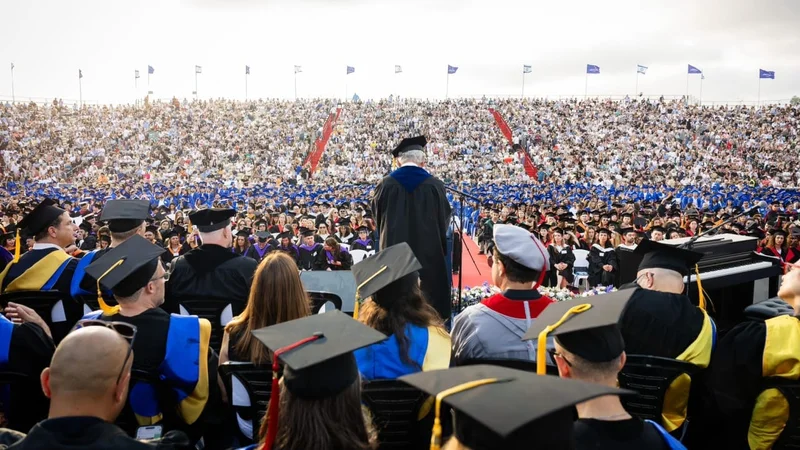
Image: Jpost
Main Takeaway
Around 200 Stanford students walked out of commencement to protest Google's Project Nimbus contract with Israel, drawing sharp criticism from billionaire.
Jump to Key PointsSummary
Why students targeted Pichai
Around 200 Stanford graduates walked out of their commencement ceremony on Sunday as Google CEO Sundar Pichai took the stage, according to local reports cited by multiple outlets. The protest was organized by the Stanford chapter of Students for Justice in Palestine, a nationwide network of student-led activist groups. Students carried Palestinian flags and banners, chanting slogans as they exited the stadium before Pichai had spoken a word. The demonstration centered on Google's involvement in Project Nimbus, a $1.2 billion joint cloud-computing contract with Amazon and the Israeli government first announced in 2021. The contract has drawn sustained criticism from activists who oppose Israel's military campaign in Gaza and question the tech industry's complicity in government operations.
Pichai appeared unfazed by the disruption. His speech largely avoided artificial intelligence, the topic that has shadowed other tech-heavy commencement addresses this season, and instead offered graduates a conventional message about optimism, hard choices, and pursuing meaningful work. The Jerusalem Post noted that the ceremony began as a typical Stanford celebration, with thousands of onlookers present for nearly 6,000 degree recipients.
The Project Nimbus controversy
Project Nimbus is not a new grievance. The contract, which provides cloud infrastructure services to the Israeli government, has been a flashpoint since its announcement. Google workers have staged protests and sit-ins against the deal, with some employees fired for their activism. The contract's value, $1.2 billion, and its joint structure with Amazon have made it a sustained target for organizers who argue that tech infrastructure enables military operations. For the Stanford protesters, Pichai's presence represented a direct connection between their institution and corporate policy they find objectionable.
The timing amplified the visibility. Commencement ceremonies are highly publicized, media-saturated events. By selecting this moment, activists guaranteed coverage that a routine campus protest would not achieve. Fortune observed that Pichai had been careful to avoid direct AI discussion in his speech, apparently attuned to the backlash other tech executives have faced from graduates this season. The protesters found a different avenue of confrontation.
Khosla's scathing response
Billionaire venture capitalist Vinod Khosla, a Stanford alumnus and Sun Microsystems co-founder, responded with unusual ferocity on social media. In a post that drew 1.4 million views, he called the protesting students biased, idiotic, short-sighted, and very selfish. He reserved particular contempt for what he described as the stupidity of taking the greatest opportunity for equality in humanity ever, referring to AI, and walking out on Google and Sundar Pichai, who he said had pioneered that opportunity. Khosla argued the students were selfish because they ignored the bottom 3 billion people on the planet who could benefit from AI, prioritizing their own misinformed self-interest instead.
The post ricocheted across social media, drawing substantial engagement including over 6,500 likes and 1,200 bookmarks. Khosla's intervention represents more than individual outrage. As a major Silicon Valley investor with substantial AI portfolio interests, his framing of the protest as anti-progress and anti-equality reframes corporate criticism as selfish obstructionism. The Times of India highlighted his Indian-origin background, noting the cross-cultural dimensions of a prominent Indian-American executive defending another against primarily American student activists.
The generational divide in tech criticism
The incident exposes a widening fracture in how different generations evaluate technology's role in society. For Khosla and Silicon Valley's established elite, AI represents an unalloyed good, a force for democratization and economic opportunity that should transcend political disagreements. For a significant segment of young technologists, the industry's products cannot be separated from the contexts of their deployment, including military and surveillance applications. This is not merely about Israel; it reflects a broader skepticism about tech exceptionalism, the idea that innovation's benefits automatically outweigh its harms.
The protest also signals that AI is not the only, or even the primary, grievance driving campus activism against tech leaders. Fortune's original framing, that students found a reason other than AI to protest, captures an important shift. Earlier in the commencement season, figures like Mark Zuckerberg faced student pushback over AI's labor and environmental costs. Pichai's avoidance of the topic did not insulate him. If anything, it demonstrated that tech executives now face multiple, intersecting lines of criticism that cannot be managed through careful speechwriting alone.
What this means for tech's public standing
The Stanford walkout and its aftermath illustrate the increasingly precarious position of tech executives as public figures. Once welcomed as visionaries at universities, they now face organized opposition that treats their presence as political endorsement. The protest was not impromptu; it was planned, branded, and executed with media awareness. Students for Justice in Palestine issued a formal statement, understanding that confrontation with a CEO of Pichai's stature generates coverage their cause needs.
For Google, the episode adds to existing reputational challenges around Project Nimbus. The company has struggled to contain internal dissent on the contract while maintaining its public commitment to ethical AI principles. Pichai's personal connection to Stanford, his alma mater, made this particular protest more symbolically charged. The company's response, or lack thereof, will be watched closely. For now, the incident stands as another data point in tech's deteriorating relationship with the generation it most needs to recruit, a tension that no amount of commencement optimism is likely to resolve soon.
Key Points
Approximately 200 Stanford students walked out during Sundar Pichai's commencement address to protest Google's Project Nimbus contract with Israel.
Project Nimbus is a $1.2 billion joint cloud-computing contract between Google, Amazon, and the Israeli government that has drawn sustained criticism since 2021.
Pichai deliberately avoided discussing AI in his speech, unlike other tech executives who faced backlash on the topic at recent commencements.
Billionaire Vinod Khosla called the protesters biased, idiotic, short-sighted, and very selfish in a viral social media post with 1.4 million views.
The incident highlights growing generational tension over whether technology's benefits can be separated from its military and surveillance applications.
Questions Answered
Stanford students walked out on Sundar Pichai to protest Google's involvement in Project Nimbus, a $1.2 billion cloud-computing contract with the Israeli government. The protest was organized by the Stanford chapter of Students for Justice in Palestine, with approximately 200 students participating.
Project Nimbus is a $1.2 billion joint cloud infrastructure contract between Google, Amazon, and the Israeli government announced in 2021. Critics argue it provides technological infrastructure that enables Israeli military operations, and Google employees have previously staged protests and sit-ins against the contract.
Vinod Khosla called the protesting Stanford students biased, idiotic, short-sighted, and very selfish in a social media post. He argued they ignored the potential of AI to help the world's poorest 3 billion people by prioritizing their own misinformed self-interest.
The Stanford protest was highly visible, with around 200 students walking out before Pichai spoke, carrying Palestinian flags and banners in front of thousands of attendees. The incident received international media coverage and sparked a prominent public response from billionaire investor Vinod Khosla.
Source Reliability
43% of sources are trusted · Avg reliability: 69
Go deeper with Organic Intel
Simple AI systems for your life, work, and business. Each one includes copyable prompts, guides, and downloadable resources.
Explore Systems