Spain’s 69-Death Train Crash Exposes Safety Failures and Deepens Pressure on Sánchez
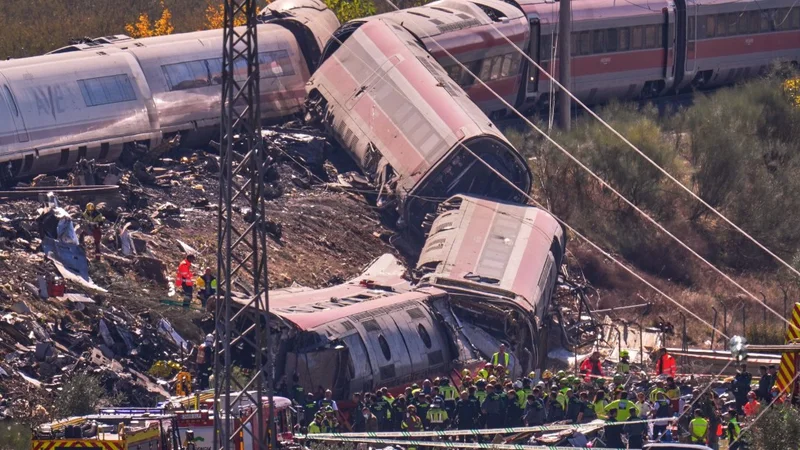
Image: Fortune AI
Main Takeaway
Spain’s Toledo train collision killed 69 people after a safety system outage, triggering scrutiny of human error, rail maintenance and Pedro Sánchez’s government.
Jump to Key PointsSummary
The crash and its toll
A high-speed train collision in Spain’s Toledo province killed 69 people and injured dozens, making it the country’s second deadly rail disaster of 2026. The crash occurred when one train struck another that had stopped on the tracks, according to accounts from Spanish authorities and international broadcasters.
The regional government of Castilla-La Mancha said 58 people were receiving medical treatment during the initial rescue operation. A preliminary report cited by Reuters said the moving train was traveling at 160 kilometers per hour when it hit the stationary train. The impact left rescuers searching wreckage for survivors and turned a national rail system once associated with modernity and safety into the center of a public crisis.
Safety systems under scrutiny
The central safety question is how a train traveling at high speed reached a stopped train after a rail traffic safety system went down. Spain’s transport minister attributed much of the disaster to incorrect instructions and a traffic controller’s poor judgment, while unions argued that staffing shortages, heavier workloads and deteriorating working conditions contributed to the failure.
The competing explanations point to a broader inquiry than an examination of one controller’s decisions. ABC News and NBC4 Washington described scrutiny of both human error and system failures, while the minister said roughly 170 rail-system outages recorded this year were normal. That characterization has intensified criticism because the fatal collision occurred after a safety system interruption and followed another deadly rail accident earlier in 2026. Investigators will need to establish which safeguards were unavailable, what warnings reached staff and whether operating procedures compensated for the outage.
A political crisis for Sánchez
The crash has placed Prime Minister Pedro Sánchez under acute political pressure as he faces a national election campaign and already trails in assessments of his reelection prospects. Sánchez called it unacceptable for Spain to suffer 2 high-speed rail accidents in one year and pledged stronger safety measures to restore confidence.
The political damage reaches beyond the immediate death toll. BBC, CNN, The New York Times and NPR framed the disaster as a major challenge for a leader already struggling electorally. The transport minister said he wouldn't resign, keeping responsibility for the rail system inside the government rather than resolving the dispute through a cabinet departure. Sánchez’s response now faces a practical test: whether his administration produces an independent account of the crash and visible repairs before voters judge its record on public infrastructure.
Unions challenge the official account
Railway unions reject an explanation centered mainly on a controller’s mistake, saying staffing and working conditions shaped the circumstances surrounding the collision. Their argument places the outage inside an operational system where employees must manage disrupted technology, train movements and emergency decisions under pressure.
That dispute matters because safety systems are designed to limit the consequences of individual error. If a controller issued incorrect instructions, investigators must still determine why automated or procedural barriers failed to stop the train. The transport ministry’s description of 170 outages as normal has sharpened the debate over what counts as an acceptable failure rate in a high-speed network. Coverage from Fortune, ABC News and NBC4 Washington links the public controversy to the unresolved boundary between personal accountability and institutional responsibility.
What investigators must establish
The investigation must reconstruct the train’s speed, the condition of the track and signaling equipment, the instructions given to both trains and the timing of the safety-system outage. The reported 160-kilometer-per-hour impact speed provides a measure of the collision’s force, but it does not by itself explain why the moving train entered an occupied section.
Authorities also face pressure to examine whether the first deadly rail crash of 2026 exposed weaknesses that remained unresolved. Sánchez has promised tougher action over possible safety failures, while the transport minister has defended his position and rejected calls to resign. The next findings will shape compensation, criminal or administrative accountability, changes to staffing and investment in automatic protections. They will also determine whether the disaster is treated as an isolated operational error or evidence of a network-wide safety problem.
Confidence in high-speed rail
The collision has damaged public confidence in Spain’s high-speed rail network at a moment when reliability and safety are politically important. The country’s rail system had been a source of national pride, making a second deadly crash in one year especially difficult for the government to contain.
Restoring trust will require more than official assurances. Passengers will look for functioning safeguards, transparent outage reporting, adequate staffing and clear responsibility when automated systems fail. The government’s response will also be measured against the 170 outages cited by the minister and against the competing account offered by unions. For Sánchez, the rail inquiry is now both a safety investigation and an election issue, with the credibility of Spain’s transport institutions tied to what officials disclose next.
Key Points
Spain’s Toledo collision killed 69 people after a high-speed train struck a stationary train.
Railway unions blame staffing pressures and working conditions alongside the controller’s reported instructions.
Spain’s transport minister called roughly 170 rail-system outages this year normal.
Pedro Sánchez pledged tougher safety measures after Spain’s second deadly rail crash of 2026.
Investigators are examining human error, signaling failures, outages and automatic safety protections.
Questions Answered
Spain’s Toledo train crash killed 69 people when a high-speed train struck another train stopped on the tracks. Preliminary reporting placed the moving train’s speed at 160 kilometers per hour, while investigators examine the instructions and safety systems involved.
Spain’s rail safety system is under investigation because the collision followed an outage in a system designed to prevent trains from entering occupied track. Officials cited incorrect instructions and controller judgment, while unions pointed to staffing shortages and difficult working conditions.
Pedro Sánchez called Spain’s 2 high-speed rail accidents in one year unacceptable and promised stronger safety measures. The prime minister is also facing political pressure because the crash occurred ahead of a national election.
Spain’s transport minister said he will not resign after the crash. He has defended the government’s position and attributed much of the disaster to incorrect instructions and a traffic controller’s poor judgment.
Spain’s rail investigation will reconstruct the train movements, instructions, outage, signaling conditions and safety-system performance. Its findings will guide decisions about staffing, infrastructure investment, accountability and possible regulatory changes.
Source Reliability
67% of sources are highly trusted · Avg reliability: 82
Go deeper with Organic Intel
Simple AI systems for your life, work, and business. Each one includes copyable prompts, guides, and downloadable resources.
Explore Systems