SpaceX Starship Reaches Orbit, Deploys 26 Satellites and Ends First Orbital Test Early
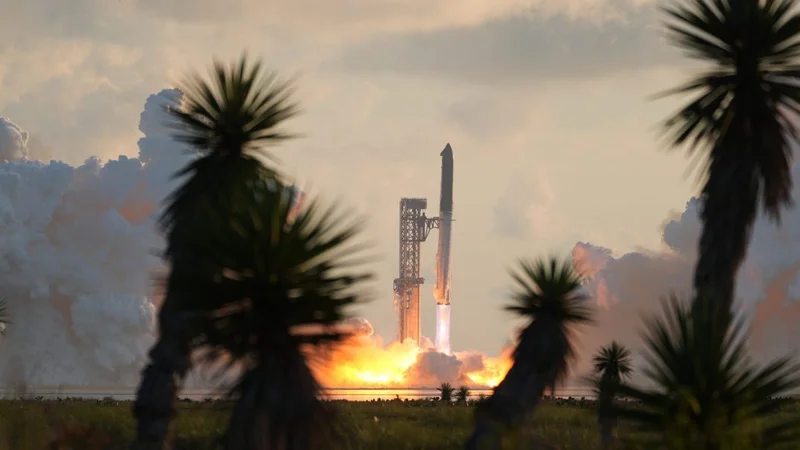
Image: Fortune AI
Main Takeaway
SpaceX’s Starship reached orbit for the first time, deployed 26 Starlink satellites, then ended its planned 10-hour mission after an engine failure.
Jump to Key PointsSummary
A historic orbital milestone
SpaceX’s Starship reached Earth orbit for the first time on Monday, completing the central objective of its Flight 14 test. The giant vehicle lifted off from Texas and carried 26 Starlink satellites, marking the first operational-style payload deployment for the company’s largest rocket. AP, PBS News and ABC News described the flight as a successful first orbital test, while Bloomberg characterized the achievement as a major milestone despite a propulsion problem during ascent.
The flight gave SpaceX its clearest demonstration yet that Starship can climb through the atmosphere, reach orbital velocity and release payloads. The achievement also advanced Elon Musk’s plan for a fully reusable heavy-lift system designed to carry people, cargo and large satellite constellations.
Mission ended ahead of schedule
Starship’s mission ended after roughly 3 hours instead of the planned 10-hour flight. An engine failure contributed to the decision to shorten the mission, but the vehicle completed its orbital insertion and deployed all 26 satellites before reentering over the Pacific Ocean and splashing down, according to Bloomberg and Fortune.
That sequence made the test both a breakthrough and a diagnostic flight. Reaching orbit showed that the launch architecture worked through its most demanding early phases; the early return limited the time available to assess long-duration operations, orbital maneuvering and other systems. NASA Administrator Jared Isaacman congratulated SpaceX, praising the flight’s execution as safe, responsible and inspirational, Fortune reported.
Starlink provided the payload test
The 26 Starlink satellites turned the flight into more than a demonstration of altitude and speed. Deploying a payload tested Starship’s ability to perform a core commercial task: placing large numbers of spacecraft into orbit. Bloomberg, Yahoo Finance and Fox Business all identified the satellites as a central part of the mission, with the payload described as an advanced generation of Starlinks.
The deployment also links Starship’s engineering program to SpaceX’s satellite internet business. A successful heavy-lift vehicle can give the company another way to expand Starlink, while the constellation supplies a recurring customer for future Starship missions. The payload result matters because reusable launch economics depend on repeated delivery, not a single spectacular ascent.
Reusability remains the harder test
Reaching orbit establishes a foundation for Starship’s usefulness, but reusability remains the program’s defining challenge. The Space Review argued that Starship could become useful before it becomes fully reusable, separating near-term payload capability from the longer engineering effort needed to recover and rapidly relaunch every major component.
The flight’s splashdown provided an important return phase, yet the shortened mission and engine failure leave additional work before the system can demonstrate airline-like operational cadence. CNN, CNBC and Space coverage framed the test around what comes next: reliable ascent, controlled return, payload operations and repeated flights. Those steps will determine whether Starship becomes a routine launch platform or remains a high-value experimental vehicle.
Pressure rises for future missions
The orbital success raises the stakes for Starship’s development schedule. SpaceX had spent years iterating through test flights, and coverage from Ars Technica, Space and CNBC focused on the program’s transition from preparation to operational testing. Flight 14 now gives engineers data from an actual orbital mission, including the engine anomaly, satellite deployment and Pacific reentry.
The result also matters beyond SpaceX. NASA has selected Starship-related technology for lunar missions, while satellite operators and launch competitors are watching the vehicle’s capacity, reliability and turnaround time. The next tests will need to show that Monday’s accomplishment can be repeated with fewer failures and longer mission duration.
What happens after Flight 14
SpaceX’s immediate task is to analyze the engine failure and the shortened mission while preserving the successful elements of the flight. The company has now demonstrated orbital access and satellite deployment, but routine service requires stronger propulsion reliability, controlled recovery and a repeatable launch cadence.
The milestone shifts the debate from whether Starship can reach orbit to how quickly it can become dependable infrastructure. Scott Morton, a former SpaceX Starship software manager and current Revel CEO, called the achievement a “monumental step forward,” Bloomberg reported. Future flights will determine whether that description holds as a one-time breakthrough or becomes the first entry in a reliable operating record.
Key Points
SpaceX Starship reached orbit and deployed 26 Starlink satellites during its first orbital test flight.
Starship ended its planned 10-hour mission after about 3 hours following an engine failure.
SpaceX demonstrated orbital payload delivery while leaving full reusability and reliability unresolved.
Starship’s success strengthens SpaceX’s plans for Starlink expansion and future lunar missions.
Flight 14 gives engineers data on ascent, satellite deployment, reentry and Pacific splashdown performance.
Questions Answered
SpaceX Starship reached orbit for the first time during Flight 14. The vehicle also deployed 26 Starlink satellites before ending the mission over the Pacific Ocean.
SpaceX ended the Starship test early after an engine failure during the flight. The mission lasted about 3 hours instead of the planned 10 hours, but the rocket still reached orbit and released its payload.
SpaceX Starship deployed 26 Starlink satellites. The deployment tested the rocket’s ability to perform a commercial orbital delivery, not just reach space.
SpaceX Starship gives Starlink a high-capacity launch vehicle for future constellation deployments. Repeated successful missions will be needed before Starship can provide dependable launch cadence.
SpaceX will analyze the engine failure and data from the orbital flight, payload deployment and splashdown. Later tests must demonstrate longer missions, stronger propulsion reliability and repeatable recovery.
Source Reliability
47% of sources are highly trusted · Avg reliability: 79
Go deeper with Organic Intel
Simple AI systems for your life, work, and business. Each one includes copyable prompts, guides, and downloadable resources.
Explore Systems