South Korea Bets 10.1 Trillion Won on AI Superpower Ambition
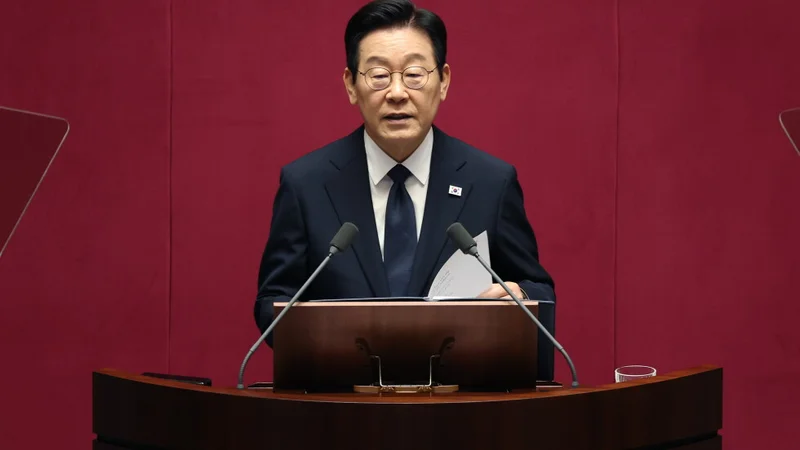
Image: Apnews
Main Takeaway
South Korea triples AI spending to 10.1 trillion won in 2026 budget as President Lee pushes G3 vision.
Jump to Key PointsSummary
What Seoul is spending
President Lee Jae-myung's administration has pledged 10.1 trillion won for artificial intelligence in the 2026 budget, triple the prior year's allocation, according to AP News and AsiaNews. The figure anchors a broader 728 trillion won ($506 billion) national budget that Lee framed as Korea's first designed to open the AI era. Parliament cleared the spending package, giving legislative force to an ambition that had previously existed mainly as policy rhetoric.
The spending surge arrives as Lee's government advances what it calls the AI G3 vision: placing South Korea among the top three global AI powers. Access Partnership notes this marks a decisive turn under the new administration, with financial commitments now backing long-standing strategic documents. The Ministry of Science and ICT, which has stewarded Korea's AI planning since the 2019 National Strategy, retains central coordination authority through 2030.
Why chipmakers are central to the plan
Samsung Electronics and SK Hynix sit at the heart of Korea's AI push, Bloomberg reports, with both companies initiating large-scale investments aligned with the government strategy. Their position reflects a deliberate full-stack approach: Korea aims to control not just AI applications but the semiconductor hardware that powers them. This matters because advanced AI training and inference depend heavily on high-bandwidth memory and specialized processors, areas where Korean firms hold dominant market positions.
Citi Research, in a note cited by the bank, raised its KOSPI target to 3,700 on the expectation that AI-driven productivity gains will offset demographic headwinds from population aging and declining labor supply. The analysts see the transformation as macroeconomically consequential, not merely a sectoral bet. For Samsung and SK Hynix, the policy tailwind reinforces investment plans already underway, reducing uncertainty about demand for their most advanced products.
The legal framework taking shape
South Korea's AI Basic Act, passed in January 2025 and effective January 2026, provides the regulatory backbone for the spending surge, according to CSET analysis. The law includes incentives to attract foreign AI specialists and requires foreign AI companies operating in Korea to designate a local representative for government liaison. These provisions signal intent to build domestic capacity while maintaining oversight of international players.
The 2019 National Strategy for Artificial Intelligence, which set a 2030 vision of becoming an AI world leader beyond IT, remains the foundational planning document. The OECD STIP Compass database shows this as a cross-ministerial effort running 2020-2030, with the Ministry of Science and ICT leading coordination. The new spending thus operationalizes a strategy that has been developing for six years, rather than representing a sudden pivot.
Where critics see risks
Not all observers welcome the acceleration. Hugh Stephens Blog raised concerns that Korea's approach to copyright in AI training threatens to sacrifice its creative industries for uncertain technological gains. The proposal to reduce legal uncertainty for AI developers using copyrighted material, the blog argues, actually increases unpredictability for creators while undermining a cultural sector that has generated significant soft power.
This tension between AI development and content protection mirrors debates in Europe and the United States, but carries particular weight in Korea given the global success of its music, film, and television industries. The criticism suggests that Seoul's AI push may face internal opposition from constituencies that have benefited from stricter intellectual property enforcement. How the government balances these competing priorities will shape whether the G3 vision achieves broad political support.
What the global context reveals
Microsoft's AI Economy Institute reported that global AI adoption rose 1.2 percentage points in the second half of 2025, with roughly one in six people worldwide now using generative AI tools. Yet the same research highlighted a widening digital divide between Global North and Global South, suggesting that AI benefits concentrate in advanced economies with existing digital infrastructure. Korea's spending surge can be read as an attempt to secure position in this bifurcating landscape.
Reuters reported that the budget boost aims specifically to spur AI-led growth, framing the policy in competitive terms against China and the United States. Korea's strategy differs from American reliance on private capital and Chinese state direction by attempting to synchronize large corporate actors, particularly its semiconductor champions, with government funding priorities. Whether this hybrid model can match the scale of U.S. private investment or Chinese state capacity remains an open question.
What happens next
The 2026 budget implementation will test whether Korea's institutional capacity matches its financial ambition. Citi's raised KOSPI target implies market confidence, but actual productivity gains from AI investment typically lag spending by several years. The AI Basic Act's January 2026 effective date will bring foreign company registration requirements into force, potentially affecting how international AI firms operate in Korea.
Bloomberg's live coverage of the presidential briefing suggested additional policy details may emerge as implementation plans develop. For now, the 10.1 trillion won figure serves as both a concrete commitment and a signaling device, announcing Korea's determination not to cede AI ground to larger economies. Whether that spending translates to G3 status by 2030 depends on execution across semiconductor manufacturing, talent attraction, software development, and the regulatory balance that critics like Hugh Stephens have questioned.
Vector TLDR
South Korea's government under President Lee Jae-myung has announced a major increase in artificial intelligence spending, allocating 10.1 trillion won in the 2026 national budget, three times the previous year's amount. The investment is part of the AI G3 vision to establish South Korea as one of the top three global AI powers by 2030. Samsung Electronics and SK Hynix are leading corporate investments aligned with this strategy, leveraging Korea's dominant position in advanced semiconductor manufacturing. The AI Basic Act, passed in January 2025 and taking effect January 2026, provides regulatory framework including incentives for foreign AI experts and requirements for foreign AI companies to designate local representatives. Citi Research raised its KOSPI target to 3,700 based on expectations that AI productivity gains will offset demographic challenges from population aging. Critics have raised concerns about copyright policy changes potentially harming Korea's creative industries. The 2019 National Strategy for Artificial Intelligence, coordinated by the Ministry of Science and ICT, provides the long-term roadmap through 2030. Global AI adoption continues to rise but with a widening digital divide between advanced and developing economies.
Key Points
South Korea triples AI spending to 10.1 trillion won in 2026 budget.
President Lee Jae-myung advances AI G3 vision for top-three global ranking.
Samsung Electronics and SK Hynix lead corporate investment aligned with strategy.
AI Basic Act passed January 2025 requires foreign AI firms to designate local representatives.
Citi Research raised KOSPI target to 3,700 citing AI productivity gains offsetting aging demographics.
Questions Answered
South Korea allocated 10.1 trillion won for artificial intelligence in its 2026 budget, triple the previous year's amount. President Lee Jae-myung announced the figure as part of a 728 trillion won national budget framed as opening the AI era.
The AI G3 vision is the Lee administration's goal to place South Korea among the top three global AI powers by 2030. Access Partnership reports this strategy now has significant financial backing after existing as policy rhetoric since the 2019 National Strategy for Artificial Intelligence.
Yes. The AI Basic Act, effective January 2026, requires foreign AI companies operating in South Korea to designate a local representative for government liaison. CSET analysis notes the law also includes incentives to attract foreign AI specialists to the country.
Samsung Electronics and SK Hynix dominate advanced semiconductor manufacturing, particularly high-bandwidth memory critical for AI training and inference. Bloomberg reports both companies are making large-scale investments aligned with the government strategy, giving Korea hardware control in its full-stack AI approach.
Critics including Hugh Stephens Blog warn that proposed copyright changes for AI training threaten Korea's creative industries. The concern is that reducing legal uncertainty for AI developers would sacrifice globally successful music, film, and television sectors for uncertain technological gains.
Source Reliability
50% of sources are highly trusted · Avg reliability: 65
Go deeper with Organic Intel
Simple AI systems for your life, work, and business. Each one includes copyable prompts, guides, and downloadable resources.
Explore Systems