SK Hynix Launches $28 Billion U.S. IPO to Capitalize on AI-Driven Memory Demand
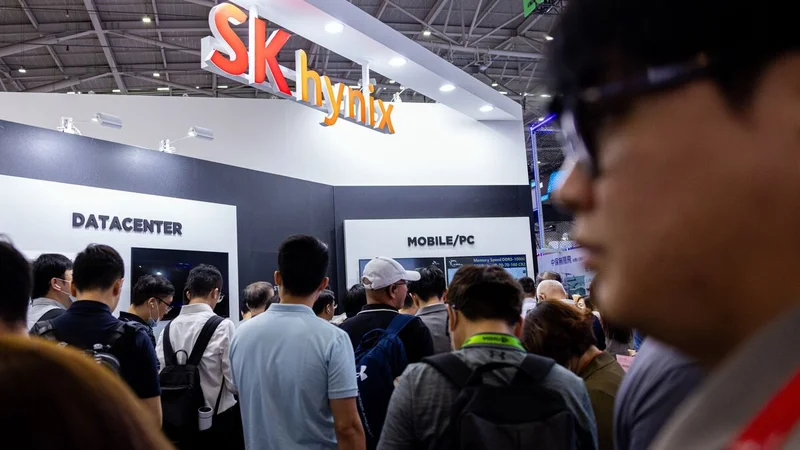
Image: Bloomberg AI
Main Takeaway
SK Hynix kicked off marketing for a $28 billion U.S. listing on Monday, targeting American investors eager for exposure to AI-fueling memory chip demand.
Jump to Key PointsSummary
Why SK Hynix is betting on American investors now
SK Hynix opened formal marketing for its U.S. listing on Monday, seeking to tap into surging American investor appetite for semiconductor companies powering artificial intelligence infrastructure. The South Korean memory chipmaker plans to sell nearly 17.8 million shares, with the deal valuing the company at approximately $28 billion according to multiple reports. This represents one of the largest foreign listings on U.S. exchanges in recent years.
The timing is deliberate. SK Hynix has emerged as the dominant supplier of high-bandwidth memory (HBM) chips, the specialized components that sit alongside NVIDIA's AI accelerators in data centers worldwide. Its HBM3E products command premium pricing and limited competition. By listing in New York, SK Hynix gains access to institutional capital pools that have driven NVIDIA and AMD to trillion-dollar valuations, while reducing its historical dependence on Seoul-based retail investors. Bloomberg reports that the company explicitly framed its pitch around AI growth narratives during early investor meetings.
How this listing reshapes memory chip competition
The U.S. IPO creates a three-way race for American capital among memory chipmakers. Samsung, the longtime global leader in DRAM and NAND flash, already trades with American depositary receipts but lacks the same AI-focused growth story. Micron, the Boise, Idaho-based rival, has aggressively marketed its own HBM ambitions but trails SK Hynix in technology and market share for the most advanced AI memory products.
S&P Global data indicates SK Hynix is on track to overtake Samsung as the leading DRAM supplier by revenue, a historic shift driven entirely by AI demand. The U.S. listing amplifies this competitive dynamic. Samsung's concurrent earnings report this week, noted by Bloomberg, puts both Korean firms in direct comparison for global investor attention. Micron's recent U.S.-focused manufacturing investments, including CHIPS Act subsidies, now face a direct challenge from a better-positioned foreign competitor with deeper AI credentials. HSBC analysts cited by CNBC see SK Hynix commanding a 20% valuation premium over Korean-listed peers precisely because of this U.S. market access.
What the $28 billion valuation signals about AI infrastructure
The scale of SK Hynix's listing reflects extraordinary capital requirements for memory chip manufacturing. HBM production demands advanced packaging facilities, expensive die-stacking equipment, and yields that remain notoriously difficult to predict. The $28 billion target suggests SK Hynix needs substantial funding to expand capacity while maintaining research spending for next-generation HBM4 products already in development.
This capital intensity has structural implications for the semiconductor industry. Only three companies, Samsung, SK Hynix, and Micron, can manufacture HBM at scale. The U.S. listing effectively asks American investors to finance Korean production capacity that will predominantly supply U.S. AI companies like NVIDIA and Meta. This geographic mismatch, Korean manufacturing feeding American demand, financed through New York capital markets, illustrates how AI has rewired traditional semiconductor supply chain logic. Startupfortune's reporting on the $29 billion figure, slightly higher than other sources, hints at potential last-minute adjustments as demand estimates fluctuate.
The political calculus behind Korean chipmaker U.S. listings
SK Hynix's move occurs amid intensifying U.S.-China technology competition and Washington's push to reshore critical semiconductor manufacturing. The Biden administration's CHIPS Act has directed billions toward domestic memory production, particularly Micron facilities in New York and Idaho. A major Korean competitor listing in New York rather than expanding U.S. physical presence creates political complexity.
South Korean government policy has encouraged its chipmakers to maintain advanced production at home while diversifying some legacy capacity abroad. CNBC and Korea JoongAng Daily reporting highlights how Seoul's industrial strategy now explicitly ties national competitiveness to AI semiconductor leadership. SK Hynix's U.S. financial presence without corresponding manufacturing investment may draw scrutiny from American policymakers who expected capital inflows to translate into domestic jobs. The company must navigate this tension while convincing investors that its Korean production base, with established supply chains and engineering talent, represents an asset rather than geopolitical vulnerability.
What happens after the IPO pricing
Market reception of SK Hynix's offering will test whether AI infrastructure enthusiasm extends beyond NVIDIA to its critical suppliers. The company reportedly told investors it sees strong demand for the listing, according to Reuters, but final pricing depends on broader market conditions and competing offerings. If successful, the IPO could trigger a wave of Korean technology companies seeking U.S. listings, following a pattern established by biotech and electric vehicle firms.
Longer term, SK Hynix must convert its valuation premium into sustained technology leadership. HBM products turn over rapidly, each generation lasting roughly two years before obsolescence. Samsung's massive research budget and Micron's U.S. government support both threaten this position. The capital raised in this listing will largely determine whether SK Hynix can maintain its narrow HBM lead while expanding into emerging memory categories like computational storage and edge AI applications. For investors, the bet is straightforward: AI's hunger for memory bandwidth will outpace commoditization pressures long enough to justify premium pricing. Whether that holds true through 2027 and beyond remains the open question this listing will eventually answer.
Key Points
SK Hynix opened marketing for a $28 billion U.S. IPO to fund AI memory expansion.
The listing targets American institutional investors seeking direct exposure to HBM chip demand.
SK Hynix has overtaken Samsung in AI-specific memory market share and revenue growth.
HSBC projects a 20% valuation premium for SK Hynix versus Korean-listed semiconductor peers.
The IPO tests whether AI investment enthusiasm extends from NVIDIA to critical memory suppliers.
Questions Answered
SK Hynix is targeting approximately $28 billion in its U.S. listing, according to multiple financial news sources. The South Korean memory chipmaker plans to sell nearly 17.8 million shares to American institutional investors.
SK Hynix seeks access to deeper American capital pools and institutional investors who have driven valuations of AI infrastructure companies. The U.S. listing also provides currency for potential acquisitions and employee compensation in competitive Silicon Valley talent markets.
SK Hynix currently leads in high-bandwidth memory technology, the specialized chips paired with AI accelerators. S&P Global data shows SK Hynix is overtaking Samsung in DRAM revenue, while Micron trails in both technology and market share for advanced AI memory products.
High-bandwidth memory, or HBM, stacks multiple DRAM dies vertically to deliver faster data transfer rates than traditional memory. AI training and inference require massive data movement between processors and memory, making HBM essential for modern accelerators from NVIDIA and others.
SK Hynix must maintain technology leadership against Samsung's research spending and Micron's U.S. government support. HBM products face rapid obsolescence cycles, and any slowdown in AI infrastructure buildout would directly impact demand and pricing for its premium products.
Source Reliability
42% of sources are highly trusted · Avg reliability: 75
Go deeper with Organic Intel
Simple AI systems for your life, work, and business. Each one includes copyable prompts, guides, and downloadable resources.
Explore Systems