Google Adds Chatbot-Tuned Discover Feeds as Publishers Face New AI Traffic Tradeoffs
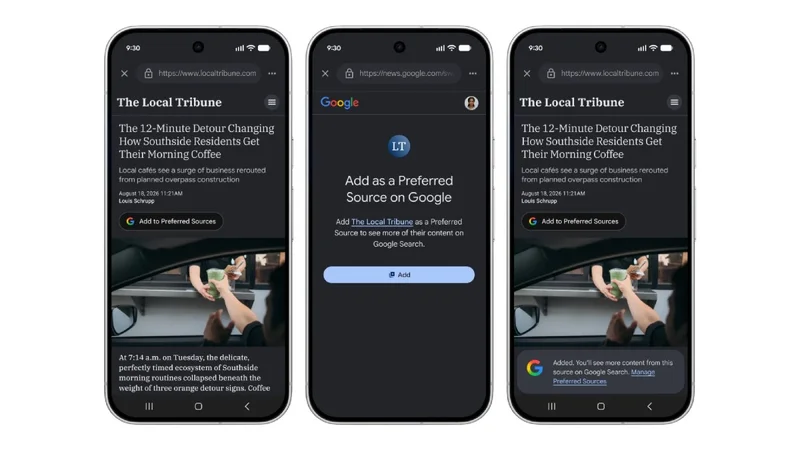
Image: TechCrunch AI
Main Takeaway
Google is adding conversational controls and AI summaries to Discover while giving publishers new tools to shape visibility and opt out of some AI uses.
Jump to Key PointsSummary
Discover gets conversational controls
Google is adding an AI feature to Discover that lets users describe the topics, angles, or interests they want to see, with the Google app rollout beginning in the coming days. The conversational control turns feed personalization into a request users can phrase in ordinary language, rather than relying only on follows, likes, or individual story controls.
The feature is part of a wider update spanning Search, Discover, and Google News. Coverage from The Verge, ZDNET, and Android.gadgethacks frames the chatbot-style interface as a new way to steer the feed, while Google’s publisher-facing changes connect personalization with a broader redesign of how information is selected and presented.
AI summaries change the bargain
Google is also bringing AI-generated summaries into Discover, a move that puts more of the answer inside Google’s products and less of the reading journey on publishers’ sites. The summaries can make feeds faster to scan, but they also intensify the dispute over whether news organizations receive enough audience and revenue when their reporting helps power AI features.
The change lands as publishers are already dealing with declining referral traffic from AI search experiences. TechCrunch described the new Discover summaries as another threat to publisher visits, while The Wall Street Journal portrayed Google’s broader AI tools as placing heavy pressure on news sites. Digiday, Computer Weekly, and TV News Check focused on the resulting policy tradeoff: publishers can restrict some AI uses, but doing so can affect their presence in Google’s distribution system.
Publishers get a preference button
Google is giving readers a way to mark a publisher as a “favorite source,” allowing that outlet to receive greater emphasis across Search, Discover, and Google News. The control gives publishers a direct route to audience preference at a time when algorithmic distribution and AI answers are absorbing more of the discovery process.
The button addresses visibility, while Google’s opt-out controls address data use and AI presentation. Those tools serve different purposes, yet they create a single strategic calculation for publishers: accept broader participation in Google’s systems to pursue reach, or limit certain uses to protect content and direct traffic. TechCrunch highlighted the favorite-source feature, and coverage from Mediapost, TheHub, Digiday, and Computer Weekly placed it alongside Google’s developing opt-out framework.
The opt-out carries a cost
Google’s AI controls let publishers restrict their content from some AI summaries, training uses, or search experiences, but opting out can reduce exposure across the company’s products. That makes the policy less like a simple on-off switch and more like a distribution decision with commercial consequences.
The tension is especially sharp for news organizations that depend on search and recommendation traffic. Mediapost and TV News Check described publisher opt-outs as a response to AI search, while Computer Weekly detailed controls covering AI summaries and training. Digiday emphasized the difficult choice facing publishers, and TheHub presented the change as an exit route that does not remove the underlying dependence on Google.
Why the change matters for users
For users, conversational Discover controls promise a feed that responds more precisely to changing interests. Someone can ask for a particular subject or editorial angle instead of waiting for the recommendation system to infer it from behavior. AI summaries also reduce the time needed to understand a story before deciding whether to open it.
That convenience changes the economics of attention. When users can receive both tailored recommendations and condensed explanations without leaving Google, publishers compete for inclusion in an answer layer as well as for a click. The Verge, ZDNET, and Android.gadgethacks centered on the consumer-facing chatbot feature, while TechCrunch and the Journal connected Google’s product changes to the traffic pressure facing publishers.
What publishers do next
Publishers are responding on several fronts: testing Google’s preference tools, weighing AI restrictions, and seeking audiences through channels that depend less on search referrals. A separate industry discussion has pushed outlets toward video, direct relationships, and efforts to block or manage AI crawlers, according to Whatsnewinpublishing.substack.
Google’s next challenge is balancing a more useful Discover experience with a sustainable supply of original reporting. Publishers will watch whether favorite-source signals generate meaningful traffic, how prominently AI summaries appear, and whether opt-out settings preserve enough search visibility to be practical. The decisions made during this rollout will shape how news organizations price access to their work and how users encounter it.
Key Points
Google adds conversational Discover controls and AI summaries, reshaping how users find and consume news.
Publishers can mark preferred sources for stronger visibility across Search, Discover, and Google News.
AI summaries threaten referral traffic by answering more questions inside Google’s products.
Publisher opt-outs provide control over AI uses while risking reduced visibility in Google distribution channels.
News organizations are pursuing video, direct audiences, and anti-bot measures as search economics deteriorate.
Questions Answered
Google is adding conversational AI controls that let users describe what they want to see in Discover. The Google app will also show AI-generated summaries for some content.
Google’s Discover chatbot-style feature will let users express interests in natural language. The feed will use those requests to tailor recommended topics and stories.
Google Discover AI summaries can give users key information without sending them to the publisher’s website. That threatens referral traffic, audience engagement, and advertising opportunities for news organizations.
Publishers can use Google controls to restrict some AI summaries, search experiences, or training uses. Those restrictions can carry a visibility cost across Google’s products.
Google’s favorite-source button lets readers signal that they want more content from a particular publisher. The preference can influence visibility across Search, Discover, and Google News.
Source Reliability
45% of sources are trusted · Avg reliability: 74
Go deeper with Organic Intel
Simple AI systems for your life, work, and business. Each one includes copyable prompts, guides, and downloadable resources.
Explore Systems