Samsung Joins $1 Trillion Club as AI Chip Boom Quadruples Stock Price
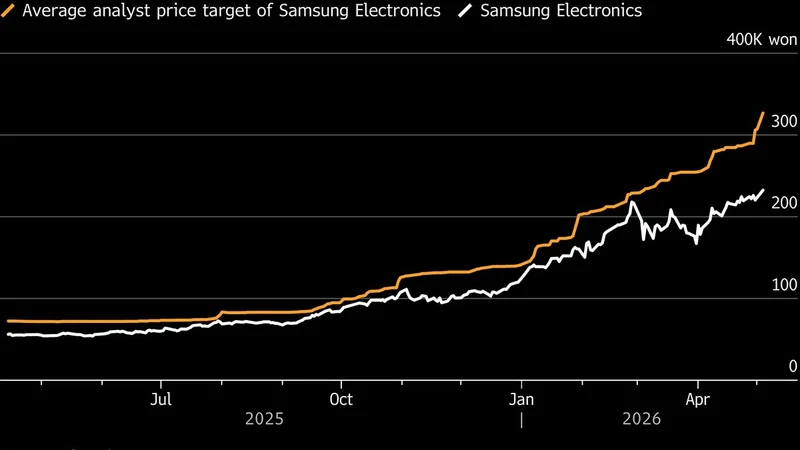
Image: Bloomberg AI
Main Takeaway
Samsung hits $1 trillion valuation, second Asian company after TSMC, driven by AI chip demand and 4x stock surge.
Jump to Key PointsSummary
How Samsung crossed the trillion-dollar threshold
Samsung Electronics reached a $1 trillion market capitalization on May 6, 2026, becoming only the second Asian company after Taiwan Semiconductor Manufacturing Company (TSMC) to achieve this milestone. The achievement came as Samsung's stock more than quadrupled over the past year, driven by surging demand for AI chips and memory components. According to CNBC, shares jumped over 10% on the day the threshold was crossed, pushing the Kospi index above 7000. Bloomberg reports this represents a historic rally for the world's largest memory manufacturer, with the stock surge reflecting investor confidence in Samsung's dominant position in the AI infrastructure supply chain.
What this means for the semiconductor landscape
Samsung's milestone signals a fundamental shift in how markets value memory and chip manufacturers in the AI era. The company's semiconductor division posted an 756% year-over-year increase in operating profits for Q1 2026, according to Finance.biggo, driven primarily by AI data center orders. This performance has elevated Samsung to the 12th position globally by market value, as noted by Biz.chosun. The achievement also highlights the growing importance of memory chips in AI infrastructure, moving beyond traditional CPU-centric valuations. SK Hynix, Samsung's primary competitor, saw its revenue jump 198% during the same period, indicating the broader industry transformation rather than isolated company success.
The volatile reality behind the trillion-dollar badge
Despite the celebratory headlines, Samsung's journey to maintaining this valuation has been anything but smooth. Sammyguru reported that just days after first crossing the $1 trillion mark on February 26, Samsung shed over $110 billion in market value, highlighting the extreme volatility in semiconductor stocks. The initial February milestone coincided with the Galaxy S26 series launch, suggesting the valuation spike wasn't solely AI-driven. This volatility pattern indicates that while AI demand provides strong fundamentals, Samsung's trillion-dollar status remains sensitive to broader tech sentiment and cyclical semiconductor trends. The stock's ability to regain and hold the trillion-dollar level by May reflects sustained institutional confidence despite these fluctuations.
Why Korea's chaebol structure accelerated this milestone
Samsung's achievement carries special significance within South Korea's corporate landscape. As reported by both AJU Press and SamMobile, Samsung became the first South Korean company to reach this threshold, marking a watershed moment for the country's tech dominance. The company's integrated chaebol structure, spanning from semiconductor manufacturing to consumer electronics, provided unique advantages during the AI boom. Unlike Western tech giants that had to build supply chain partnerships, Samsung's vertical integration across memory, foundry services, and end-user devices created multiple revenue streams feeding the AI demand surge. This structural advantage likely accelerated the path to $1 trillion compared to more specialized competitors.
What happens next for Samsung and AI infrastructure
Analysts foresee continued price appreciation driven by persistent AI chip shortages and Samsung's expansion into advanced packaging and foundry services. The company's upcoming investments in next-generation memory technologies, including HBM4 and advanced DRAM, position it to capture increasing AI workloads. However, Samsung faces potential headwinds from a threatened 18-day worker strike, as noted by CNBC TV18, which could impact production schedules. The broader implication extends beyond Samsung: TSMC's similar valuation suggests the market now recognizes memory and foundry companies as core AI infrastructure plays, potentially revaluing the entire semiconductor supply chain. Samsung's next challenge will be translating this market confidence into sustained technological leadership as AI architectures evolve beyond current paradigms.
Key Points
Samsung reached $1 trillion market cap on May 6 2026, becoming second Asian company after TSMC to achieve this milestone
Stock quadrupled over past year driven by AI chip demand surge and 756% profit growth in semiconductor division
First crossed $1 trillion on February 26 but briefly lost $110 billion days later, highlighting semiconductor volatility
Achievement makes Samsung first South Korean company to reach trillion-dollar status, ranking 12th globally
AI data center orders drove historic 756% year-over-year profit increase in Q1 2026 semiconductor division
Questions Answered
Samsung first crossed $1 trillion on February 26 2026, but briefly dropped below this level before regaining it on May 6 2026.
Samsung's stock more than quadrupled (over 400% gain) over the past year to reach the $1 trillion valuation.
Samsung's semiconductor division reported a 756% year-over-year increase in operating profits for Q1 2026.
Taiwan Semiconductor Manufacturing Company (TSMC) was the first Asian company to reach $1 trillion valuation.
After hitting $1 trillion, Samsung ranks 12th globally in terms of market capitalization.
Samsung faces potential production disruptions from a threatened 18-day worker strike and the inherent volatility of semiconductor markets.
Source Reliability
36% of sources are trusted · Avg reliability: 63
Go deeper with Organic Intel
Simple AI systems for your life, work, and business. Each one includes copyable prompts, guides, and downloadable resources.
Explore Systems