Salesforce to Acquire AI Customer Service Firm Fin for $3.6 Billion
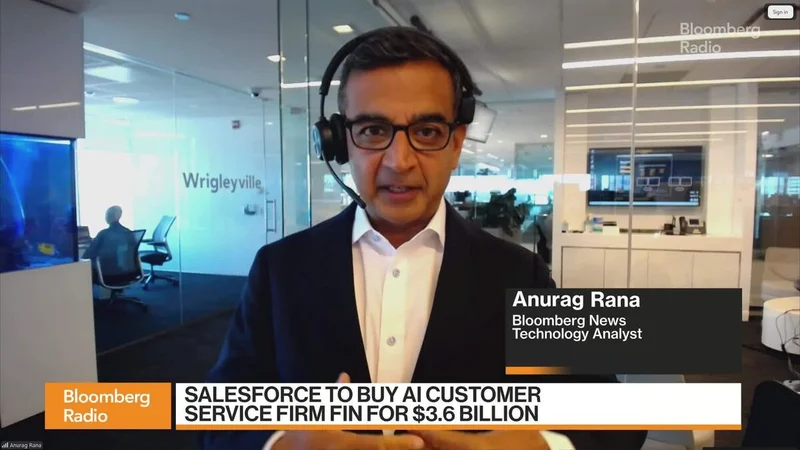
Image: Bloomberg AI
Main Takeaway
Salesforce agreed to buy AI customer service platform Fin for $3.6 billion to strengthen its Agentforce enterprise AI agent platform.
Jump to Key PointsSummary
Why Salesforce is buying now
Salesforce agreed on Monday to acquire Fin, an artificial intelligence customer service platform, for $3.6 billion. The deal represents one of the largest AI acquisitions of 2026 and signals Salesforce's aggressive push to dominate the enterprise AI agent market. Fin develops AI-powered customer agents that automate support interactions, a capability that Salesforce plans to fold into Agentforce, its existing platform for building custom business AI agents.
The acquisition comes as enterprise software vendors race to embed autonomous AI agents into their product suites. Salesforce has been particularly active on this front, with multiple acquisition announcements in recent months including Contentful and other AI-focused targets. The Fin deal stands out for its size and strategic clarity. Rather than building customer service AI from scratch, Salesforce is buying proven technology and talent that can accelerate Agentforce's capabilities. Bloomberg reports that the deal is structured to help Salesforce win new business for enterprise AI, reflecting pressure to show concrete returns on its AI investments.
What Fin brings to the table
Fin, formerly known as Intercom's AI division before spinning out, specializes in conversational AI that handles complex customer support scenarios. The platform uses large language models to resolve tickets, route inquiries, and maintain context across multi-turn conversations with human-like fluency. This isn't basic chatbot territory; Fin's agents can process refunds, update orders, and escalate nuanced cases without predefined scripts.
Salesforce explicitly stated it wants Fin's team and technology to improve Agentforce. That platform currently lets businesses build custom AI agents for various tasks, but customer service has emerged as the highest-value initial use case. Fin's technology fills a gap in natural language understanding and autonomous resolution that Salesforce had been developing more slowly internally. The combination creates a more complete offering for enterprises looking to reduce support costs while maintaining service quality. TechCrunch notes that Salesforce's investor relations page has been busy with acquisition announcements, suggesting this is part of a broader consolidation strategy rather than a one-off purchase.
How this reshapes the AI agent market
The $3.6 billion price tag puts real valuation meat on the bone for AI agent startups, which have proliferated rapidly but struggled to prove enterprise-grade reliability. Salesforce's willingness to pay a premium signals conviction that autonomous customer service agents are graduating from pilot projects to production infrastructure. This validates the entire vertical and likely triggers a wave of competing acquisitions from Oracle, SAP, Microsoft, and other enterprise software giants.
The competitive dynamics are shifting fast. Microsoft has been building agentic capabilities into Copilot, while smaller players like Ada and Forethought have raised significant funding for similar use cases. Salesforce's move pressures these competitors to either accelerate their own acquisitions or risk being boxed out of the enterprise customer service AI market. The deal also raises questions about whether best-of-breed AI agents can survive as standalone products, or if they inevitably get absorbed into platform plays. For Salesforce specifically, this acquisition tightens the integration between its Service Cloud and the newer Agentforce offering, creating a more defensible moat against pure-play AI vendors.
What happens to existing customers
Salesforce has not detailed specific product integration timelines, but historical patterns suggest Fin's standalone offerings will gradually merge into Service Cloud and Agentforce over 12 to 18 months. Enterprise customers currently using Fin directly will likely face migration decisions, though Salesforce typically offers transition support to minimize churn. The more interesting question is how Salesforce prices combined capabilities; Fin's technology could command premium tiers within existing Salesforce contracts.
For businesses already invested in Salesforce's ecosystem, the acquisition promises tighter integration between AI agents and core CRM data. For Fin customers outside Salesforce's orbit, the deal introduces platform lock-in risks that didn't exist previously. The acquisition follows Salesforce's established playbook of buying capabilities rather than building them organically, a strategy that has produced both hits and integration headaches over the company's history of approximately 30 acquisitions. Whether Fin becomes another Slack-level success or follows a bumpier path depends on execution speed and how aggressively Salesforce pushes platform consolidation.
The broader consolidation signal
This deal is a clear data point in a larger pattern: enterprise software is consolidating around AI agents as the next interface layer. Salesforce's acquisition spree, including Contentful for marketing content and now Fin for customer service, reveals a strategy to own the full stack of enterprise AI agent deployment. The company is positioning itself as what its marketing now calls the number one agentic AI CRM, a framing that stretches beyond traditional CRM into general-purpose business automation.
The $3.6 billion investment also reflects Salesforce's urgency to maintain relevance as AI reshapes how enterprises interact with software. Pure cloud CRM growth is maturing; agentic AI represents a new expansion vector. Investors will watch closely whether Salesforce can integrate these acquisitions without the bloat that has plagued some past deals. The market's reaction to this specific transaction, and Salesforce's subsequent ability to upsell Agentforce capabilities, will determine whether this acquisition marks a genuine strategic pivot or an expensive attempt to buy innovation rather than cultivate it.
What analysts expect next
Wall Street and industry analysts will focus on two metrics: revenue contribution from Agentforce and customer retention rates among migrated Fin users. Salesforce has historically been opaque about segment-specific revenue from acquired products, but the scale of this deal will pressure greater transparency. If integration proceeds smoothly, expect Salesforce to pursue similar acquisitions in vertical AI agents for sales, marketing, and operations.
The deal also sets a valuation benchmark that venture investors will use to price AI agent startups in upcoming funding rounds. A $3.6 billion exit for a customer service AI specialist suggests substantial upside for companies with comparable technology in adjacent domains. However, it also means strategic acquirers may prefer to build rather than buy at inflated prices, or target earlier-stage companies at lower valuations. For Salesforce employees and customers, the immediate priority is execution, specifically demonstrating that Fin's technology performs at scale within Salesforce's infrastructure and that promised synergies materialize in actual product improvements rather than marketing slides.
Key Points
Salesforce will acquire AI customer service platform Fin for $3.6 billion.
Fin's conversational AI agents automate complex support interactions for enterprises.
Salesforce will integrate Fin into Agentforce, its custom AI agent building platform.
The deal validates AI agent startups and pressures competitors to acquire or build rapidly.
Integration is expected to take 12 to 18 months with potential pricing changes.
Questions Answered
Salesforce agreed to pay $3.6 billion for Fin. The deal was announced on June 15, 2026, and represents one of the largest AI acquisitions of the year.
Fin develops AI-powered customer service agents that use large language models to handle complex support conversations. The platform can resolve tickets, process refunds, update orders, and escalate nuanced cases without relying on rigid scripts.
Fin's standalone offerings are expected to gradually merge into Salesforce's Service Cloud and Agentforce over 12 to 18 months. Existing Fin customers will likely need to migrate, though Salesforce typically provides transition support.
Salesforce is following its established acquisition strategy of buying proven capabilities to accelerate time to market. Fin's technology and talent offer faster enhancement of Agentforce than internal development would achieve.
The deal pressures enterprise software competitors to accelerate their own AI agent acquisitions or risk losing ground in the customer service automation market. It also sets a high valuation benchmark that may complicate their own acquisition strategies.
Source Reliability
30% of sources are highly trusted · Avg reliability: 62
Go deeper with Organic Intel
Simple AI systems for your life, work, and business. Each one includes copyable prompts, guides, and downloadable resources.
Explore Systems