Google Launches Playground for Prompt-Based Game Creation as Unity Partnership Expands AI Gaming Push
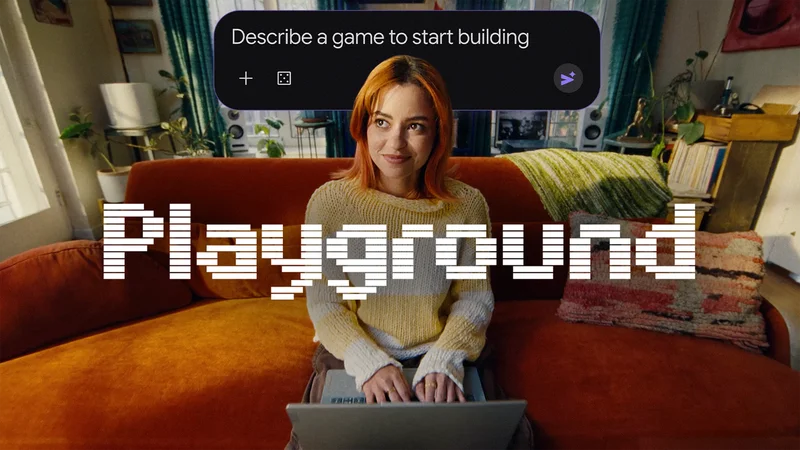
Image: Google AI Blog
Main Takeaway
Google launched Playground, a browser-based platform that uses AI prompts to help people create, play, and share custom 2D and 3D games without coding.
Jump to Key PointsSummary
Google opens game creation to prompts
Google launched Playground on Oct. 7 as an experimental browser-based platform for creating, playing, and sharing custom games without coding. The service is available in the United States to users 18 and older through playground.google, according to Google’s product announcement and coverage from The Verge AI. Its central interface turns typed instructions into game-building directions, giving nontechnical users a way to move from an idea to a playable browser experience.
The launch positions game creation as a form of everyday expression rather than a specialist workflow. Google Labs describes Playground as a place to create custom games in minutes, while TechCrunch AI frames it within a broader reduction in barriers to programming, illustration, and design. The platform remains experimental, and Google warns that generative AI output is experimental.
How Playground builds games
Playground combines conversational instructions with preset starting points and guided development tools. Users can begin with a blank canvas, remix starter prompts, or describe the experience they want to build. The interface supports choices such as 2D or 3D presentation, game genre, and single-player or multiplayer formats, according to 9to5google and TechCrunch AI.
The underlying system uses Google’s Gemini, Nano Banana, and Lyria models alongside a custom harness designed for game creation. That combination gives the platform access to text reasoning, image generation, and audio generation within one workflow. Google’s product page presents the result as a browser-based experience that can be shared after creation, although the published details do not establish the depth of editing, export, collaboration, or multiplayer support.
A new audience for game development
Playground targets people who have ideas for games but lack experience with conventional engines and development tools. Google says complex technical knowledge has historically limited game creation to a smaller group, while its new platform is intended to make creation more approachable and encourage everyday creativity. The pitch reaches beyond hobbyist programmers to players, educators, creators, and communities that want to turn concepts into interactive experiences.
That approach also shifts the value of a game platform toward rapid experimentation. A user can test a trivia concept, a racing game, or another genre through natural-language iteration rather than building systems from scratch. Techbuzz described the move as part of Google’s broader push into AI-powered entertainment, but the available product details point to an early creative experiment rather than a replacement for professional production pipelines.
Unity partnership broadens the strategy
Google’s Playground release arrived alongside news of a separate partnership with Unity for an AI gaming platform planned for later in 2026. Bloomberg AI reported that Google and Unity are working on a service for creating video games from text prompts, while a Google and Unity announcement describes an integrated platform aimed at connecting Google’s AI and consumer reach with Unity’s game-building technology.
The relationship indicates that Google’s gaming strategy extends beyond a standalone Labs experiment. Playground offers an immediate browser-based test of prompt-driven creation; the Unity initiative points toward deeper ties to established development infrastructure and a larger distribution ecosystem. The 2 efforts are related, but the published information does not establish that Playground itself runs on Unity or that the later platform will share all of its features.
Google’s longer AI gaming push
Playground follows an earlier Google effort to showcase AI-assisted game creation around Google I/O 2026. A March Google AI Blog post said the company was using Gemini to demonstrate how people could build games, placing the October launch within a continuing effort rather than an isolated announcement. The progression runs from a public demonstration to a named product that users can access directly.
The rollout also reflects Google Labs’ preference for public experiments that test new interfaces before broader product commitments. The company is gathering attention around prompt-based creation while keeping the experience bounded by age and geography. For creators, the immediate question is how consistently Playground can translate open-ended instructions into playable, shareable results. For Google, usage will help show whether conversational game-making has staying power beyond novelty.
What happens next for creators
Playground is available now in the United States for adults, giving creators an immediate way to test AI-generated browser games. The next milestones are feature depth, reliability, sharing controls, and the quality of games produced across different genres. Those details will determine whether the service functions mainly as a playful prototype tool or develops into a meaningful creation platform.
The Unity partnership adds a second path for Google’s ambitions later this year. If the project connects prompt-based creation with Unity’s established tooling, it could reach developers and players beyond the lightweight browser experiments introduced through Labs. For now, Google has established the direction clearly: typed instructions, multimodal AI, and shareable games are becoming part of the company’s public product testing.
Key Points
Google launched Playground, enabling no-code creation of custom browser games through AI prompts.
Playground combines Gemini, Nano Banana, and Lyria for text, image, and audio-assisted game building.
Users can choose 2D or 3D formats, genres, and single-player or multiplayer game concepts.
Google’s Unity partnership targets a separate integrated AI gaming platform planned for later in 2026.
Playground extends Google’s earlier Gemini game-building demonstrations from its 2026 I/O buildup.
Questions Answered
Google Playground is an experimental browser-based platform for creating, playing, and sharing custom games with AI prompts. It is designed for users without coding experience and is available in the United States to people aged 18 and older.
Google Playground turns conversational instructions into game-building output through a chat-based interface. It uses Gemini, Nano Banana, and Lyria models, with options for formats such as 2D, 3D, single-player, and multiplayer games.
Google Playground does not require coding experience for its prompt-based creation workflow. Users can begin with a blank canvas, remix starter prompts, or follow guided development support.
Google Playground and Unity are part of Google’s broader AI gaming push, but the announced Unity partnership describes a separate platform planned for later in 2026. The published details do not establish that Playground itself uses Unity technology.
Google Playground is available in the United States to users who are 18 or older. The platform is accessed through a web browser at playground.google.
Source Reliability
50% of sources are highly trusted · Avg reliability: 72
Go deeper with Organic Intel
Simple AI systems for your life, work, and business. Each one includes copyable prompts, guides, and downloadable resources.
Explore Systems