DoorDash Brings AI Food Ordering to Apple Messages, Slack and Agent Workflows
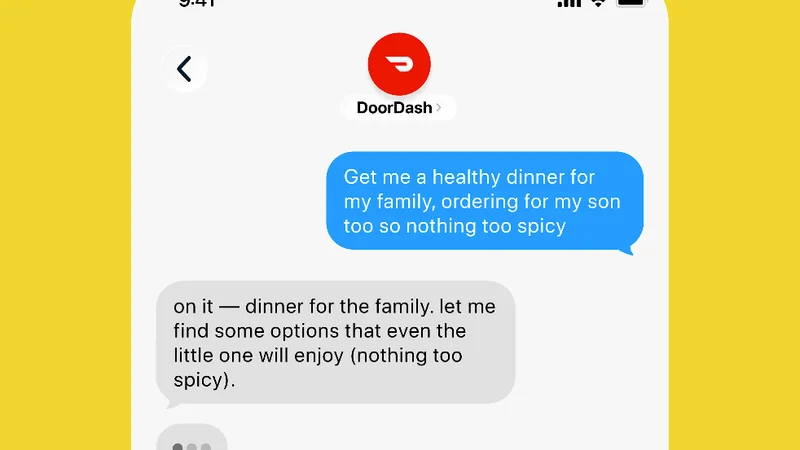
Image: TechCrunch AI
Main Takeaway
DoorDash is testing an AI agent that takes food orders through Apple Messages while opening its marketplace to workplace tools and autonomous software agents.
Jump to Key PointsSummary
DoorDash moves ordering into chat
DoorDash is testing an AI agent that lets customers order food through Apple Messages, turning a familiar text thread into a restaurant search, recommendation and checkout channel. Users can type requests such as “order my usual,” ask for a specific dish or seek a local recommendation. The system searches nearby restaurants, builds a suggested cart and can send photos of recommended food, according to the company.
The feature extends DoorDash’s in-app Ask DoorDash chatbot, which can interpret more open-ended requests such as recipes or photos. The text interface is designed to remove the need to open the DoorDash app for repeat orders and simple discoveries. Bloomberg described the launch as part of DoorDash’s broader effort to place its marketplace inside personal AI assistants, while TechCrunch identified Uber Eats and Grubhub as competitive pressure behind the move.
How the text agent handles requests
The agent is built around intent rather than rigid menu navigation. A customer can describe a craving, request a recurring meal or ask for options nearby, and DoorDash handles restaurant discovery before presenting a cart for approval. Group ordering is also part of the announced capability, although the available product details do not spell out every step of that workflow.
DoorDash’s approach keeps recommendations and ordering inside Apple Messages, where customers already communicate with friends and family. That matters because the service competes for attention with other conversational ordering tools, including Instinct-style agents and Square’s ChatGPT and Claude integrations. AOL characterized DoorDash’s feature as a beta, while coverage from The Verge also placed it alongside the company’s other agentic delivery experiments, including drone deliveries and retail returns.
DoorDash targets workplace orders too
DoorDash is extending agentic ordering beyond individual customers through DoorDash MCP, a Model Context Protocol offering for corporate ordering. Companies can use the system to automate office restaurant orders and supply restocks through workplace software, including Slack, according to Adweek. That creates a separate path into DoorDash’s marketplace, where a request can begin in a team conversation instead of a consumer app.
The workplace push gives DoorDash a way to serve recurring, multi-person transactions with software rather than a single customer. It also places the company in a race to make its menus, prices, availability and checkout functions readable by outside assistants. Square’s restaurant integrations show the same direction from the merchant side: conversational tools can expose live menus and modifiers, route orders to existing point-of-sale systems and label them as an AI channel.
Autonomous agents raise the stakes
DoorDash is also opening programmatic access through dd-cli, a command-line interface that allows AI agents to search restaurants, compare deals and complete real orders. Finance.yahoo reported that the tool can process real payments without requiring manual input at checkout. That shifts DoorDash’s AI strategy from a customer-facing chatbot toward infrastructure that other software agents can call.
The commercial upside is broader distribution across assistants, enterprise workflows and automated purchasing systems. The operational burden rises with it. Agents must handle substitutions, dietary requirements, payment authorization, delivery addresses and order errors accurately, while restaurants need menus that software can interpret. DoorDash’s earlier voice-ordering work for restaurants and its use of Replicant to automate more than 350,000 support calls per day show the company has been building automation across both sides of the marketplace.
Competition shifts to the interface
DoorDash’s launch places the company in competition with delivery platforms and AI assistants over who controls the customer’s first interaction. Uber Eats and Grubhub remain direct rivals in food delivery, while Instinct and Square represent adjacent approaches that connect conversational software with transactions. The key contest is moving from app features to access inside the places where people already type requests.
That shift gives DoorDash a reason to expose its marketplace through Apple Messages, Slack and command-line tools at the same time. It also creates a new risk: when an assistant selects a restaurant, the platform’s ranking, pricing and recommendations become part of an automated decision rather than an explicit browsing session. DoorDash’s marketplace gains more entry points, but each one requires clear controls around consent, payments and the final cart.
What happens next for customers and restaurants
DoorDash’s immediate next step is testing and refining the Apple Messages experience before broader adoption. Customers will judge the feature on whether “order my usual” reliably identifies the right meal, whether recommendations reflect real availability and whether the convenience beats opening the app. Group ordering and image-based suggestions will also test how well the agent handles ambiguous, multi-person requests.
Restaurants face a parallel adjustment as AI agents become another ordering channel. Accurate menus, modifiers, prices, hours and inventory will matter more because software needs structured information to make reliable purchases. DoorDash’s support automation and corporate tools indicate a larger effort to connect discovery, checkout and fulfillment, while Square’s integrations show that rival platforms are building similar paths. The winning service will be the one that makes automated ordering dependable without making customers feel they’ve lost control.
Key Points
DoorDash is testing an Apple Messages AI agent for natural-language food ordering and repeat purchases.
DoorDash MCP brings automated restaurant ordering and office supply restocking to Slack and corporate workflows.
DoorDash dd-cli lets AI agents search menus, compare deals and complete real paid orders.
AI ordering intensifies competition among DoorDash, Uber Eats, Grubhub, Instinct and Square.
Restaurants need accurate menus, prices and modifiers as conversational agents become a new sales channel.
Questions Answered
DoorDash’s new AI agent lets customers order food through Apple Messages using natural-language text. Users can reorder a usual meal, request a dish, ask for recommendations and receive a suggested cart.
Yes, DoorDash is testing food ordering through Apple Messages. The beta lets customers text cravings or repeat-order requests and receive restaurant suggestions, food photos and cart details.
DoorDash MCP is designed to connect corporate ordering workflows with DoorDash through tools such as Slack. Companies can use it to automate office restaurant orders and recurring supply restocks.
DoorDash dd-cli allows AI agents to search restaurants, compare deals and complete real DoorDash orders with payment. It opens a programmatic ordering channel beyond the consumer DoorDash app.
DoorDash focuses on its delivery marketplace, Apple Messages, Slack and autonomous ordering tools, while Square connects restaurant menus and checkout to ChatGPT and Claude. Both approaches bring restaurant discovery and payment into conversational interfaces.
Source Reliability
40% of sources are established · Avg reliability: 68
Go deeper with Organic Intel
Simple AI systems for your life, work, and business. Each one includes copyable prompts, guides, and downloadable resources.
Explore Systems