Google DeepMind Introduces Genie 4 With Real-Time Audio and More Realistic Interactive AI Worlds
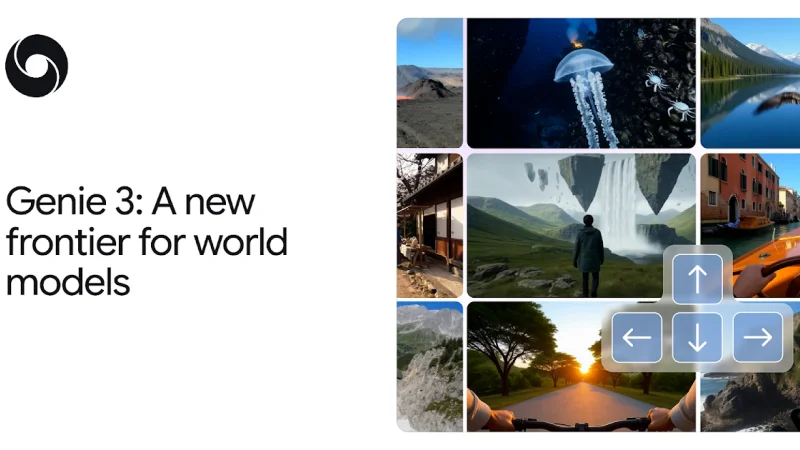
Image: Deepmind
Main Takeaway
Google DeepMind’s Genie 4 generates more realistic interactive worlds with real-time audio, persistent environments, and text prompts that steer simulations as they run.
Jump to Key PointsSummary
Google’s world model advances
Google DeepMind has introduced Genie 4, a world model designed to generate interactive environments that users can explore and alter in real time. The system builds on Genie 3, which generated navigable worlds at 24 frames per second and 720p resolution while maintaining consistency for several minutes. Google describes Genie 4 as its most realistic and interactive world model yet.
The release places world simulation alongside text, image, and video generation as a major AI development track. Genie converts prompts into environments with controllable characters, scenes, and actions, extending the approach first outlined in the original Genie research, which learned a latent action interface from internet videos.
What Genie 4 adds
Genie 4 adds real-time audio, more convincing physical behavior, and improved visual realism. Simulations can include ambient sound, music, and interactive dialogue that respond to events inside the generated world. Users can also enter text prompts during a simulation to change the scene rather than restarting the experience.
The model connects several Gemini capabilities to the world-generation process. Google says Gemini Omni anchors simulations in real-world appearance and behavior, while other Gemini models supply reasoning that helps preserve coherence and continuity. The company has highlighted more realistic humans and physics as central improvements over earlier versions.
From research to usable experiences
Project Genie turns the underlying research into a consumer-facing prototype. Google AI Ultra subscribers in the United States received access in January 2026, while the Project Genie interface lets users create and explore worlds from text and images, build a character, and use Street View imagery as part of a prompt.
The product remains an early research prototype, but its design points toward experiences that sit between games, simulations, and creative tools. Users provide a starting description, then navigate an environment that generates itself around them. The service gives Google a way to test how people interact with persistent AI-created spaces before the technology reaches broader audiences.
Why realism matters for developers
Higher visual and physical fidelity makes Genie 4 more relevant to game creation, agent training, robotics research, and simulation. A model that maintains a coherent environment while a user or software agent acts inside it can provide richer training settings than static images or prerecorded video. Genie 2 was explicitly framed as a way to generate diverse environments for future general agents, and Genie 3 extended that idea into real-time navigation.
The practical constraints remain substantial. Generated worlds have finite continuity, and real-time rendering, audio generation, and interactive steering require significant computing resources. Developers also need reliable control over rules, state, and repeatability, especially when simulations are used for testing rather than entertainment.
Google’s competitive position
Genie 4 arrives as world models become a larger focus across the AI industry. Google’s progression from Genie 2 to Genie 3, Project Genie, and Genie 4 shows a strategy that combines research models with limited product access and iterative user testing. The company is positioning world simulation as a complement to its Gemini model family, rather than as a separate video-generation feature.
That distinction matters. A generated video produces a sequence for viewing, while a world model must respond to movement, preserve spatial relationships, and adapt when users change the scenario. Genie 4’s audio and mid-simulation prompting move the system closer to an interactive medium, although the model’s research-preview status keeps expectations tied to experimentation rather than a finished game platform.
What happens next
Google plans to expand access to Genie 4 through developers and Google AI Ultra subscribers, with the initial release limited to trusted testers and research-preview settings. Broader access will depend on performance, operating cost, safety controls, and the model’s ability to maintain stable worlds over longer sessions.
The next test is whether developers can turn generated environments into repeatable tools instead of short demonstrations. If Genie 4 can combine realistic physics, responsive characters, coherent sound, and dependable steering, it will support new forms of game prototyping, agent evaluation, education, and virtual exploration. For now, Google’s release establishes a more capable research platform and a clearer path from generative media toward interactive simulation.
Key Points
Google DeepMind introduced Genie 4 with realistic interactive worlds, real-time audio, and live text steering.
Genie 4 builds on Genie 3’s real-time 720p world generation and several-minute environmental consistency.
Project Genie lets Google AI Ultra subscribers create and explore worlds from text, images, and Street View.
Genie 4 targets game development, agent training, robotics simulation, creative tools, and virtual exploration.
The research preview’s main tests are controllability, compute costs, physics, continuity, and longer simulation sessions.
Questions Answered
Google DeepMind Genie 4 is a generative world model that creates interactive environments users can explore and modify. It combines generated visuals, physics, characters, and real-time audio rather than producing a fixed video.
Google DeepMind Genie 4 adds real-time audio, more realistic physics and human behavior, and text prompts that can steer a simulation while it is running. The model also improves visual realism and environmental continuity.
Project Genie is Google’s experimental interface for creating and exploring AI-generated worlds built on the Genie research line. Google AI Ultra subscribers in the United States can use it to create worlds from text and images, build characters, and incorporate Street View imagery.
Google DeepMind Genie 4 is available in a limited research preview for trusted testers and selected developers. Wider access depends on performance, operating costs, safety controls, and the model’s reliability during longer sessions.
Google DeepMind Genie 4 can support game prototyping, agent training, robotics simulation, interactive storytelling, education, and virtual exploration. Its value depends on whether generated worlds remain controllable, repeatable, and coherent under sustained interaction.
Source Reliability
50% of sources are highly trusted · Avg reliability: 71
Go deeper with Organic Intel
Simple AI systems for your life, work, and business. Each one includes copyable prompts, guides, and downloadable resources.
Explore Systems