DeepSeek V4 Flash 0731 Lands: Post-Training Tweak Beats Bigger Models at a Quarter of the Cost
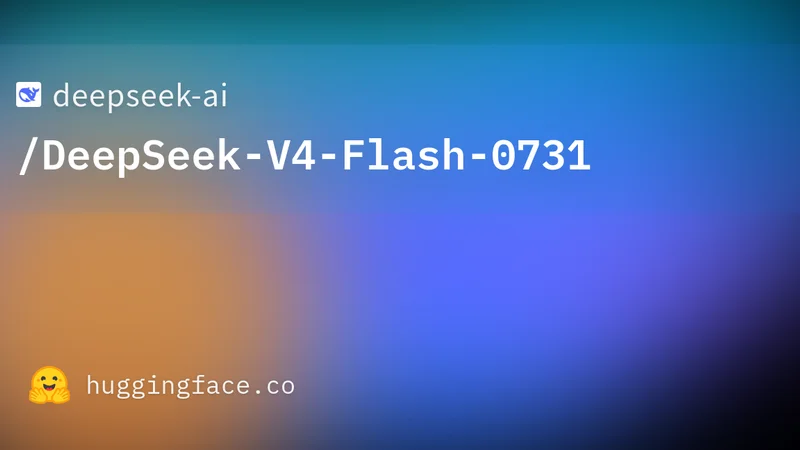
Image: Hugging Face Daily Papers
Main Takeaway
DeepSeek's re-post-trained V4 Flash 0731 release beats the much larger V4-Pro-Preview on agent benchmarks while costing as little as $0.0236 per complete agentic task, resetting the price-performance equation for open-weight models.
Jump to Key PointsSummary
The official release and what changed under the hood
DeepSeek moved V4 Flash out of preview on July 31, 2026, with the official API release carrying the build name DeepSeek-V4-Flash-0731. The architecture and parameter count remain identical to the preview, according to the changelog cited by Developers Digest: a 284B total parameter Mixture-of-Experts model with 13B activated parameters and a 1M-token context window.
The only difference is post-training. DeepSeek explicitly states the model was re-post-trained, and that process produced benchmark numbers that now far exceed V4-Pro-Preview, a much larger model in the same family. The Hugging Face model card confirms the release supersedes the preview version with substantially enhanced agentic capabilities, while the NVIDIA developer forum shows it running on vLLM with an AI Index score of 50, putting it on par with GLM 5.2.
The model weights are open and available on Hugging Face. Developers can run it locally via vLLM or access it through multiple API providers, including OpenRouter and Fireworks.
Where the benchmark numbers actually land
Artificial Analysis assigns the model a perfect 4 out of 4 on its Intelligence Index, a score that places it in elite company. According to the Artificial Analysis model summary, the evaluation measures reasoning quality, instruction following, and factual accuracy across a battery of tests. BenchLM tracks 22 sourced benchmark rows for the model but has not yet assigned a public overall rank, citing insufficient evidence for a definitive quality score.
On agentic tasks specifically, the numbers tell a stark story. Developers Digest reports the 0731 build beats V4-Pro-Preview on agent benchmarks, which is notable given that V4-Pro is a substantially larger model. Tessl's independent evaluation scores Flash at 82.3 on their agentic task benchmark, just 0.6 points behind Claude Haiku 4.5 at 82.9, and within striking distance of Sonnet 4.6. The NVIDIA developer forum confirms strong tool-calling performance, with the model completing a tool-call benchmark run in 202 milliseconds warm-up time.
Hacker News discussion threads on Artificial Analysis data point to strong community interest, with the post earning 69 points and 15 comments within hours of publication.
The price that rewrites the cost equation
The pricing structure makes the performance numbers hit harder. OpenRouter lists the model at $0.0896 per million tokens, while the Lightning analysis frames it as a fundamental shift in price-performance math. Tessl puts the cost in concrete terms: $0.0236 to run a complete agentic task on Fireworks pricing, compared to $0.10 for Claude Haiku 4.5 and $0.30 for Sonnet 4.6.
That's roughly a quarter of the cost for comparable quality. Tessl's evaluation shows Flash scoring 82.3 against Haiku's 82.9, meaning the performance gap is negligible while the cost gap is enormous. For developers running high-volume agentic workloads, this math is hard to ignore.
Lightning's analysis positions the release as altering everything engineers thought they knew about price-performance curves, recommending the model for specific use cases where cost efficiency matters more than marginal quality improvements. The comparison is stark: a model that competes with the best closed-source offerings while costing less than a third as much per task.
How it stacks up against the competition
Tessl's evaluation places Flash in direct competition with Anthropic's Claude lineup. At 82.3 on their eval suite, Flash sits just below Haiku 4.5 at 82.9 and well below Sonnet 4.6 at a higher score, but the cost differential flips the value proposition entirely. A task that costs $0.30 on Sonnet costs $0.0236 on Flash.
The NVIDIA forum comparison puts Flash at an AI Index of 50, matching GLM 5.2 at 51, suggesting competitive performance across a broader set of open-weight models. Lightning's matrix comparison includes models developers are already using, placing Flash as the cost-efficiency champion for agentic tasks while acknowledging that larger models still hold an edge on raw reasoning benchmarks.
The Artificial Analysis provider benchmarks show performance varies across API providers, with output speed and time to first token differing depending on infrastructure. The model's open-weight nature means developers can also self-host, eliminating API costs entirely for those with the right hardware.
What this means for developers choosing a model
Lightning's analysis offers clear guidance on when to use Flash versus alternatives. For agentic coding tasks where cost per task dominates the decision, Flash becomes the obvious choice. For workloads requiring the absolute highest reasoning quality regardless of cost, larger models still hold an edge.
The open-weight release changes the deployment calculus. Developers can run the model locally through vLLM, as demonstrated on the NVIDIA forum, sidestepping API costs and latency concerns. The 1M-token context window supports long-form code generation and complex agentic workflows without truncation.
Multiple API providers now offer the model, including OpenRouter and Fireworks, giving developers price flexibility and infrastructure choice. The post-training improvement specifically targeted agentic capabilities, meaning the model is optimized for the kind of multi-step, tool-using tasks that dominate developer workflows in 2026. The model weights on Hugging Face include the full technical report on arXiv, giving researchers and engineers the transparency needed for fine-tuning and further optimization.
What happens next in the price-performance race
The release of V4 Flash 0731 signals a broader shift in how AI companies compete. Post-training improvements that deliver large gains without architectural changes mean the cost of staying competitive is dropping. Lightning's analysis suggests this model fundamentally changes expectations about what affordable models can deliver.
The open-weight strategy continues to pressure proprietary providers. When a model scoring 82.3 on agentic tasks costs a quarter of what competitors charge, the economic pressure on closed-source API providers intensifies. The Hacker News discussion thread reflects this sentiment, with developers noting that the cost-performance curve is bending in favor of open models.
For the broader industry, the implication is clear: model quality is commoditizing faster than expected, and differentiation is shifting toward infrastructure, tooling, and ecosystem integration. The model's immediate availability across multiple providers and as an open-weight download accelerates this trend.
Key Points
DeepSeek V4 Flash 0731 uses re-post-training alone to beat the larger V4-Pro-Preview on agentic benchmarks
The model scores 4 out of 4 on the Artificial Analysis Intelligence Index while costing under $0.09 per million tokens
Agentic task costs drop to $0.0236 on Fireworks, roughly four times cheaper than Claude Haiku 4.5 for comparable quality
Open weights are available on Hugging Face, with local deployment supported through vLLM and multiple API providers
The 284B parameter MoE model with 13B activated parameters supports a 1M-token context window
Questions Answered
DeepSeek V4 Flash 0731 is the official July 31, 2026 release of DeepSeek's Mixture-of-Experts model with 284B total parameters and 13B activated parameters. It was re-post-trained from the preview version without architectural changes, resulting in substantially improved agentic capabilities.
DeepSeek V4 Flash 0731 costs $0.0236 per complete agentic task on Fireworks pricing, compared to $0.10 for Claude Haiku 4.5 and $0.30 for Sonnet 4.6. On OpenRouter, the model costs $0.0896 per million tokens.
According to Developers Digest, the V4 Flash 0731 build exceeds V4-Pro-Preview on agentic benchmarks despite being a smaller model. The improvement comes entirely from re-post-training rather than architectural changes.
Yes, the model weights are open and available on Hugging Face. Developers can run the model locally using vLLM, as confirmed by the NVIDIA developer forum, which demonstrated tool-calling benchmarks running on local infrastructure.
In Tessl's independent evaluation, DeepSeek V4 Flash 0731 scores 82.3 on agentic tasks compared to Claude Haiku 4.5 at 82.9, making the models comparable in quality. The key difference is that Flash costs roughly one quarter as much per task.
DeepSeek V4 Flash 0731 supports a 1M-token context window, as listed on OpenRouter and confirmed in the Hugging Face model card. This large context window makes it suitable for complex agentic workflows and long-form code generation.
Source Reliability
36% of sources are established · Avg reliability: 62
Go deeper with Organic Intel
Simple AI systems for your life, work, and business. Each one includes copyable prompts, guides, and downloadable resources.
Explore Systems