DBS CEO Warns AI Financing Is Facing a Market Repricing as Banks Demand Real Earnings
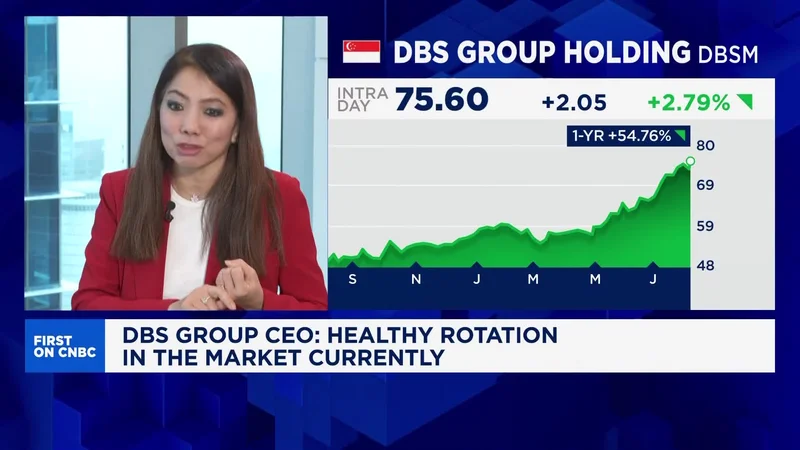
Image: Cnbc
Main Takeaway
DBS CEO Tan Su Shan says investors are reassessing AI financing risks, favoring hardware businesses with proven earnings while banks impose greater discipline on expansion.
Jump to Key PointsSummary
AI financing enters a stricter phase
AI financing is entering a more disciplined phase as investors reassess the risks tied to data centers, computing infrastructure and software ventures, DBS CEO Tan Su Shan said. The repricing reflects concern over who carries the cost of the AI buildout and whether spending will produce durable cash flows. Bloomberg described the shift as a market reassessment that could tighten financing standards, while CNBC reported Tan’s view that hardware companies have emerged as the clearest winners because they generate genuine earnings.
That distinction matters for banks. Credit providers must evaluate the borrowers funding AI infrastructure, the customers buying capacity and the revenues supporting the resulting debt. Rising scrutiny also places more weight on power availability, supply chains and demand forecasts, issues Tan has linked to inflation and infrastructure constraints. The financing cycle is therefore moving from enthusiasm around AI exposure toward evidence of repayment capacity and operating returns.
Hardware leads the earnings test
Hardware companies currently provide the strongest financial proof within the AI economy, according to Tan’s comments to CNBC. Chipmakers, server suppliers and infrastructure firms benefit from immediate demand as businesses and governments expand computing capacity. Their revenue is easier to identify than the future monetization of many AI applications, giving lenders and investors a clearer basis for assessing risk.
The advantage comes with exposure to concentrated demand and expensive infrastructure. AI facilities require semiconductors, electricity, cooling systems and resilient networks, while supply disruptions and energy constraints can raise costs across the chain. Tan has urged companies to build more intentional and resilient supply networks, linking the AI investment boom to broader trade and inflation pressures. DBS’s own technology strategy reflects the same divide: the bank is scaling practical internal uses while watching the economics of the infrastructure supporting the sector.
DBS turns AI into bank operations
DBS is applying AI across hundreds of use cases and says its AI and data analytics initiatives generated about $1 billion, according to coverage of the bank’s strategy. The programs span operational efficiency, customer services, risk management and decision support. That experience gives Tan a direct view of AI as an operating investment rather than only a market theme.
The bank is also preparing for agentic AI systems that can perform multistep tasks with greater autonomy. DBS has described agentic AI as part of its transformation, while broader discussions around gen AI banking emphasize combining automation with customer trust and human judgment. The approach supports a measured financing argument: AI projects should demonstrate concrete productivity, revenue or risk benefits before they receive the same confidence as established businesses. DBS is pairing that effort with expansion in tokenization, cross-border finance and digital assets, areas where controls and execution remain central.
Risk extends beyond balance sheets
AI creates risks that reach beyond loan performance. Cybersecurity is the issue Tan has identified as keeping her awake, with attacks increasingly tied to geopolitical conflict and advanced technology. Financial institutions face threats to customer data, payment systems and automated decision processes as they connect more operations to AI-enabled tools.
That security concern reinforces the case for disciplined deployment. Banks must test models, limit permissions, preserve audit trails and keep recovery plans ready when automated systems fail or are attacked. Geopolitical fragmentation adds another layer through tariffs, foreign-exchange volatility and shifting trade routes. DBS is positioning Singapore and Hong Kong as distinct growth engines while navigating those pressures, making technology spending inseparable from resilience planning. The cost of an AI system includes defense, oversight and continuity, not just chips and software.
What lenders will watch next
Lenders will focus on cash generation, customer demand, power access and the structure of AI-related debt as the market reprices risk. Businesses with identifiable earnings and diversified customers will have a stronger case than projects dependent on continuing capital inflows. Infrastructure financing will also face closer review of utilization rates, energy contracts and supply-chain exposure.
For DBS, the next test is whether internal AI gains continue while the bank preserves controls around agentic systems, cybersecurity and digital assets. Its reported $1 billion contribution from AI and analytics provides a benchmark for measuring results, but investors will still distinguish realized benefits from long-term promises. The broader banking sector is entering a phase where AI adoption remains active, yet financing follows proof.
The broader market signal
Tan’s warning signals a shift in how financial institutions price the AI buildout. Capital remains available for computing, chips and proven enterprise applications, but the terms will reflect execution risk, infrastructure costs and the distance between investment and earnings. That pressure favors companies able to show revenue today while forcing newer businesses to explain how their models become economically sustainable.
The result is a more selective AI economy. DBS is using AI to improve a large operating business, while its leadership is pressing investors to examine who absorbs downside risk across the financing chain. As banks apply that standard to borrowers, the next stage of AI growth will be judged less by spending totals and more by earnings, security and resilience.
Key Points
DBS CEO Tan Su Shan says AI financing risks are being repriced around earnings and downside exposure.
Hardware companies lead AI winners because chips and infrastructure businesses generate measurable revenue today.
DBS says AI and data analytics initiatives generated about $1 billion across hundreds of use cases.
Agentic AI expansion raises new requirements for cybersecurity, governance, auditability and operational resilience.
Energy constraints and supply-chain disruption are increasing costs and risks across AI infrastructure financing.
Questions Answered
DBS CEO Tan Su Shan said markets are repricing risks around AI-related investments and demanding greater financing discipline. She emphasized the importance of identifying who bears costs and downside exposure across the AI buildout.
DBS CEO Tan Su Shan identified AI hardware companies as the biggest winners so far because they generate genuine earnings. Their revenue provides clearer evidence for investors and lenders than many early-stage AI applications.
DBS says its AI and data analytics initiatives generated about $1 billion. The bank has applied AI across hundreds of use cases spanning operations, customer services, risk management and decision support.
DBS CEO Tan Su Shan views cybersecurity as a major concern because attacks can disrupt financial systems, expose data and exploit increasingly automated operations. She connects cyber threats with geopolitical conflict and advances in AI.
AI lending and investment will face closer scrutiny of cash flow, customer demand, power access, utilization and debt structures. Companies with proven earnings and resilient infrastructure will receive stronger consideration than projects dependent on continued capital inflows.
Source Reliability
50% of sources are highly trusted · Avg reliability: 82
Go deeper with Organic Intel
Simple AI systems for your life, work, and business. Each one includes copyable prompts, guides, and downloadable resources.
Explore Systems