Chinese Military-Linked Labs Target Nvidia H200 Chips Despite US Export Bans
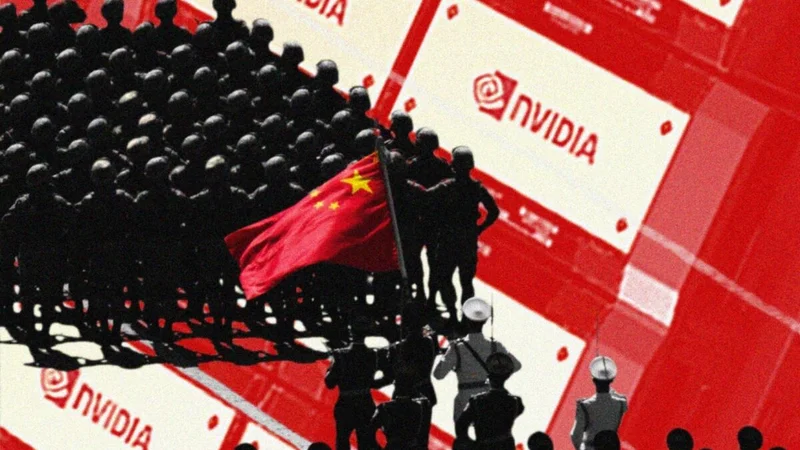
Image: Bloomberg AI
Main Takeaway
Seven Chinese defense-linked universities seek Nvidia H200 chips, testing US export controls.
Jump to Key PointsSummary
How military-linked labs are accessing restricted chips
At least seven Chinese universities that support the country's armed forces and defense industry are seeking access to Nvidia's H200 chips, the most powerful artificial intelligence processors the company makes. Bloomberg reports that these institutions, which have direct ties to China's military and defense sectors, are attempting to acquire hardware that is explicitly restricted under US export controls.
The H200 is Nvidia's most advanced data center GPU, designed for training and running large AI models. Its sale to Chinese entities has been banned by the US government as part of broader efforts to limit China's military AI capabilities. The fact that these universities are openly pursuing the chips suggests either a gap in enforcement or a belief that alternative procurement channels remain viable.
Why the H200 matters for military applications
The H200 represents a significant leap in AI computing power, with faster memory and greater bandwidth than its predecessor, the H100. For military applications, this translates into faster development of autonomous systems, improved surveillance analysis, and more sophisticated command-and-control algorithms. The New York Times notes that Chinese military entities have sought Nvidia chips for years, indicating a persistent gap between domestic Chinese chip capabilities and what's available from US suppliers.
Nvidia has repeatedly stated it complies with all applicable export controls. However, the company's chips have historically found their way to restricted end users through third-party resellers, cloud computing arrangements, and academic partnerships. The university pathway is particularly difficult to police because academic research often falls into gray areas under current regulations.
Political pressure on the Trump administration
US senators have criticized the Trump administration for what they view as insufficient enforcement of AI chip export restrictions. The Straits Times reports that lawmakers are blasting the administration for allowing AI chips to be sent overseas despite clear national security concerns. This political pressure adds another dimension to the story, suggesting that export control policy has become a partisan flashpoint.
The criticism reflects broader anxiety in Washington about whether current regulatory frameworks can keep pace with the speed of technological development and the creativity of procurement networks. Military applications of AI are seen as a zero-sum competition between the US and China, making any perceived laxity in enforcement politically explosive.
What export control gaps this exposes
The Council on Foreign Relations has analyzed the consequences of potential H200 exports to China, highlighting systemic weaknesses in how technology transfer is monitored. Current regulations rely heavily on end-user certifications and voluntary compliance by companies, which creates obvious incentives for misrepresentation. Academic institutions, in particular, can claim civilian research purposes while conducting work with direct military applications.
The CFR analysis suggests that without more robust verification mechanisms and steeper penalties for violations, restricted chips will continue to flow to Chinese military end users through indirect channels. This is not a new problem, but the scale and sophistication of the H200 make it particularly consequential.
How this fits into the broader US-China tech rivalry
This incident is the latest chapter in an escalating technological competition between the US and China. Japan Times coverage contextualizes the chip pursuit within China's broader strategy to achieve AI self-sufficiency by 2030. While Chinese firms like Huawei have developed domestic alternatives, they remain generations behind Nvidia in performance for the most demanding AI workloads.
The university pathway is especially sensitive because it touches on the tension between scientific openness and national security. Cutting off all academic collaboration would harm US interests in other ways, but maintaining it creates obvious vulnerabilities. Policymakers have struggled to strike the right balance, and this case illustrates how that ambiguity gets exploited.
What happens next for enforcement policy
The revelation that military-linked Chinese labs are actively seeking H200 chips is likely to accelerate policy changes. Industry watchers expect the Trump administration to face renewed pressure to close loopholes in academic and cloud-based chip access. Potential measures include stricter licensing requirements, enhanced due diligence obligations for resellers, and expanded definitions of military end users.
Nvidia finds itself in a familiar position: caught between commercial interests in the Chinese market and regulatory constraints that limit its ability to serve that market. The company's stock has proven sensitive to export control news, and any tightening would further constrain its revenue from China, which has already declined significantly under existing restrictions. How Nvidia and its peers adapt to an increasingly fragmented global market for advanced semiconductors will shape the industry's trajectory for years.
Key Points
Seven Chinese defense-linked universities actively pursuing banned Nvidia H200 chips
H200 is Nvidia's most powerful AI processor, restricted under US export controls
Senators criticize Trump administration for weak enforcement of chip restrictions
Academic partnerships create enforcement gaps due to dual-use research ambiguity
Incident intensifies pressure to tighten export control loopholes
Questions Answered
The H200 is Nvidia's most advanced data center GPU, offering superior memory bandwidth and processing power for training large AI models, with direct applications in military autonomous systems and surveillance.
Attempting to acquire restricted chips violates US export controls, though enforcement depends on the specific transaction method and whether intermediaries are involved.
Common channels include third-party resellers, cloud computing arrangements, academic partnerships, and shell companies that obscure the true end user.
Nvidia states it complies with all applicable export controls and does not sell restricted chips directly to military end users in China.
Yes, the incident is likely to accelerate policy changes including stricter licensing, enhanced reseller due diligence, and expanded definitions of military end users.
Source Reliability
100% of sources are highly trusted · Avg reliability: 89
Go deeper with Organic Intel
Simple AI systems for your life, work, and business. Each one includes copyable prompts, guides, and downloadable resources.
Explore Systems