China Unveils $295 Billion Plan to Build Nationwide AI Data Center Network
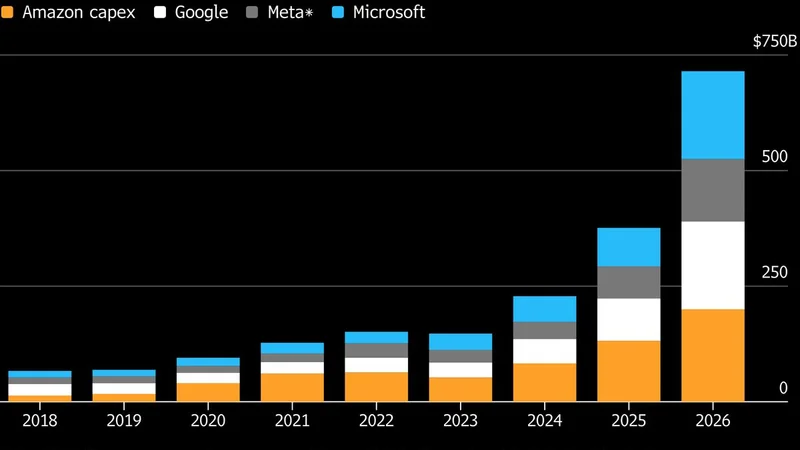
Image: Bloomberg AI
Main Takeaway
China plans to spend 2 trillion yuan on data centers over five years to surpass the US in artificial intelligence.
Jump to Key PointsSummary
China's massive AI infrastructure bet
China is preparing to invest approximately 2 trillion yuan ($295 billion) over the next five years to construct data centers across the country, according to Bloomberg. The spending plan represents one of the largest state-directed technology buildouts in history, designed to propel China's domestic AI sector and close the gap with American technological leadership. The scale of the investment signals Beijing's determination to treat artificial intelligence as a strategic priority on par with previous national initiatives in nuclear weapons and space exploration.
The funding mechanism and specific allocation across provinces remain unclear, though the plan reportedly involves coordination between central government directives and local implementation. Bloomberg's Neil Campling, reporting on Bloomberg Television, noted the figure underscores how China views AI infrastructure as foundational economic infrastructure rather than optional commercial development. Previous Chinese industrial policy, such as the 2017 New Generation Artificial Intelligence Development Plan translated by Stanford's DigiChina project, established the bureaucratic architecture for such centralized technology drives. That earlier plan set targets for China to become the world leader in AI by 2030, making this $295 billion commitment a late but substantial down payment on that ambition.
Why chip constraints still matter
The spending commitment does not resolve China's fundamental semiconductor bottleneck. A commentator identified as Teortaxes, cited by Digg, argued that capital alone cannot overcome China's chip constraints, the specialized processors that power advanced AI systems. This critique points to the persistent gap between infrastructure investment and actual computational capability, a tension that has defined China's tech sector since US export controls tightened in 2022 and 2023.
Data centers without advanced GPUs or domestically produced alternatives remain expensive warehouses. China's chip fabrication capabilities, while improving through firms like SMIC, still lag behind TSMC and Samsung at the most advanced process nodes. The $295 billion could fund concrete and cooling systems, but not easily the lithography equipment now restricted by multilateral export controls. This creates a potential scenario where China builds world-class facilities that run on second-tier silicon, capping the sophistication of the AI models they can train. The investment thus becomes a test of whether infrastructure scale can compensate for component quality.
How this compares to US AI spending
The announced figure dwarfs private American data center investment in absolute terms, though direct comparison is complicated by differing economic structures. US AI infrastructure spending flows primarily through cloud providers, Amazon, Microsoft, and Google, which collectively planned approximately $100 billion in capital expenditures for 2024 alone. China's state-directed approach concentrates decision-making but may sacrifice the market feedback mechanisms that redirect capital toward productive uses.
Bloomberg's reporting frames the plan explicitly in competitive terms, as fueling Beijing's ambition to surpass the US in a potentially transformative technology. The Top500 supercomputing news outlet contextualized China's broader AI ambitions within this global race narrative. However, the US maintains advantages in foundational model development, chip design, and the venture capital ecosystem that seeds innovation. China's bet rests on the theory that infrastructure abundance will eventually attract or generate the talent and algorithms to match American capabilities. Whether that theory holds has become the central question in assessing global AI competition.
Implementation risks and historical patterns
China's track record with massive technology plans is mixed. The 2017 AI plan, analyzed by Stanford's DigiChina and MacroPolo's archive, established impressive bureaucratic coordination but produced uneven results. Some targets were met through concentrated effort; others revealed the limits of central planning in fast-moving technical fields. MacroPolo's research specifically examined how implementation, not just aspiration, determines outcomes in Chinese industrial policy.
Local governments have incentives to claim AI investment funds while diverting resources to real estate or other priorities. The five-year timeline for this data center plan coincides with political cycles that may prioritize ribbon-cutting over operational efficiency. Past infrastructure binges in China produced ghost cities and empty industrial parks alongside genuine economic transformation. The AI buildout risks similar misallocation if provincial officials are measured by construction starts rather than computational output or model performance.
What this means for global AI supply chains
The construction surge will reshape demand for construction materials, cooling technology, and electrical equipment, with ripple effects across global supply chains. Chinese firms in these sectors stand to benefit directly. The plan also intensifies competition for limited supplies of AI chips that do reach China, potentially driving premium pricing in gray-market transactions and accelerating domestic substitution efforts.
For international technology firms, the buildout creates both opportunity and peril. Equipment suppliers may find lucrative contracts, but geopolitical tensions increasingly constrain which companies can participate. The investment signals that China anticipates a prolonged technological competition rather than détente, suggesting export controls and countermeasures will persist. The $295 billion commitment effectively locks in a multi-year cycle of infrastructure competition that will influence everything from energy demand to rare earth pricing.
What happens next
Specific project approvals and regional allocation of the $295 billion will provide early signals of implementation seriousness. Observers should watch for whether spending matches announced timelines or follows the pattern of previous plans that front-loaded announcements and back-loaded actual expenditure. The first major data center completions, expected within 18-24 months, will reveal whether quality matches quantity.
The chip constraint question will likely intensify. If China cannot source sufficient advanced processors, the government faces a choice between accepting second-tier AI capabilities or dramatically accelerating domestic semiconductor investment beyond already substantial commitments. Either outcome reshapes the competitive landscape. The plan also sets up a natural test of industrial policy efficacy that economists and policymakers worldwide will study, whatever the result.
Key Points
China commits $295 billion over five years to build nationwide AI data center infrastructure.
The investment aims to close China's AI technology gap with the United States by 2030.
Chip export constraints limit China's access to advanced processors despite massive infrastructure spending.
State-directed allocation differs from US market-driven cloud provider capital expenditure models.
Implementation risks include historical misallocation and local government incentive problems.
Questions Answered
China plans to spend approximately 2 trillion yuan, or $295 billion, over the next five years. Bloomberg first reported the figure, which covers nationwide data center construction to support domestic AI development.
US and allied export controls restrict China's access to advanced AI processors from Nvidia and other firms. Domestic alternatives from SMIC and others remain behind leading process nodes, creating a supply constraint that money alone cannot immediately solve.
The $295 billion five-year commitment exceeds annual capital expenditure by individual US cloud providers, though American firms Amazon, Microsoft, and Google collectively invest comparable amounts through market-driven decisions rather than central planning.
Historical patterns of Chinese industrial policy show mixed results, with some targets met and others revealing implementation gaps. Local governments may prioritize construction metrics over actual AI capability, and chip constraints may leave new data centers underutilized or running inferior hardware.
Major completions are expected within 18 to 24 months based on typical construction timelines for large-scale facilities. The pace of actual deployment will indicate whether announced funding translates into operational infrastructure.
Source Reliability
43% of sources are established · Avg reliability: 72
Go deeper with Organic Intel
Simple AI systems for your life, work, and business. Each one includes copyable prompts, guides, and downloadable resources.
Explore Systems