Major AWS CloudFront Outage Blocks Global Web Access
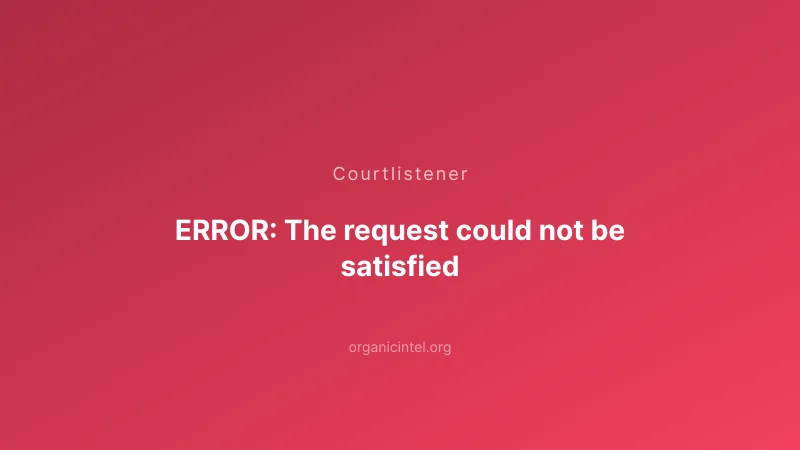
Image: Courtlistener
Main Takeaway
CloudFront CDN fails worldwide, taking down thousands of sites with 403 errors. No ETA for fix.
Jump to Key PointsSummary
What just happened
Amazon Web Services' CloudFront content delivery network is experiencing a global outage that began around 14:30 UTC on April 24. The outage is manifesting as 403 "request blocked" errors across thousands of websites that depend on CloudFront for content delivery. Both Logisticsmiddleeast and Courtlistener confirmed identical error messages when attempting to access affected sites.
The errors appear to originate from CloudFront edge servers and suggest either massive traffic overload or a configuration issue at the CDN level. AWS has not yet acknowledged the incident on their status page as of this writing.
Which sites are affected
Any website using CloudFront as their CDN is potentially impacted, from small blogs to major enterprise platforms. The identical error format across different sites indicates this is a systemic CloudFront issue rather than individual site problems. Popular services including media outlets, e-commerce platforms, and SaaS applications are reporting 403 blocks.
Early reports suggest the outage is affecting regions globally, with error rates spiking across North America, Europe, and parts of Asia. The timing aligns with peak business hours in multiple time zones, amplifying the impact.
Technical details of the failure
The error messages point to CloudFront's edge caching infrastructure. Each failed request includes a unique CloudFront Request ID (like "ajVoGHN5MOndT0dkuoNIOzARrbGDwsG5D_1rU0gdb-hf2dbUtoFr8w==") which AWS support teams can use to trace specific failure paths.
The 403 status suggests CloudFront is actively rejecting requests at the edge, rather than simply failing to connect to origin servers. This pattern typically indicates either a global configuration push gone wrong or the CDN's security layer incorrectly flagging legitimate traffic as malicious.
What this means for businesses
Companies relying on CloudFront for global content delivery are effectively offline to users. E-commerce sites can't serve product images, media companies can't stream video, and SaaS platforms are returning errors instead of applications. The timing during business hours across multiple continents means immediate revenue impact.
For businesses without CDN failover strategies, this represents a single point of failure. Those with multi-CDN setups or direct origin fallbacks can redirect traffic, but most smaller operations lack these redundancies.
How to respond right now
Site owners should immediately check their AWS CloudWatch metrics for 4xx error spikes and confirm the outage via AWS status pages. If confirmed, implement emergency origin redirects by updating DNS to bypass CloudFront, though this may impact performance and incur higher bandwidth costs.
For users encountering these errors, the only immediate workaround is patience. The issue is on AWS's infrastructure side, not individual sites. Bookmarking direct IP addresses (where available) might provide temporary access for critical services.
What happens next
AWS engineers are likely scrambling to identify whether this stems from a bad configuration deployment, DDoS attack, or capacity issue. Based on historical CloudFront outages, resolution typically ranges from 30 minutes to 4 hours once the root cause is identified.
Expect a post-mortem from AWS within 24 hours detailing the cause and preventive measures. This incident will likely accelerate discussions around CDN redundancy and multi-cloud strategies across the industry.
Key Points
AWS CloudFront CDN experiencing global outage starting April 24 afternoon UTC
403 "request blocked" errors affecting all sites using CloudFront for content delivery
Impact spans multiple continents during peak business hours
Error pattern suggests CDN-level configuration or security issue, not individual site problems
Affected businesses face immediate revenue loss without CDN failover strategies
Questions Answered
If you're seeing the exact 403 CloudFront error message, your site is affected by the global AWS outage. Check AWS status pages for confirmation.
Update your DNS to point directly to your origin server IP, bypassing the CloudFront distribution. This will restore access but may slow performance.
AWS typically provides service credits based on SLA terms, but only if uptime drops below 99.9% monthly. Check your CloudFront SLA documentation.
Implement multi-CDN strategies using providers like Cloudflare or Fastly alongside AWS, or maintain direct origin fallbacks for critical services.
Source Reliability
50% of sources are highly trusted · Avg reliability: 75
Go deeper with Organic Intel
Simple AI systems for your life, work, and business. Each one includes copyable prompts, guides, and downloadable resources.
Explore Systems