Anthropic brings Claude's Opus and Sonnet models to voice mode, moving beyond quick answers into complex conversations
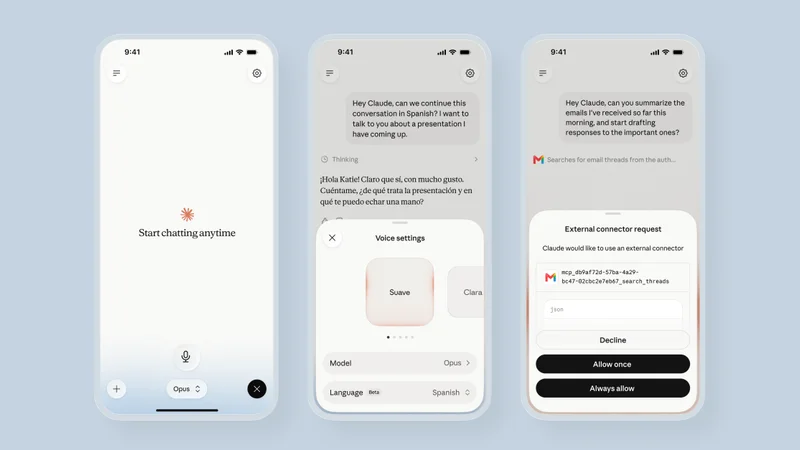
Image: The Verge AI
Main Takeaway
Anthropic expanded Claude's voice mode on Thursday to support Opus and Sonnet models alongside Haiku, enabling longer, more complex spoken interactions.
Jump to Key PointsSummary
What changed in Claude's voice mode
Anthropic announced Thursday that Claude's voice mode now supports its more powerful Opus and Sonnet models, breaking out of the lightweight Haiku-only constraint that defined the feature since its beta launch earlier this year. Until now, anyone using Claude's voice interface was locked into Haiku, the company's fastest but least capable model, which delivered quick responses but struggled with complex reasoning or sustained back-and-forth. The update lets users choose between Opus, Sonnet, and Haiku directly from the voice interface.
According to TechCrunch, the voice mode defaults to the fastest version of whichever model the user last employed in text chat. That means if someone was working with Opus in a typed conversation, voice mode picks up Opus automatically, rather than forcing a downgrade. The Verge reports the expansion also extends Claude's reach into third-party apps like Gmail, Slack, and Canva, signaling a broader push to make voice interaction a first-class interface across productivity workflows, not just a standalone chatbot feature.
How the model selection works in practice
Anthropic tied voice mode model selection to the user's recent text chat history, a design choice that sidesteps the friction of manual switching mid-conversation. TechCrunch notes that the system picks up the last model used and runs its fastest variant by default, which means Opus in voice mode operates in a speed-optimized configuration rather than its full deliberative mode. This keeps latency low while preserving enough reasoning depth for tasks that Haiku couldn't handle, like drafting emails or rescheduling meetings through spoken instruction.
Cryptobriefing adds that the update includes a refreshed user interface with a model selector and glow effects, making the model-switching capability visually apparent rather than buried in settings. The combination of UI changes and automatic model inheritance suggests Anthropic is treating voice as a persistent modality that should feel continuous with text interactions, not a separate stripped-down experience. For users who bounce between quick factual queries and deeper analytical work, the handoff between models now happens without breaking conversational flow.
Why this matters in the voice AI race
The timing puts Anthropic directly in competition with OpenAI's recent voice model refresh. TechCrunch frames the update as Anthropic's countermove, coming weeks after OpenAI released a new family of conversational models and updated ChatGPT's voice mode for more natural live conversations. Where OpenAI focused on emotional expressiveness and real-time responsiveness, Anthropic is betting on model capability depth: letting users bring Opus's reasoning power to spoken interactions rather than optimizing primarily for conversational feel.
Pymnts reports that Anthropic is systematically adding voice mode across its assistant ecosystem, positioning Claude as a multimodal tool rather than a text-first chatbot with voice bolted on. The inclusion of Opus, Anthropic's most capable model known for nuanced analysis and cybersecurity applications, signals that the company sees voice as a serious productivity interface, not just a convenience feature for hands-free quick questions. This shifts the competitive axis from "who sounds most human" to "who can actually do complex work through speech."
What Claude Code's voice capability adds
A parallel announcement covered by TechCrunch reveals that Claude Code, Anthropic's developer-focused coding assistant, is also getting voice mode capability. This extends voice interaction into software development workflows, where spoken commands could accelerate code generation, debugging queries, and project scaffolding without breaking keyboard focus. The move mirrors broader industry interest in voice-driven developer tools, though Anthropic hasn't detailed the specific command vocabulary or IDE integrations yet.
Bringing voice to Claude Code alongside the consumer-facing Opus and Sonnet expansion suggests a unified strategy: Anthropic wants voice to permeate every Claude surface, from casual chat to professional coding environments. For developers already using Claude Code for complex refactoring or architecture decisions, voice input with Opus-level reasoning could reduce the friction of context-switching between thinking aloud and typing precise instructions.
The app integration play
The Verge highlights that voice mode's expansion isn't confined to Claude's native interface. Anthropic is extending voice capabilities into Gmail, Slack, and Canva, embedding spoken interaction directly into the tools where people already do their work. This moves Claude from a destination app to an ambient assistant that can draft emails, summarize Slack threads, or manipulate Canva designs through voice commands without leaving the host application.
This integration strategy mirrors what competitors have attempted with mixed success: making AI voice a utility layer across productivity suites rather than a separate experience. For Anthropic, the combination of stronger models plus app integrations addresses the core limitation of earlier voice assistants, which could answer questions but couldn't act on them in the software where answers need to become actions. The Slack and Gmail integrations in particular point toward enterprise workflows where voice-driven task completion could reduce the overhead of constant context-switching.
What happens next
Anthropic hasn't disclosed whether Opus and Sonnet voice support will remain free or eventually require a paid tier, though the company's existing pricing structure for API access to these models suggests premium features could follow. The rollout appears to be immediate for existing Claude users, with the updated interface and model selector surfacing automatically. TechCrunch reports that the voice mode picks the last text model used, so adoption should be seamless for anyone already working with Opus or Sonnet in typed conversations.
The broader trajectory points toward voice becoming a default interaction mode rather than an optional add-on. With Claude Code, productivity app integrations, and the full model family now speaking, Anthropic is building the infrastructure for a voice-first assistant that spans consumer and professional use cases. The unanswered question is latency: Opus's full reasoning mode is computationally intensive, and whether the speed-optimized voice variant preserves enough capability for genuinely complex spoken tasks remains to be tested in real-world use.
The competitive context and limitations
The update addresses a gap that had been widening since voice mode's initial Haiku-only launch. While Haiku excelled at rapid factual responses, users attempting sustained analytical conversations or multi-step task completion through voice hit the model's capability ceiling quickly. TechCrunch notes that the original voice mode "wasn't well suited for complex work," a limitation Anthropic is now explicitly tackling by bringing its most powerful models into spoken interactions.
OpenAI's recent voice model updates focused on conversational naturalness and emotional range, while Anthropic's approach emphasizes cognitive depth. Neither company has fully solved the latency-versus-capability tradeoff inherent in voice interfaces, where users expect near-instant responses but also want sophisticated reasoning. Anthropic's solution of using the fastest variant of each model is a pragmatic middle ground, though it leaves open the question of whether a speed-constrained Opus still outperforms a full-capability Sonnet for spoken tasks.
Key Points
Anthropic added Opus and Sonnet model support to Claude's voice mode, ending the Haiku-only limitation that defined the feature since launch.
Voice mode now defaults to the fastest variant of the model last used in text chat, creating seamless continuity between typed and spoken interactions.
The update extends Claude's voice capabilities into Gmail, Slack, and Canva, embedding spoken AI assistance directly into productivity applications.
Claude Code, Anthropic's developer-focused coding tool, also received voice mode capability, bringing spoken interaction to software development workflows.
The expansion positions Anthropic's reasoning-depth approach against OpenAI's recent voice model updates focused on conversational naturalness and emotional range.
Questions Answered
Claude's voice mode now supports Opus, Sonnet, and Haiku models. Previously, voice mode was limited to Haiku only. Users can select any of the three models, and the system defaults to the fastest variant of whichever model was last used in text chat.
Voice mode automatically picks up the last model the user employed in text chat and runs its fastest version by default. This means if someone was using Opus for typed conversations, voice mode starts with Opus rather than downgrading to Haiku. A visible model selector in the updated interface also allows manual switching.
Claude's voice mode now integrates with Gmail, Slack, and Canva, allowing users to draft emails, summarize Slack threads, or manipulate designs through spoken commands without leaving those applications. This extends Claude from a standalone chatbot into an ambient assistant across productivity tools.
Yes, Anthropic announced that Claude Code, its developer-focused coding assistant, now includes voice mode capability. This lets developers use spoken commands for code generation, debugging queries, and project tasks, though specific command vocabularies and IDE integrations haven't been detailed yet.
Anthropic's update focuses on bringing more powerful reasoning models to voice interactions, while OpenAI's recent voice refresh emphasized conversational naturalness and emotional expressiveness. Anthropic is betting that users want complex task completion through speech, not just more human-sounding conversation.
The rollout appears to be immediate for existing Claude users, with the updated interface and model selector surfacing automatically. Anthropic hasn't disclosed whether Opus and Sonnet voice support will remain free or eventually require a paid tier, though the company's existing pricing structure for API access to these models suggests premium features could follow.
Source Reliability
33% of sources are established · Avg reliability: 56
Go deeper with Organic Intel
Simple AI systems for your life, work, and business. Each one includes copyable prompts, guides, and downloadable resources.
Explore Systems