Alibaba Drops Qwen3.8-Max, a 2.4 Trillion Parameter Model It Claims Rivals Anthropic’s Claude Fable 5
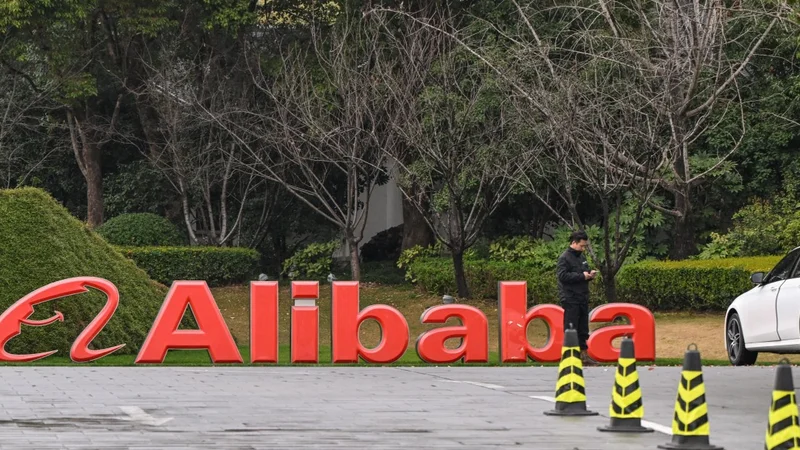
Image: The Verge AI
Main Takeaway
Alibaba released Qwen3.8-Max, a 2.4 trillion parameter flagship AI model with benchmark scores it claims rival Anthropic’s Claude Fable 5 and surpass OpenAI’s GPT-5.6 Sol, intensifying the US-China AI arms race.
Jump to Key PointsSummary
What Alibaba just released
Alibaba has officially previewed Qwen3.8-Max, describing it as its largest and most capable AI model to date. The model is a dense, 2.4 trillion parameter multimodal system that the Chinese tech giant claims can go head-to-head with the best frontier models from American labs. According to The Verge, Alibaba positions Qwen3.8-Max as a direct competitor to Anthropic’s Claude Fable 5 and OpenAI’s most advanced systems, as well as domestic rivals like Moonshot AI’s Kimi K3.
Bloomberg reports that the model’s benchmark scores place it alongside, and in some cases ahead of, global leaders. Siliconangle notes that Alibaba specifically claims Qwen3.8-Max is second only to Claude Fable 5 on certain evaluations, while Neowin reports it challenges GPT-5.6 Sol. The model is being made widely available to users immediately, signaling Alibaba’s intent to capture market share in the consumer and enterprise AI space simultaneously.
The trillion-parameter club gets a new member
Qwen3.8-Max isn’t just a marginal upgrade. It’s a 2.4 trillion-parameter behemoth, according to Techstrong and Marktechpost, making it one of the largest publicly known dense models. The scale matters because it demonstrates that Chinese labs can now train models at the extreme frontier, a capability once thought to be constrained by US export controls on advanced chips. Reuters confirms Alibaba’s framing of this as its most capable model, and the company’s decision to release it widely suggests it has solved significant engineering challenges to serve a model of this size at scale.
Independent reviews from sources like Eesel and Thomas-wiegold have already put the model through its paces, testing its multimodal capabilities across text, code, and visual reasoning tasks. While those reviews are early, the sheer parameter count puts Qwen3.8-Max in a weight class previously occupied only by a handful of US models. The model’s existence reshapes the conversation about who can build at the frontier.
The shifting balance of AI power
The release lands at a moment when the narrative around US AI supremacy is fracturing. An op-ed from CNBC argues bluntly that America’s lead over China in AI is all but gone. The Wall Street Journal reports that China is quickly eroding the US advantage, pointing to a pattern of accelerated releases from Alibaba, Moonshot, and other Chinese labs that are closing the gap faster than many policymakers anticipated.
The Belfer Center for Science and International Affairs frames the development within a broader strategic contest, asking whether China is beating the US to AI supremacy. Brookings weighs in with analysis of the competing AI strategies both nations are pursuing, noting that while the US still leads in foundational research and chip design, China’s ability to deploy and scale models like Qwen3.8-Max for mass adoption gives it a different kind of edge.
Benchmark claims and the competitive landscape
Alibaba’s benchmarking claims are bold. The company says Qwen3.8-Max rivals Anthropic’s Fable 5, and multiple sources, including Bloomberg and Siliconangle, note that Alibaba has published scores showing it surpasses OpenAI’s GPT-5.6 Sol on several key metrics. BenchLM provides a comparative pricing and performance analysis, showing Qwen3.8-Max positioned aggressively against both US and Chinese competitors. The model’s cost-to-performance ratio is a major part of the story, not just raw capability.
Finimize frames this as a heavyweight fight within China’s domestic AI scene, where Alibaba is now rattling rivals who thought they had breathing room. Yahoo Finance reports that the Qwen push is unsettling other Chinese AI firms, forcing them to accelerate their own roadmaps. The second-order effect is a compressed innovation cycle where Chinese labs are iterating faster, driven by both patriotic ambition and brutal local competition.
The US export control paradox
One of the most striking subtexts of the Qwen3.8-Max release is what it says about US export controls on advanced semiconductors. The Wall Street Journal and Brookings both highlight a paradox: restrictions designed to slow China’s AI progress appear to have accelerated domestic innovation and efficiency. Chinese labs have been forced to optimize software and training pipelines to do more with less, and Qwen3.8-Max is a product of that pressure.
The Belkin Center notes that some analysts now believe the chip controls have backfired, spurring China to develop alternative supply chains and novel training architectures that may ultimately prove more resilient. Alibaba’s ability to train and serve a 2.4 trillion parameter model at scale while under sanctions is itself a statement about the limits of hardware-based containment strategies.
What happens next
Alibaba has made Qwen3.8-Max broadly available, which means the next phase is real-world testing by developers, researchers, and enterprises. The model will be judged not just on benchmark scores but on reliability, safety, and practical utility in production environments. Bloomberg Law reports that the release raises regulatory questions, particularly around model access and safety evaluations, as US and European policymakers grapple with how to treat frontier models originating from China.
For the broader AI race, the Qwen3.8-Max release signals that the window for US companies to establish an unassailable lead is closing. The model is a proof point that Chinese labs can compete at the highest level, and the pace of iteration shows no signs of slowing. The next round of releases, from both US and Chinese labs, will determine whether this is a temporary parity or a permanent shift in the competitive landscape.
The developer and enterprise calculus
For builders and enterprises, Qwen3.8-Max represents a new option at the frontier tier. BenchLM’s pricing analysis shows Alibaba is positioning the model competitively, and its multimodal capabilities mean it can handle the same range of tasks as Claude Fable 5 or GPT-5.6 Sol. The availability of a model this powerful outside the US duopoly changes the procurement calculus for global enterprises, especially in markets where Alibaba Cloud already has a strong presence.
Developers testing the model, according to early reviews from Thomas-wiegold and Eesel, report strong performance on code generation and reasoning tasks, though they note the usual caveats about benchmark gaming and the gap between controlled evaluations and messy real-world use. The model’s true capability will become clearer as the community stress-tests it over the coming weeks.
Key Points
Alibaba released Qwen3.8-Max, a 2.4 trillion parameter model claiming performance rivaling Anthropic’s Claude Fable 5 and OpenAI’s GPT-5.6 Sol.
The model is Alibaba's largest and most capable, and it is being made widely available to users globally.
The Wall Street Journal and CNBC report that China is rapidly eroding America's lead in the global AI race.
The release challenges the effectiveness of US export controls, which may have accelerated Chinese domestic AI innovation.
Independent reviewers and benchmark platforms are now testing the model's real-world multimodal and reasoning capabilities.
Questions Answered
Qwen3.8-Max is Alibaba's latest flagship AI model, a 2.4 trillion parameter multimodal system that the company claims is its largest and most capable to date. It is designed to compete with frontier models from Anthropic and OpenAI.
Alibaba claims Qwen3.8-Max rivals Claude Fable 5 on key benchmarks, with some sources noting it positions as second only to that model on certain evaluations. Independent testing is ongoing to verify these claims.
Multiple reports from the Wall Street Journal, CNBC, and the Belfer Center indicate that China is quickly eroding the US lead in AI. The release of models like Qwen3.8-Max is cited as evidence that the gap has narrowed significantly.
The model's release suggests US export controls on advanced semiconductors have not prevented Chinese labs from building frontier-scale AI. Some analysts argue the controls have backfired by spurring domestic innovation and alternative training methods.
Alibaba is competing directly with US labs Anthropic and OpenAI, as well as domestic Chinese rivals like Moonshot AI and its Kimi K3 model. The release has unsettled other Chinese AI firms and accelerated the domestic arms race.
Source Reliability
44% of sources are highly trusted · Avg reliability: 73
Go deeper with Organic Intel
Simple AI systems for your life, work, and business. Each one includes copyable prompts, guides, and downloadable resources.
Explore Systems