Varda Space Lands First Commercial Pharma Deal to Manufacture Drugs in Orbit
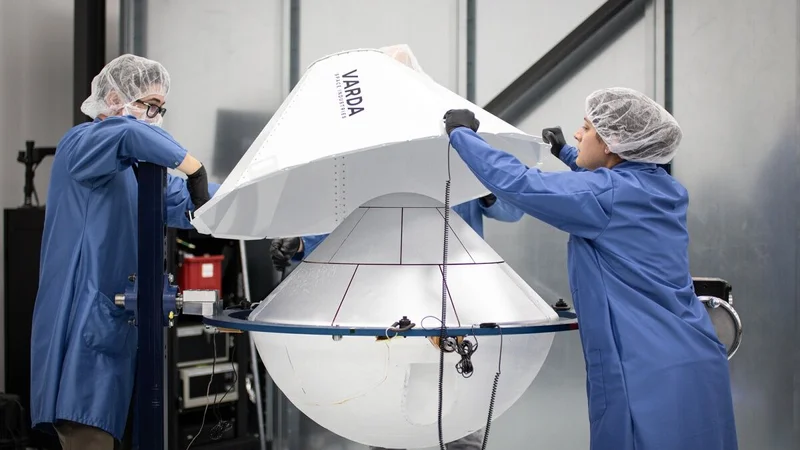
Image: Bloomberg AI
Main Takeaway
Varda Space partners with United Therapeutics to manufacture drugs in microgravity, building on its success crystallizing HIV medication in orbit.
Jump to Key PointsSummary
Why space factories might fix broken drugs
Drugs don't always behave on Earth. Gravity pulls crystals into imperfect shapes, proteins clump wrong, and molecules settle in ways that waste billions in R and D. Varda Space Industries, a startup based in El Segundo, California, is betting that manufacturing in orbit solves these problems. The company just signed United Therapeutics, its first commercial pharmaceutical partner, to develop improved formulations for rare pulmonary disease treatments aboard its orbital platform. This moves Varda from government-backed experiments toward repeatable commercial production. CEO Will Bruey frames the shift simply: "We're not in the space industry; we're in-space industry. Space is just another place to ship to." The deal follows Varda's successful crystallization of ritonavir, an HIV antiviral, proving microgravity can produce drug structures impossible on Earth.
The United Therapeutics collaboration is structured across multiple missions to low Earth orbit, each using Varda's manufacturing and reentry capsules. These are small spacecraft, not crewed stations, keeping costs far below International Space Station experiments. Varda recently raised 90 million dollars, giving it runway to scale this model. The company's pitch to pharma is specific: better crystal polymorphs, more stable proteins, and formulations that simply cannot form under Earth's gravity. For United Therapeutics, which focuses on rare diseases with limited treatment options, any improvement in drug stability or bioavailability justifies the orbital premium.
How microgravity changes molecular behavior
Crystals grow differently when gravity stops bossing them around. On Earth, sedimentation and convection create uneven conditions that trap impurities. In orbit, molecules diffuse more uniformly, allowing larger, more ordered structures to form. This matters enormously for pharmaceuticals, where a molecule's crystal form (its polymorph) determines everything from shelf stability to how well the body absorbs it. Varda's ritonavir mission demonstrated this directly: the HIV drug processed in microgravity showed structural properties that conventional manufacturing could not replicate.
Irish researchers at SSPC, the Research Ireland Centre for Pharmaceuticals, have been studying this phenomenon in collaboration with Varda. Their work examines how gravity influences small molecule properties both in space and through ground-based simulations. Polymorphism, the ability of a molecule to exist in multiple crystal forms, becomes controllable in ways that could transform both materials science and drug development. Some drug compounds have dozens of possible polymorphs, but only one or two work well clinically. The ability to selectively produce superior forms would be worth significant launch costs for high-value medications. Varda's platform aims to make this selection process routine rather than accidental.
The path from experiment to boring infrastructure
Varda's explicit goal is to make orbital manufacturing unremarkable. CEO Will Bruey told Yahoo Finance that within 10 years, multiple spacecraft per night could return pharmaceuticals from orbit, and within 15 to 20 years, sending workers to space for manufacturing could cost less than keeping them on Earth. These timelines sound aggressive, but they reflect Bruey's view that space access costs are collapsing while automation improves. The company is not selling rocket launches or astronaut experiences. It is selling a production location, no more exotic in its view than building a factory in Switzerland or Singapore.
This framing matters for investor and customer psychology. Previous space manufacturing experiments, including those on the International Space Station, were scientific curiosities funded by governments. They proved concepts but never scaled. Varda's bet is that dedicated, automated orbital platforms can cross the threshold to commercial viability. The United Therapeutics deal is the test case. If it succeeds, other pharma companies with high-value, structure-sensitive drugs will follow. If it fails, the entire orbital manufacturing sector faces a credibility crisis. Siemens Software has featured Varda on its startup podcast, suggesting industrial software players see potential in integrating orbital production into terrestrial supply chains.
What rare disease treatments gain from orbit
United Therapeutics specializes in conditions that affect small patient populations, where drug development costs are high and every formulation improvement matters. Pulmonary diseases, including pulmonary arterial hypertension, require precise drug delivery and stable formulations. Microgravity manufacturing could improve both. The companies' joint announcement emphasized this is the first collaboration focused specifically on space-based drug formulation with potential patient therapies, not just research. That distinction signals regulatory and commercial intent, not scientific exploration.
The economics hinge on value per gram. Orbital manufacturing costs thousands of dollars per kilogram to launch and return. Only drugs with sufficient value, complex structure requirements, and small physical mass make sense. Biologics, certain small molecules, and personalized therapies fit this profile. United Therapeutics' participation validates that at least one major pharma company has run the numbers and found them plausible. The Wall Street Journal's framing, asking whether space-made drugs could extend lifespan, stretches the immediate application but captures the long-term ambition: orbital manufacturing as a platform for medicines that simply cannot exist otherwise.
Who else is watching this bet
Varda's progress puts pressure on several categories of competitors and collaborators. Other space manufacturing startups, including Space Tango and BioServe, have conducted microgravity experiments but lack Varda's dedicated reentry capability. Traditional pharma manufacturers must now evaluate whether orbital production threatens or enhances their existing processes, likely starting with partnerships rather than in-house programs. Launch providers including SpaceX and emerging competitors stand to benefit if orbital manufacturing demand grows, though Varda's model minimizes launch frequency by maximizing production per mission.
Regulatory agencies face novel questions. The FDA has no established pathway for space-manufactured pharmaceuticals. Each drug will require specific approval, with the manufacturing location as a variable. Varda's early engagement with United Therapeutics, a company with existing approved products, suggests regulatory strategy is already underway. Insurance and liability frameworks for orbital production remain undeveloped. For now, the sector moves on commercial momentum and investor tolerance, not established rules. Varda's 90 million dollar funding round buys time to build both the technical and regulatory foundations before competitors catch up.
What happens if orbital pharma actually works
Success for Varda means normalized orbital manufacturing within five years, with multiple pharma contracts and regular reentry schedules. Failure means the ritonavir mission remains a one-off, cited in future retrospectives as a near-miss. The United Therapeutics deal is the pivot point. If the collaboration produces measurable improvements in drug formulation, the business case for microgravity manufacturing strengthens rapidly. If results are ambiguous, Varda must find other demonstration projects while capital lasts.
Bruey's timeline projections, while bold, serve a strategic purpose. They force the conversation away from whether orbital manufacturing works in principle to when it becomes routine. The space industry has seen many technologies promised and delayed. Varda's distinction is that it has already flown and returned product. The next 24 months will show whether that achievement scales to a business model. For patients with rare diseases, the upside is new treatment options that gravity-bound factories cannot produce. For the space economy, it is proof that orbit can generate value beyond communications and observation. Both outcomes depend on molecules behaving as predictably in space as Varda's investors hope.
Key Points
Varda Space signed United Therapeutics for commercial orbital drug manufacturing, its first pharma partnership
Previous ritonavir crystallization mission proved microgravity can create drug structures impossible on Earth
United Therapeutics collaboration targets rare pulmonary disease treatments across multiple orbital missions
CEO Will Bruey projects orbital manufacturing will become routine infrastructure within 10-15 years
Economic viability depends on high-value, small-mass drugs where formulation improvements justify launch costs
Questions Answered
In microgravity, molecules diffuse more uniformly without sedimentation and convection effects, allowing larger, more ordered crystal structures to form. This can produce drug polymorphs with better stability and bioavailability than Earth-made equivalents.
Previous experiments used the International Space Station and were government-funded research. Varda uses dedicated, automated orbital platforms with reentry capability, aiming for repeatable commercial production rather than one-off science missions.
Ritonavir, an HIV antiviral drug. The mission demonstrated that microgravity could produce structural properties that conventional manufacturing could not replicate.
Launch and return costs thousands of dollars per kilogram, so only high-value, small-mass drugs with complex structural requirements are currently viable. Biologics and certain small molecules for rare diseases fit this profile.
The FDA has no established approval pathway for space-manufactured drugs. Each product will require specific regulatory review with manufacturing location as a novel variable. Liability and insurance frameworks also remain undeveloped.
Source Reliability
38% of sources are highly trusted · Avg reliability: 71
Go deeper with Organic Intel
Simple AI systems for your life, work, and business. Each one includes copyable prompts, guides, and downloadable resources.
Explore Systems