Uber-Backed Lime Raises $174 Million in Nasdaq IPO at $1.6 Billion Valuation
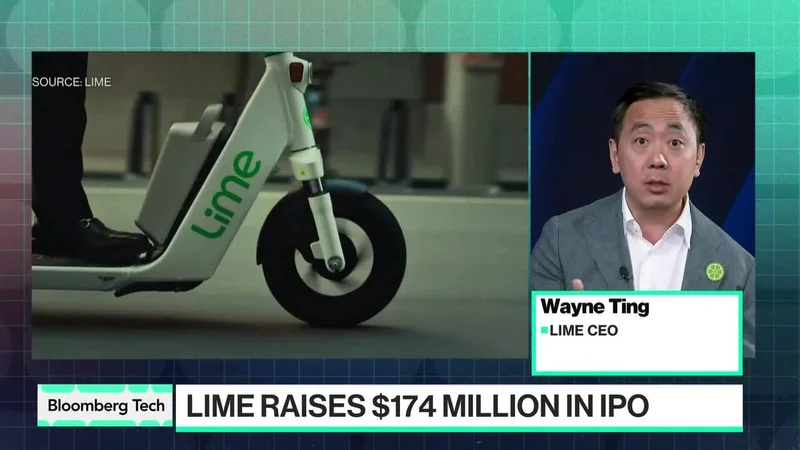
Image: Bloomberg AI
Main Takeaway
Lime priced its IPO at $25 per share, raising $174 million in a cautious market debut backed by Uber.
Jump to Key PointsSummary
Why Lime chose now for its market debut
Lime went public at a delicate moment for tech IPOs. The company priced 7 million shares at $25 each, hitting the midpoint of its marketed range and raising $174 million. That is a modest haul compared to the frothy valuations of 2021, but it signals that the IPO window has cracked open for select companies with credible paths to profitability. Lime CEO Wayne Ting has emphasized the company's operational discipline as a selling point to investors wary of cash-burning startups.
The timing is not accidental. After a nearly two-year drought in tech listings, underwriters and executives have been hunting for a receptive audience. Lime's decision to price conservatively suggests it read the room correctly: get the deal done, build a trading track record, and avoid the post-IPO collapses that have haunted recent debuts. According to Bloomberg, the pricing came after careful calibration with institutional investors who wanted evidence that Lime's economics had stabilized.
How Uber shaped the offering
Uber's presence looms large over this IPO. The ride-hailing giant is Lime's most prominent backer and strategic partner, having led previous funding rounds and integrated Lime scooters into its app. That relationship gave Lime credibility with investors who might otherwise have dismissed micromobility as a pandemic fad. Uber's backing also provided a ready-made distribution channel and a template for navigating regulatory complexity in cities worldwide.
The partnership cuts both ways, though. Uber's own financial health and strategic priorities directly influence how investors value Lime. When Uber reports earnings or shifts its micromobility strategy, Lime's stock will likely move in sympathy. CNBC notes that some investors viewed the Uber connection as a reason to participate, while others worried about over-dependence on a single large partner with its own shareholder pressures. TheNextWeb reports that Uber anchored the offering, meaning its continued support was likely a condition for other institutional commitments.
What the $1.6 billion valuation says about micromobility
Lime's $1.6 billion valuation is a comedown from the $2.4 billion it commanded in private markets in 2020, but it is still a meaningful number for a sector that many declared dead. The repricing reflects both the broader market correction and specific skepticism about scooter economics. Lime had to prove that its unit economics had improved since the pandemic, when ridership collapsed and competitors like Bird went bankrupt.
The company has pointed to its status as the largest remaining standalone micromobility operator in the U.S. as a competitive moat. With Bird's collapse and Spin's acquisition by Tier, Lime faces less direct competition domestically, though European operators like Dott and Tier remain active. Yahoo Finance notes that the roadshow initially targeted a higher $1.8 billion valuation and $181 million raise, suggesting Lime trimmed ambitions to ensure the deal cleared. That flexibility likely preserved the company's ability to access public capital markets again in the future.
Where the IPO money goes
Lime intends to use the proceeds to expand its fleet, invest in technology, and pursue selective acquisitions. The company has been pushing into electric bikes and exploring modular hardware that can swap between scooter and bike configurations. Capital efficiency is the watchword: Lime wants to demonstrate it can grow without repeating the destructive land-grab tactics that defined the 2018-2019 scooter wars.
Technology investment focuses on improving battery swap logistics and predictive maintenance, both critical to unit economics. Lime has also been developing in-house mapping and parking compliance tools to reduce regulatory friction with cities. These are not sexy investments, but they address the operational failures that killed earlier competitors. According to Fast Company, the Nasdaq listing gives Lime currency for potential deals in a consolidating industry where distressed assets remain available.
What happens next for Lime and micromobility IPOs
Lime's trading performance in coming weeks will be watched as a barometer for other venture-backed companies considering public listings. A stable or rising stock would embolden a backlog of tech companies that have delayed IPOs since 2022. A disappointing debut would reinforce the view that only the largest, most capital-efficient companies can access public markets currently.
The company must now deliver quarterly results that justify its valuation while managing investor expectations around seasonal ridership fluctuations. Winter quarters have historically been brutal for micromobility operators in temperate markets. Lime's ability to diversify revenue geographically and by vehicle type will determine whether it becomes a sustainable public company or follows Bird into restructuring. Moneycontrol notes that the $174 million raised provides roughly two years of runway at current burn rates, giving management limited time to prove the model works at scale.
Key Points
Lime priced its IPO at $25 per share, raising $174 million on the Nasdaq.
Uber served as Lime's anchor investor and strategic partner for the public debut.
The $1.6 billion valuation fell below earlier private market expectations of $1.8 billion.
Lime plans to invest IPO proceeds in fleet expansion, technology, and potential acquisitions.
The offering tests whether the tech IPO window has reopened for select profitable-path companies.
Questions Answered
Lime raised $174 million by pricing 7 million shares at $25 each. The amount matched the midpoint of the company's marketed range, according to Bloomberg.
Uber is Lime's largest strategic backer and anchored the offering, providing credibility with institutional investors. The ride-hailing giant also integrates Lime scooters into its app, creating a distribution advantage.
Lime has not publicly disclosed profitability at IPO, though management emphasized an improved path to sustainable unit economics. The company trimmed its valuation target from $1.8 billion to $1.6 billion to ensure the deal cleared.
Lime plans to expand its vehicle fleet, invest in battery and maintenance technology, and pursue selective acquisitions in a consolidating micromobility industry. The capital also provides roughly two years of runway at current operations.
Lime's debut suggests selective openings for companies with credible profitability paths, but does not indicate a broad tech IPO resurgence. Investors will watch Lime's trading performance to judge whether other delayed listings can follow.
Source Reliability
50% of sources are trusted · Avg reliability: 66
Go deeper with Organic Intel
Simple AI systems for your life, work, and business. Each one includes copyable prompts, guides, and downloadable resources.
Explore Systems