Spotify Will Label AI Personas and Remove Them From Music Recommendations Starting in September
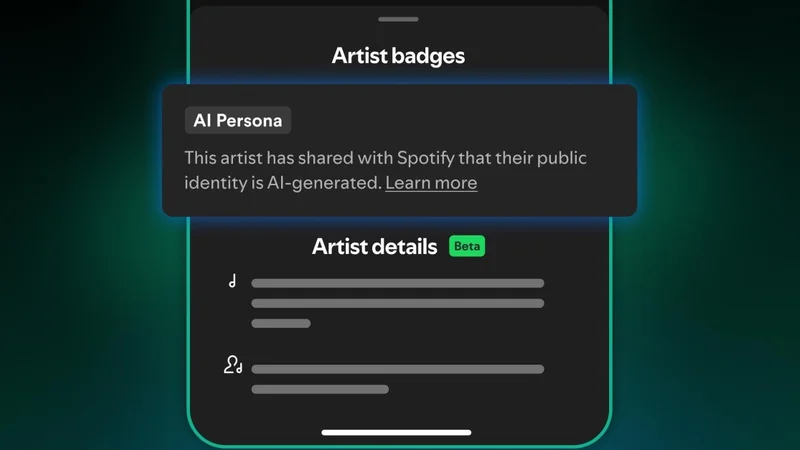
Image: The Verge AI
Main Takeaway
Spotify will begin labeling AI-generated artist identities and exclude them from recommendations as it responds to listener concerns about synthetic music and impersonation.
Jump to Key PointsSummary
Spotify’s recommendation policy changes
Spotify will begin labeling certain synthetic artist identities and excluding them from personalized recommendations in mid-September, according to The Verge AI and Bloomberg AI. The company’s “AI Persona” badge will identify an artist that does not represent a real person, while Spotify asks creators to disclose when music is generated with artificial intelligence.
The policy addresses a growing visibility problem for listeners. Spotify Community posts show users asking how to disable, filter, or report AI-generated songs, while NPR’s coverage frames the debate around why clear labeling has been difficult. The rollout gives Spotify a formal way to distinguish an artificial artist identity from a human performer without removing every AI-assisted recording from the service.
What the AI Persona label means
The “AI Persona” designation applies to an artist identity rather than automatically classifying every track containing AI-generated elements. Artists can self-identify as AI before Spotify conducts its own review, The Verge AI reports. That process places initial responsibility on creators and distributors, while leaving Spotify to assess whether a profile represents a real person.
Bloomberg AI describes the policy as a request for creators to label AI-generated songs. The distinction matters because generative tools can appear in different parts of production, including vocals, instrumentation, songwriting, or arrangement. The available reporting does not establish a complete threshold for labeling each use. Spotify Community discussions and NPR’s coverage show why users want a control that operates at the listening level, while Spotify’s approach focuses first on identity and recommendations.
Why recommendation exclusion matters
Removing AI Personas from recommendations gives Spotify a way to reduce their algorithmic reach without banning all synthetic music. The Verge AI reports that labeled profiles won’t appear in recommendation systems, a choice that directly affects playlists, discovery surfaces, and the mechanisms that can turn an obscure upload into a high-streaming track.
That distinction becomes significant amid concerns about spam and manufactured listening activity. The Cosmic Meta Digital report describes the broader policy change as an effort to label AI music and filter spam, while FOX 26 Houston reports that Spotify is removing AI-generated songs from the platform. Those accounts describe a wider enforcement effort, but the more specific reporting from The Verge AI centers on recommendation exclusion for AI Personas. The different descriptions leave the scope of removals unclear, especially for tracks that use AI tools without presenting a fictional artist.
Dead artists and impersonation concerns
Reports about AI-generated songs appearing on pages associated with deceased artists have intensified scrutiny of Spotify’s safeguards. Consequence reports that Spotify has allowed AI-generated songs on dead artists’ pages, while Bluntmag.com similarly alleges that synthetic songs were published under the names of deceased performers.
Those reports raise a separate issue from disclosure: attribution and authorization. A label can tell listeners that content is synthetic, but it doesn’t by itself establish whether an estate, rights holder, or artist approved the use of a name or vocal identity. Spotify Community posts asking how to report fake AI artists show that users are encountering the problem as a trust and moderation issue. The supplied reporting doesn’t provide a confirmed count of affected pages or explain how Spotify will resolve disputed impersonation claims.
The industry is standardizing disclosure
Spotify’s policy arrives as other platforms build their own AI disclosure systems. Music Business Worldwide reports that TikTok rolled out a new “AI-generated” label for creators while working on automatic detection, placing Spotify’s announcement within a broader shift toward machine-readable provenance and platform labeling.
The comparison also highlights Spotify’s chosen balance. TikTok’s reported effort emphasizes detection at scale, while Spotify’s announced system combines creator disclosure, platform review, artist-profile labeling, and recommendation limits. NPR’s coverage and Spotify Community discussions point to the user demand behind these changes: listeners want to know what they’re hearing and want practical ways to avoid unwanted synthetic content. Detection remains difficult because AI can be used selectively, and labels depend partly on accurate disclosure.
What happens after the rollout
Spotify’s mid-September rollout will test whether AI Persona labels are visible enough and whether recommendation exclusion meaningfully reduces unwanted exposure. The company will also need to explain how users can report misidentified profiles, how disputes are handled, and how it separates fictional AI artists from human artists using generative production tools.
The immediate effect will fall on creators, distributors, estates, and listeners. Creators gain a formal disclosure path but face reduced discovery when an identity is classified as an AI Persona. Listeners gain clearer signals, though the available reports don’t confirm a user-controlled filter for all AI-generated tracks. Spotify’s handling of dead-artist pages will remain a key measure of whether the policy addresses impersonation as well as algorithmic spam.
Key Points
Spotify will label AI Personas and exclude them from personalized music recommendations starting in mid-September.
Creators will be asked to disclose AI-generated songs before Spotify conducts its own review.
Spotify Community posts show users seeking filters, controls, and reporting tools for synthetic music.
Reports allege AI-generated songs appeared on pages associated with deceased artists.
TikTok’s AI labels and detection work place Spotify’s policy within a broader platform disclosure shift.
Questions Answered
Spotify’s AI Persona label identifies an artist profile that does not represent a real person. The Verge AI reports that the badge will appear across Spotify and that labeled profiles won’t be included in recommendations.
Spotify plans to begin rolling out AI Persona labels in mid-September. The Verge AI says the rollout will apply to artist profiles after creator disclosure and Spotify review.
Spotify’s announced policy doesn’t establish that every AI-generated song will be removed. Reports describe removals and spam filtering, while the clearest stated measure is excluding labeled AI Personas from recommendations.
Spotify will ask creators to label songs made with artificial intelligence. Artists can self-identify as AI before Spotify reviews whether the profile represents a real person.
Reports from Consequence and Bluntmag.com allege that AI-generated songs appeared on pages associated with deceased artists. The claims raise questions about estate approval, impersonation, metadata, and platform moderation.
Source Reliability
45% of sources are trusted · Avg reliability: 72
Go deeper with Organic Intel
Simple AI systems for your life, work, and business. Each one includes copyable prompts, guides, and downloadable resources.
Explore Systems