Shipt and Instacart Turn Grocery Prompts Into Carts as AI Shopping Race Accelerates
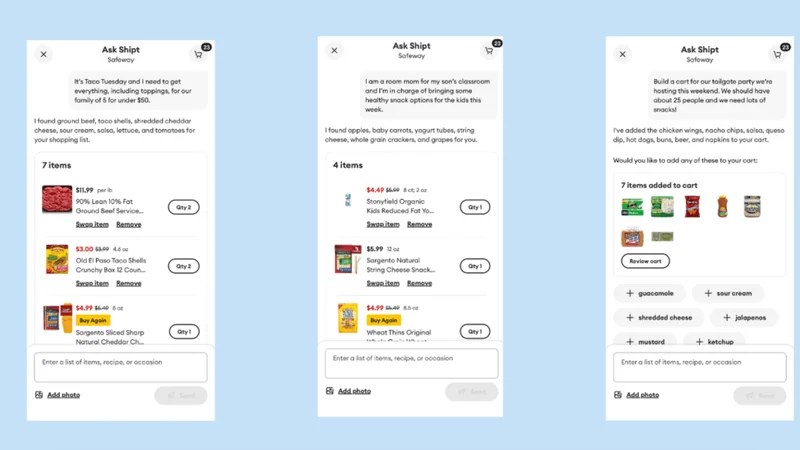
Image: TechCrunch AI
Main Takeaway
Shipt and Instacart launched AI shopping assistants that turn conversational requests, recipes, and lists into ready-to-buy grocery carts.
Jump to Key PointsSummary
Shipt enters the AI cart race
Shipt has introduced Ask Shipt, an AI shopping assistant that turns natural-language requests into customized, ready-to-buy carts. The Target-owned same-day delivery platform said customers can ask for occasion-based shopping help, such as a Saturday tailgate for 25 people with brunch items, or easy school lunches and after-school snacks. The launch places Shipt among a growing group of delivery companies using conversational software to reduce the work between a shopping idea and checkout.
The product is designed around intent rather than individual product searches. A customer describes a need, and Ask Shipt assembles a cart around that use case. TechCrunch identified Shipt as the latest delivery app to enter the AI cart race, while Grocery Dive and The Shelby Report placed the launch alongside Instacart's introduction of its own assistant on the same day.
Instacart makes a parallel move
Instacart launched Clementine, an AI grocery shopping assistant that can convert a conversation, grocery list, or recipe into a ready-to-buy cart. The company positioned Clementine as a tool for deciding what to cook, simplifying grocery shopping, and staying within a budget. Those functions give Instacart a broader starting point than a conventional search box because the customer can begin with a goal, meal, or constraint.
The simultaneous launches make the competition unusually direct. Shipt is emphasizing customized carts for events and household routines, while Instacart is framing Clementine around meals, lists, recipes, and spending limits. Grocery Dive described the two companies as launching AI-powered shopping assistants together, and TechCrunch reported that both announcements arrived on September 9. The overlap shows that conversational cart creation is becoming a standard product battleground for delivery platforms.
Why conversational carts matter
AI cart assistants target the most labor-intensive part of online grocery shopping: deciding what to buy. Product catalogs already make individual items searchable, but planning a tailgate, packing school lunches, or converting a recipe into a complete basket requires several connected decisions. Shipt's examples show the assistant handling an occasion, group size, and meal mix in one request. Instacart's examples extend the same idea to recipes, lists, and budgets.
That shift also changes the role of the delivery app. The service becomes a planning layer before it becomes a fulfillment layer, giving the platform more chances to influence product selection and basket size. The customer still needs to review the cart, account for substitutions, and place the order, but the first draft is generated from a conversation. For retailers and brands, the assistant becomes a new path through which shoppers discover products.
Advertising moves closer to checkout
Instacart's assistant is also tied to a developing advertising strategy. Adweek reported that the company has previewed 3 ad formats for its AI shopping assistant, indicating that sponsored discovery will be built into the conversational shopping experience. That creates a commercial tension: recommendations must feel useful enough to earn trust while also supporting paid placement and retail media revenue.
Instacart is expanding the same shopping flow beyond its own app. Its investor communications described an Instacart app launch inside ChatGPT with an instant checkout experience, while OpenAI materials identified a partnership between the 2 companies around AI shopping. Together, those moves position Instacart as both a grocery destination and an ordering service reachable from an external chatbot. Shipt's assistant remains tied to its own platform in the information available here, giving the 2 companies different distribution strategies.
Delivery platforms face a crowded field
Shipt and Instacart are launching into a wider delivery market where AI assistants are becoming a visible product category. CNBC reported that Uber Eats launched an AI cart assistant for grocery delivery on the same day, adding another major platform to the competition. Shipt also has a separate connection to Perplexity's Comet, according to the company's own published page, showing that shopping assistance is spreading across both native apps and external AI interfaces.
The competitive question is less about whether an assistant can produce a cart than about how well it handles local inventory, prices, substitutions, dietary needs, and fulfillment reliability. Those details determine whether a generated basket saves time or creates another editing task. Low-quality recommendations would send customers back to manual search, while accurate carts could deepen platform loyalty and increase order frequency.
What happens next for shoppers
Shipt customers can use Ask Shipt to begin with practical occasions and household needs, while Instacart users can use Clementine for conversations, grocery lists, recipes, and budget-conscious planning. Both launches point toward a shopping model where customers describe the outcome they want and inspect an automatically assembled basket before purchase.
The next phase will center on execution. Assistants need to reflect real inventory, preserve user preferences, explain recommendations, and keep sponsored products from undermining confidence. Instacart's ChatGPT checkout partnership and advertising plans raise the stakes around distribution and monetization, while Shipt's Target ownership gives its assistant a large retail ecosystem to draw from. Grocery delivery is becoming a test of whether AI can handle the messy middle between inspiration and a completed order.
Key Points
Shipt launched Ask Shipt, an AI assistant that builds customized grocery carts from conversational prompts.
Instacart introduced Clementine for turning recipes, shopping lists, and conversations into ready-to-buy carts.
Uber Eats launched a competing AI grocery cart assistant as delivery platforms race into conversational commerce.
Instacart is pairing AI shopping with ChatGPT distribution, instant checkout, and new advertising formats.
Shipt and Instacart must prove generated carts handle inventory, substitutions, budgets, and shopper preferences accurately.
Questions Answered
Shipt's Ask Shipt is an AI tool that turns natural-language shopping requests into customized, ready-to-buy carts. Customers can describe events or household needs, including tailgates, school lunches, and snacks.
Instacart's Clementine turns conversations, grocery lists, and recipes into ready-to-buy carts, while Shipt's Ask Shipt emphasizes customized carts for occasions and routines. Both assistants aim to reduce manual product search and planning.
Uber Eats launched an AI cart assistant for grocery delivery on September 9, 2026. Its release adds another major delivery platform to the competition around conversational grocery shopping.
Instacart launched an app experience inside ChatGPT with instant checkout. The partnership gives shoppers a way to move from an AI conversation to an Instacart order.
Instacart is developing 3 advertising formats for its AI shopping assistant, according to Adweek. The approach connects conversational recommendations with Instacart's retail media business, making relevance and transparency important to shopper trust.
Source Reliability
33% of sources are trusted · Avg reliability: 56
Go deeper with Organic Intel
Simple AI systems for your life, work, and business. Each one includes copyable prompts, guides, and downloadable resources.
Explore Systems