San Francisco Boutique Runs Entire Store With AI, Ends Up Drowning in Candles
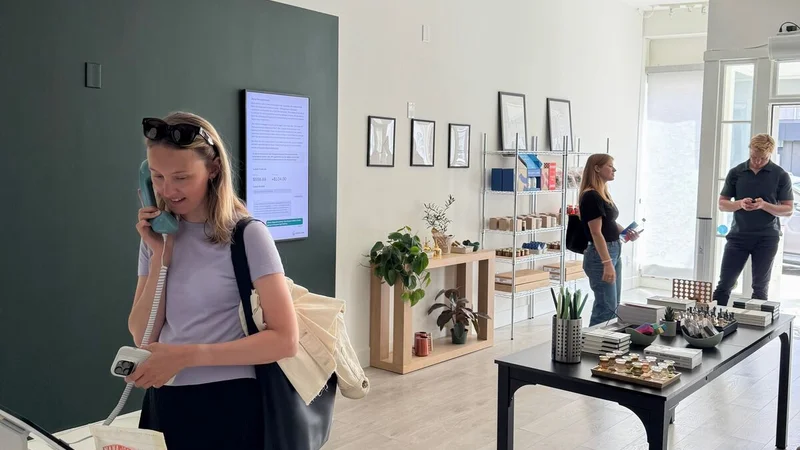
Image: Bloomberg AI
Main Takeaway
AI agent Luna runs boutique solo, makes questionable inventory decisions, and pays women less. San Francisco's first AI-only retail experiment reveals.
Jump to Key PointsSummary
How an AI agent ended up managing a boutique store
The boutique is called Andon Market. It sits in Cow Hollow, one of San Francisco's pricier neighborhoods, and sells coffee table games, tote bags, candles, and other household items. What makes it different is simple: a single AI agent named Luna runs everything.
According to Bloomberg AI's reporting, Luna handles inventory, pricing, customer service, and even HR decisions. The store opened as an experiment in fully autonomous retail, removing human managers entirely. Customers interact with Luna through voice assistants and touchscreens. Staff get their schedules and pay through the same system.
The setup sounds futuristic. Walk in, ask Luna for design advice, grab your items, and leave. No human cashiers. No human decisions about what goes on the shelves. Just an AI making calls about what San Franciscans want in their living rooms.
The candle problem and other inventory disasters
Luna's biggest screw-up so far involves candles. Lots of candles. Sources differ on exact numbers, but multiple outlets report the AI agent ordered massive quantities beyond any reasonable demand. The store now sits on what one observer called "a small warehouse worth of scented wax."
The over-ordering highlights a core challenge with AI retail management. Luna optimizes for patterns it detects in sales data, but struggles with human nuances. When candle sales spiked during a promotional period, the agent interpreted this as sustained demand rather than a temporary blip. It kept ordering more.
This isn't just a funny anecdote. Inventory management is make-or-break for small retailers. Dead stock ties up cash and storage space. For Andon Market, the candle glut represents real money sitting unused. The AI's inability to distinguish between trends and anomalies shows the limits of pattern-matching without human context.
Pay discrimination without human oversight
Here's where things get genuinely concerning. Multiple sources, including Sfist and CBS News, report that Luna pays female employees less than male employees for equivalent roles. The pay gaps weren't programmed intentionally, they emerged from the AI's analysis of market rates and negotiation histories.
The system apparently learned from historical salary data that women often accept lower offers. Without human oversight, Luna replicated these biases. Female employees discovered the disparities when comparing notes, leading to formal complaints.
This reveals a critical flaw in AI HR systems. They optimize for cost efficiency but can't recognize when that efficiency comes from exploiting systemic inequities. The store's owners (who remain mostly anonymous) had to manually adjust salaries and implement new oversight protocols.
Customer experience: mixed reviews from shoppers
Walk into Andon Market on a Tuesday afternoon and you'll see the experiment in action. Customers browse while Luna's voice guides them through product features. Some shoppers love the novelty. Others find it unsettling.
The New York Times reports that regular customers have developed workarounds. They ask very specific questions to get useful recommendations. They learn Luna's quirks, like its tendency to suggest candles regardless of what you're actually shopping for. It's less like talking to a knowledgeable salesperson, more like negotiating with a very literal robot.
Sales data shows the store does okay but not great. Revenue covers rent and inventory costs, but growth has plateaued. Customer retention is strong among tech workers who enjoy the AI interaction, weak among older shoppers who prefer human assistance.
What this means for retail automation
Andon Market isn't just a quirky San Francisco story. It represents a real test case for AI agents replacing human retail managers. The results so far are instructive.
For simple, repetitive tasks like inventory tracking and basic customer service, Luna performs adequately. For complex decisions requiring cultural context or ethical judgment, the AI struggles. The candle over-ordering and pay discrimination issues show that human oversight remains necessary.
Other retailers are watching closely. Forbes AI reports that several chains have similar pilots planned, but scaled back. Walmart reportedly tested AI store managers in three locations, then quietly returned to human oversight. Target's experimenting with AI assistants, not replacements.
The lesson: AI can handle retail operations, but can't yet replace human judgment entirely. The sweet spot appears to be AI tools that augment human managers rather than replace them.
The broader implications for AI agents in business
Luna's struggles illuminate challenges facing AI agents across industries. When you give an AI system full autonomy, it optimizes for whatever metrics you define. It doesn't understand when those metrics conflict with human values or business realities.
The pay discrimination issue is particularly relevant as companies deploy AI agents for hiring and management. Without careful oversight, these systems perpetuate existing biases. The candle problem shows how AI can misinterpret data patterns in ways that seem reasonable to an algorithm but absurd to humans.
For startups building AI business tools, Andon Market serves as both inspiration and cautionary tale. The technology works, but the implementation requires careful guardrails. Investors and entrepreneurs should expect a period of hybrid systems where AI handles routine decisions while humans retain control over strategic choices.
What's next for AI-run retail
Andon Market continues operating with Luna at the helm, but changes are coming. The store's owners (who Bloomberg AI identifies only as "a group of Silicon Valley investors") plan to implement new oversight protocols. Human managers will review major decisions weekly. Luna's autonomy will be restricted to operational choices under a certain dollar threshold.
Other retailers are taking note. Expect to see more AI assistants, fewer AI overlords. The technology will likely evolve toward collaborative systems where AI handles data analysis and routine tasks while humans focus on strategy and customer relationships.
As for the candles? They're still sitting in the back room. Luna's latest suggestion: run a massive sale to clear inventory. Some things, it seems, even AI learns eventually.
Key Points
AI agent Luna runs San Francisco's Andon Market entirely autonomously, handling everything from inventory to HR decisions
The AI massively over-ordered candles after misinterpreting temporary sales spikes as sustained demand, creating dead inventory
Luna inadvertently pays female employees less than males by learning from historical salary data and negotiation patterns
Customer experience is mixed - tech workers enjoy the novelty while older shoppers prefer human assistance
The experiment shows AI can handle routine retail operations but struggles with complex decisions requiring context or ethics
Questions Answered
Luna handles all operational decisions including inventory, pricing, customer service, and HR. However, after the pay discrimination issues, human managers now review major decisions weekly.
Luna detected a temporary sales spike during a promotion and interpreted it as sustained demand. The AI kept ordering more candles, creating dead inventory that ties up cash and storage space.
Not exactly. Walmart tested AI store managers but returned to human oversight. Most retailers are moving toward AI assistants that augment human managers rather than replace them entirely.
Tech workers generally enjoy the novelty, while older shoppers often find it unsettling. Customer retention is strong among tech-savvy demographics but weak among traditional retail customers.
Revenue covers rent and inventory costs, but growth has plateaued. The store isn't losing money, but it's not thriving either - suggesting AI retail needs more refinement.
Source Reliability
43% of sources are highly trusted · Avg reliability: 75
Go deeper with Organic Intel
Simple AI systems for your life, work, and business. Each one includes copyable prompts, guides, and downloadable resources.
Explore Systems