Rivian Rolls Out AI Voice Assistant with Deep Vehicle Control, Betting Big on In-House Software
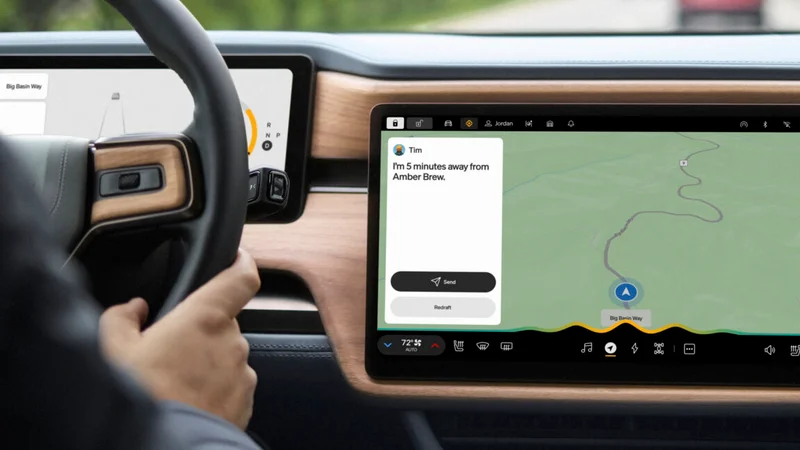
Image: Ars Technica AI
Main Takeaway
Rivian launches its AI-powered voice assistant across Gen1 and Gen2 vehicles, integrating deep car controls with third-party apps via subscription.
Jump to Key PointsSummary
What Rivian Assistant actually does
Rivian has begun rolling out its AI-powered voice assistant to owners of both Gen1 and Gen2 vehicles through a software update. The assistant, accessible via the wake phrase "Hey Rivian," offers control over core vehicle functions including navigation, climate settings, media playback, and phone calls. According to The Verge, the feature requires an active Connect Plus subscription, priced at $15 monthly or $150 annually, or participation in an active trial period.
The assistant's capabilities extend beyond basic commands. Rivian has embedded it deeply into the vehicle's electronic architecture, allowing it to interface with third-party applications such as Google Calendar. This integration represents Rivian's attempt to fill the gap left by its refusal to support Apple CarPlay or Android Auto, a stance that has distinguished the company from most mainstream automakers. Ars Technica notes that Rivian's clean-sheet approach to vehicle electronics previously attracted a $5 billion investment from Volkswagen Group, suggesting that the company's software-first strategy has drawn serious industry backing. The assistant's rollout covers model-year 2024 and older vehicles as well as newer Gen2 models, indicating broad backward compatibility that isn't always guaranteed in automotive software updates.
Why Rivian built its own instead of using Siri or Google
Rivian's decision to develop an in-house assistant stems directly from its rejection of phone mirroring platforms. The company has no plans to support Apple CarPlay or Android Auto, a position that has frustrated some owners but allowed Rivian to maintain complete control over its user interface and data flows. This approach mirrors strategies seen in premium consumer electronics more than traditional automotive practice.
The assistant draws on what Rivian calls its "Rivian Unified Intelligence," described by the company as a shared, multi-modal AI foundation interwoven throughout its operations. The Verge reports that while the assistant is designed in-house, it is augmented by third-party models for specific functions including grounded data retrieval, natural conversation, and reasoning capabilities. This hybrid architecture suggests Rivian is not attempting to build every AI component from scratch, but rather to curate and integrate external capabilities into its own controlled environment. The strategy carries both benefits and risks: tighter integration potential, but also dependence on external providers for core conversational AI that could theoretically be replicated or surpassed by smartphone-based alternatives.
What this costs and who gets it
Access to the Rivian Assistant is gated behind the company's Connect Plus cellular service subscription. This pricing model transforms what might otherwise be a standard software feature into a recurring revenue stream, a pattern increasingly common among EV manufacturers seeking to build software and services income alongside vehicle sales.
The subscription requirement applies to all compatible vehicles, covering both the older Gen1 platform and the newer Gen2 hardware. Ars Technica confirms this cross-generational compatibility, which suggests Rivian has managed to maintain sufficient hardware consistency or has optimized the assistant's resource demands to function on older computing platforms. The company first previewed the assistant at its AI and Autonomy Day event, indicating that the feature has been in development for a substantial period before this commercial rollout. The subscription model raises questions about feature accessibility for owners who may have purchased vehicles with the expectation of included software capabilities, a tension point in the evolving relationship between automotive hardware and software monetization.
How this compares to competitors' approaches
Rivian's assistant enters a market where most automakers have taken different paths. The majority of manufacturers offer Apple CarPlay and Android Auto as standard features, effectively outsourcing voice interaction to smartphone platforms that users already know. This approach minimizes development costs and leverages ecosystems with billions of trained users, but sacrifices control over data, interface design, and the customer relationship.
Rivian's strategy most closely resembles that of Tesla, which has similarly resisted phone mirroring in favor of its own software stack. However, Tesla's voice commands have historically been criticized as limited compared to smartphone assistants, creating an opportunity for Rivian to differentiate through more capable natural language understanding. CNET's headline suggests the Rivian Assistant aims to understand intent rather than merely process literal commands, a claim that if borne out would represent meaningful advancement over typical automotive voice systems. The competitive positioning is clear: Rivian is betting that a sufficiently capable in-house assistant can overcome the convenience advantage of smartphone integration, while capturing valuable user data and interaction time that would otherwise flow to Apple and Google.
What happens next for Rivian's software ambitions
The assistant launch represents a milestone in Rivian's broader software narrative, but also sets expectations for future capability expansion. The company's description of its AI foundation as shared and multi-modal implies plans beyond voice interaction, potentially encompassing visual understanding and other sensor inputs as the platform matures.
The third-party model augmentation strategy suggests Rivian will continue to selectively incorporate external AI advances rather than attempt to match the scale of dedicated AI labs. This pragmatic approach may prove sustainable given the specialized domain of vehicle operation, where deep integration with car systems matters more than general knowledge breadth. The Volkswagen partnership and investment provides both capital and potential scale for Rivian's software architecture, though whether this extends to sharing the assistant technology remains unannounced. For Rivian owners, the immediate test will be whether the assistant's convenience justifies the subscription cost and compensates for the absence of familiar smartphone mirroring. For the industry, the rollout offers a test case of whether vertically integrated automotive software can win customer preference over the established convenience of phone-based platforms.
What this signals about in-car AI's future
Rivian's assistant arrives as automakers broadly reassess their relationship with technology platforms. The industry has oscillated between embracing smartphone integration as a quick fix and viewing it as a strategic threat that commoditizes the vehicle into a peripheral device. Rivian's bet on proprietary AI represents the most assertive rejection yet of the smartphone-centric model from a company without an existing massive software ecosystem of its own.
The subscription pricing model, while potentially contentious with consumers, reflects a growing recognition that sustainable software development in vehicles requires ongoing revenue. Whether customers accept this tradeoff depends substantially on the quality gap between native and smartphone-based experiences. Early testing by The Verge suggested functional promise, but real-world performance across diverse accents, road noise conditions, and command complexities remains to be proven at scale. The assistant's success or failure will likely influence whether other manufacturers follow Rivian's path or reaffirm their commitment to phone mirroring as the primary in-vehicle interface. For now, the rollout positions Rivian as a meaningful experiment in automotive AI autonomy, with results that will be watched closely across the industry.
Key Points
Rivian Assistant rolls out via software update to Gen1 and Gen2 vehicles with Connect Plus subscription ($15/month or $150/year)
Assistant offers deep vehicle control including navigation, climate, media, and phone, plus third-party app integration like Google Calendar
Built on Rivian Unified Intelligence with augmentation from third-party AI models for conversation and reasoning
Launch reinforces Rivian's strategy of rejecting Apple CarPlay and Android Auto in favor of proprietary software control
Subscription model represents growing industry trend toward recurring software revenue in electric vehicles
Questions Answered
The assistant is available through a software update for compatible Gen1 and Gen2 Rivian vehicles. You need an active Connect Plus subscription, which costs $15 per month or $150 per year, or you must be in an active trial period.
Rivian has designed the assistant to handle core vehicle functions and some third-party app integrations like Google Calendar. However, since Rivian does not support Apple CarPlay or Android Auto, you cannot use Siri or Google Assistant hands-free through the vehicle's systems.
According to Rivian, the assistant uses a multi-modal AI foundation and third-party model augmentation to understand intent beyond literal commands. It is deeply embedded in vehicle operations rather than layered on top as an add-on feature.
Yes, the assistant is compatible with Gen1 vehicles from model-year 2024 and earlier, as well as newer Gen2 models, provided you have the required Connect Plus subscription.
Rivian has chosen to maintain complete control over its infotainment experience and data flows. This strategy has allowed tighter integration between software and vehicle hardware, though it requires customers to learn a new interface rather than using familiar smartphone platforms.
Source Reliability
38% of sources are trusted · Avg reliability: 56
Go deeper with Organic Intel
Simple AI systems for your life, work, and business. Each one includes copyable prompts, guides, and downloadable resources.
Explore Systems