Orlando Bravo: AI Bubble Looms But Software's $1.5 T Tailwind Is Real
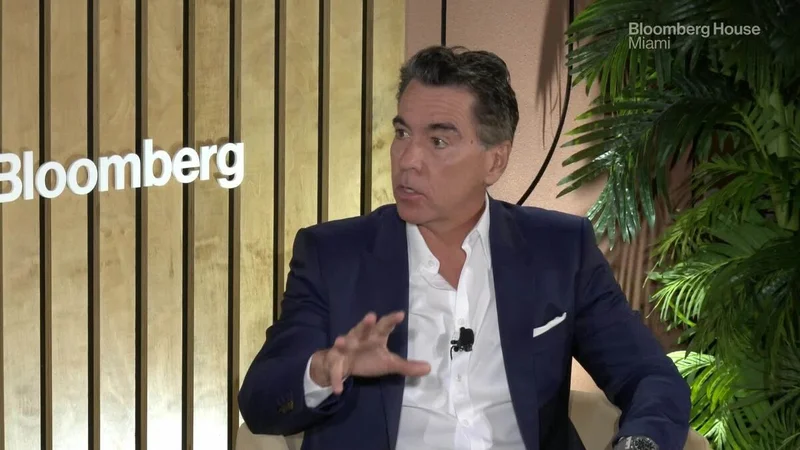
Image: Bloomberg AI
Main Takeaway
Thoma Bravo founder warns AI valuations are overheated, insists portfolio firms must become AI-centric within months, and sees enterprise software.
Jump to Key PointsSummary
Bravo's blunt AI bubble call
Orlando Bravo isn't mincing words. The founder of $130-billion private-equity shop Thoma Bravo told Bloomberg's Dani Burger in Miami that AI valuations "are in a bubble" and that fear-of-missing-out money is flooding deals that will end badly. His rule of thumb: if it smells like FOMO, walk away. Yet he still calls AI the biggest tailwind software has ever seen, a $1.5 trillion wave that will separate winners from the merely overpriced.
Why every Thoma Bravo company must flip to AI-first
"We have had to make our companies, very, very quickly, AI-centric companies," Bravo said. Translation: portfolio CEOs now get AI adoption as a board-level KPI, not an R&D experiment. The mandate is simple, bolt on generative features, automate workflows, and cut headcount where models can handle the load. Bravo argues the firms that adapt fastest will exit at premium multiples even if the broader AI hype deflates.
Private-market FOMO is already warping term sheets
Bravo sees late-cycle money chasing anything with "AI" in the pitch deck. Multiples for pure-play AI startups have touched 30-50× forward revenue, levels reminiscent of 2021 SaaS mania. His advice to LPs: underwrite cash-flow resilience, not model demos. The reckoning comes when growth stalls and investors remember that software margins compress faster than AI hype cycles spin.
The $1.5 trillion software tailwind Bravo still believes in
Despite bubble warnings, Bravo pegs the total addressable market lift from AI at $1.5 trillion for existing enterprise software. Think automated customer support, AI code generation, predictive security, use cases that slot neatly into already budgeted line items. That’s why Thoma Bravo keeps paying double-digit EBITDA multiples for mature SaaS firms: the AI overlay can triple upsell rates without increasing sales headcount.
Google Cloud partnership as AI infrastructure cheat code
Thoma Bravo inked a strategic deal with Google Cloud to let every portfolio company tap Vertex AI, TPUs, and Gemini models on pre-negotiated terms. Bravo frames it as buying a railroad ticket instead of laying track, cheaper, faster, and less dilutive than in-house AI stacks. Early pilots inside Verint and other portfolio assets show 20-30% faster deployment cycles versus DIY builds.
Enterprise software is the bubble-free zone
While consumer AI plays chase eyeballs and ad dollars, Bravo argues enterprise software has built-in immunity: recurring revenue, switching costs, and CFO vetting. His filter is simple, does the AI feature cut customer opex or boost revenue? If yes, it survives the downturn. That’s why Thoma Bravo still bids aggressively for legacy vertical SaaS even as growth-stage AI multiples compress.
What happens next for PE deal flow
Bravo expects a two-tier market: inflated AI-native valuations will crash first, while profitable SaaS companies with clear AI roadmaps trade at rational premiums. His dry powder, roughly $25 billion across latest funds, waits for the moment when founders trade growth stories for EBITDA. When that happens, he’ll be the buyer of choice, armed with Google’s AI stack and a mandate to cut costs with code instead of layoffs.
Key Points
Thoma Bravo mandates every portfolio company become AI-centric within months, treating adoption as board-level KPI
Bravo calls AI valuations a bubble driven by FOMO money but still sees $1.5 T total addressable market expansion for enterprise software
Strategic Google Cloud deal gives portfolio firms pre-negotiated access to Vertex AI, TPUs, and Gemini models
Enterprise SaaS with clear AI monetization viewed as bubble-proof due to recurring revenue and CFO vetting
Expect two-tier market: inflated AI-native multiples to crash while profitable SaaS with AI roadmaps trade at rational premiums
Questions Answered
He sees FOMO-driven money paying 30-50× forward revenue for startups with unproven models, similar to 2021 SaaS mania, and warns that growth stalls will expose unsustainable multiples.
Portfolio CEOs must treat AI integration as a board-level KPI, deploying generative features and automation that cut opex or boost upsell rates, with Google Cloud providing standardized infrastructure.
Enterprise benefits from recurring revenue, high switching costs, and CFO purchasing discipline that filters hype, making AI features that cut customer costs or boost revenue defensible even during a downturn.
Bravo expects profitable SaaS companies with clear AI monetization paths to trade at rational premiums while inflated AI-native valuations collapse, creating buying opportunities for his $25 billion in dry powder.
Source Reliability
38% of sources are highly trusted · Avg reliability: 60
Go deeper with Organic Intel
Simple AI systems for your life, work, and business. Each one includes copyable prompts, guides, and downloadable resources.
Explore Systems