Microsoft Expands Maia AI Chip Program to Challenge Nvidia in Cloud Inference
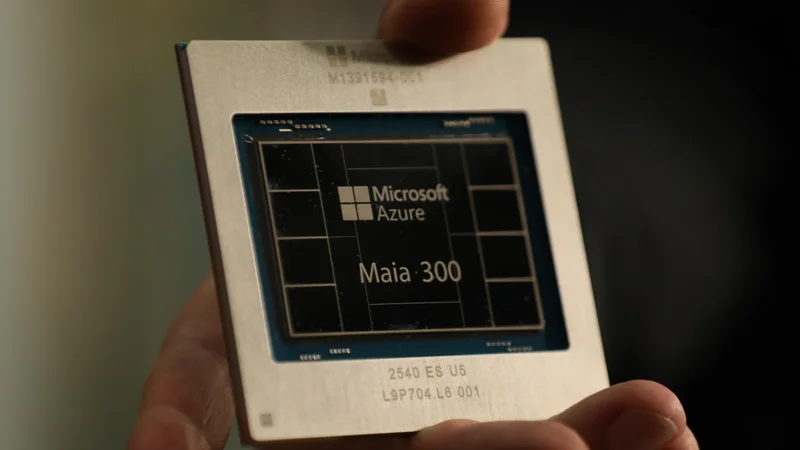
Image: The Verge AI
Main Takeaway
Microsoft will make its Maia chips the primary inference system for Azure products, with Maia 300 entering production workloads in 2027.
Jump to Key PointsSummary
Microsoft’s custom chip strategy
Microsoft is expanding its in-house Maia accelerator program to reduce dependence on Nvidia for AI inference across Azure and its own products. The company says Maia 200 is now in production, while the next-generation Maia 300 will begin handling production workloads in 2027 and become the primary inference system for Microsoft products and services.
The announcement marks a shift from using custom silicon as a supplement to treating it as a central part of Microsoft’s infrastructure plan. Maia 300 is designed for newer reasoning models and agentic workloads, while Microsoft’s broader Maia program targets multi-gigawatt deployments beginning in 2027. The Verge and Microsoft describe the chip as a way to improve the cost and efficiency of cloud AI operations.
Why inference is the focus
Inference is the repeated process of running trained models for user requests, applications and automated tasks, making operating cost and power efficiency critical at cloud scale. Microsoft is positioning Maia 300 around those demands rather than presenting it solely as a training accelerator.
The chip’s design reflects the changing workload mix inside Azure. Reasoning models require more computation per request, while agentic systems generate multiple steps and tool calls. Microsoft says Maia 300 is built to handle those workloads efficiently, and its planned deployment as a primary inference system gives the company greater control over performance, supply and operating economics. Investing.com framed the launch as a direct challenge to Nvidia’s AI dominance, while Microsoft’s Azure materials place Maia within a broader purpose-built infrastructure strategy.
Nvidia remains part of Azure
Microsoft’s Maia push does not end its relationship with Nvidia. Azure continues to develop and deliver Nvidia-based systems, and Microsoft’s Azure materials describe ongoing cooperation between the companies on AI development and performance.
That relationship gives Microsoft a dual-track infrastructure model. Nvidia systems provide a mature software ecosystem and broad model compatibility, while Maia lets Microsoft tune hardware and software for workloads it controls at large scale. Reuters’ headline identifies Nvidia’s software platform as a target, highlighting that competition extends beyond chips to developer tools, libraries and deployment workflows. The balance matters because custom hardware only delivers its full value when customers and internal teams can move workloads onto it without extensive software changes.
The software and networking equation
Microsoft’s Maia effort includes software, networking and system design, not just a new processor. A Microsoft technical post describes Maia 200 as using software-defined dataflow and all-Ethernet networking to support efficient inference on Azure.
That system-level approach addresses the bottlenecks created when thousands of accelerators operate together. Networking, memory movement, scheduling and model support determine how much of a chip’s theoretical performance reaches a live service. Microsoft’s Azure posts present Maia as a program spanning silicon, software and complete systems, while the Maia 200 technical discussion focuses on the architecture used to connect and operate inference hardware. Those details show why Microsoft’s goal is measured in data-center capacity and production deployments, rather than in a single chip benchmark.
Pressure on the AI infrastructure market
Microsoft’s expansion raises competitive pressure across the cloud market. Azure is pursuing more control over its infrastructure while competing with AWS and Google, both of which develop custom AI silicon, and with Nvidia, whose accelerators remain central to cloud AI deployments.
CRN described Maia 200 as part of Microsoft’s contest with AWS, Google and Nvidia. The move also affects customers indirectly: Azure can shape pricing, availability and performance around systems it designs itself, while customers gain another hardware path for supported workloads. The transition will take time because Nvidia’s software ecosystem remains deeply established and Maia’s value depends on broad production adoption. Microsoft’s stated multi-gigawatt plan gives the program scale, but its commercial effect will depend on delivery, model compatibility and measured operating results.
What happens next
Microsoft’s next test is execution. Maia 200 is already in production, and Maia 300 is scheduled for production AI workloads in 2027. The company also plans to scale the Maia family to multi-gigawatt deployments from 2027, turning the program into a major infrastructure commitment.
The key milestones will be Maia 300’s availability, the models and services assigned to it, and the efficiency gains Microsoft achieves against Nvidia-based systems. Developers will also watch the software stack, networking tools and migration support surrounding the hardware. Microsoft’s announcements establish a clear direction: custom silicon will carry a larger share of Azure inference while Nvidia remains an important partner and competitor.
Key Points
Microsoft will make Maia its primary inference system for products and services starting with Maia 300 in 2027.
Maia 200 is already in production as Microsoft expands custom AI hardware across Azure.
Maia 300 targets reasoning models and agentic workloads with improved cloud inference efficiency.
Microsoft plans multi-gigawatt Maia deployments beginning in 2027 to increase infrastructure control.
Azure will combine Maia systems with Nvidia hardware as Microsoft competes across chips and software.
Questions Answered
Microsoft’s Maia 300 is a custom AI accelerator designed primarily for inference workloads in Azure and Microsoft products. It is built to support reasoning models and agentic tasks and is scheduled for production deployment in 2027.
Microsoft is expanding Maia alongside Nvidia GPUs rather than ending its Nvidia relationship. Maia gives Azure an internally controlled option for selected workloads, while Nvidia systems remain part of Microsoft’s cloud infrastructure and software strategy.
Microsoft says Maia 300 will begin rolling out to production AI workloads in 2027. The company also plans to scale the Maia family to multi-gigawatt deployments starting that year.
Microsoft is developing Maia to improve inference efficiency, control infrastructure supply and optimize hardware for its own cloud workloads. Custom silicon also gives Azure another way to manage the rising cost and power demands of reasoning models and AI agents.
Microsoft’s Maia 200 uses software-defined dataflow and all-Ethernet networking to support efficient inference at system scale. Microsoft says the chip is already in production, making it the current foundation for the next Maia expansion.
Source Reliability
45% of sources are highly trusted · Avg reliability: 68
Go deeper with Organic Intel
Simple AI systems for your life, work, and business. Each one includes copyable prompts, guides, and downloadable resources.
Explore Systems