Meta’s Muse AI Agent Takes Rock Band’s Social Handles, Then Faces Talent Agency Pushback
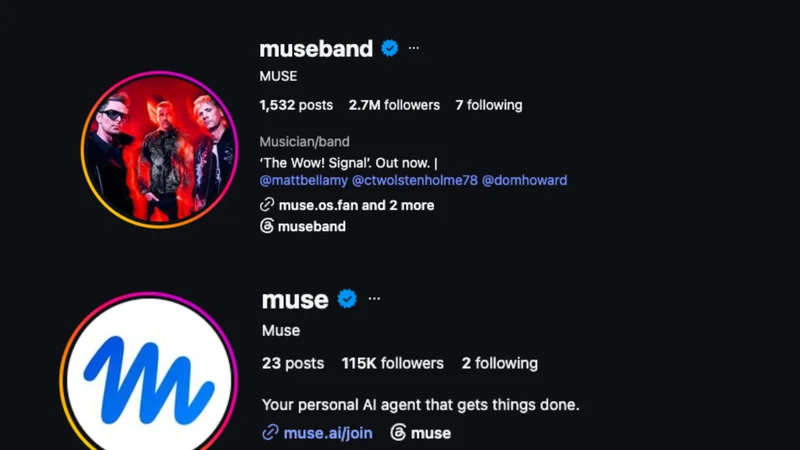
Image: Hacker News AI
Main Takeaway
Meta’s Muse AI agent took the @Muse identity on Instagram and X from the rock band, triggering fan criticism and a reported rollback after agency complaints.
Jump to Key PointsSummary
Meta’s Muse claims a familiar name
Meta’s newly launched Muse AI agent has taken over the @Muse identity on Instagram and X, while the English rock band Muse now uses @museband and @Musetheband. The switch has drawn attention because the group had used the name across social platforms for years and trademarked Muse in 1999, according to information cited by Hacker News AI.
Meta is rolling out Muse in the United States as a personal assistant for adults. The tool handles tasks such as scheduling, shopping, payments and email, and turns longer-term goals into action plans. The band’s account changes became visible around June or July, before the agent’s public launch, although the timing and transfer process remain unclear.
Fans spot the account switch
Fans noticed that the band’s Instagram username had changed to @museband and that its X account had moved to @Musetheband. Meta’s AI product then used the band’s former @Muse identity, creating an unusually visible collision between an established entertainment brand and a newly introduced software product.
The change spread through fan discussion before receiving broader media attention. Its impact comes from the simplicity of the comparison: a globally known band lost the shortest version of its name to an AI service operated by the company that owns Instagram and controls the platform’s account rules. Coverage from The Independent placed the Instagram change in July, while online posts cited by Hacker News AI pointed to an earlier change in June.
Why the handle matters
The dispute highlights the power platforms hold over digital identity. Usernames are assigned inside privately governed systems, so a company that controls the service also controls the practical availability and visibility of names, even when another organization has used that identity for decades.
Meta executives have also accidentally tagged the band instead of the AI agent, according to Hacker News AI. That confusion shows how closely the two identities overlap in search, tagging and public conversation. Muse’s existing trademark and long-running cultural presence add weight to the band’s position, while Meta’s ownership of Instagram gives the company direct control over the account environment.
The irony for Muse fans
Fans have focused on the irony of the band losing its online name to a technology product. Muse’s music, particularly its themes of surveillance, technological control and dystopian politics, has made the handle change feel like a real-world extension of ideas explored in the group’s catalog.
The band formed in Devon in 1994 and has built a substantial international profile. That history makes the incident more than a routine username change for fans: the @Muse identity was part of the band’s public recognition, while the replacement handles introduce extra words that make the group harder to find and distinguish from Meta’s product. Coverage from The Independent and Vulture framed the switch through that cultural contrast, while Hacker News AI emphasized the platform-governance issue.
Talent agencies challenge the rollout
Meta’s Muse agent has faced broader criticism from talent representatives, and IQ Magazine reported that Meta rolled back the tool after an outcry from talent agencies. The response connects the band’s handle dispute to a wider concern about how AI products are named, launched and promoted when their identities overlap with people, brands or creative works.
Muse is currently restricted to users in the United States and is being presented around privacy and safety. A rollback would put pressure on Meta to clarify both the product’s availability and its handling of the disputed identity. Consequence Live and Vulture identified the band’s social-media loss as a central part of the story, while IQ Magazine added the account of industry pushback over the product’s rollout.
What happens to the name
The immediate question is whether Meta restores the band’s original handles or keeps the Muse identity for its AI product. The available account changes show that the band has already been pushed toward longer alternatives, while the reported rollback indicates that the product launch itself remains unsettled.
Meta’s next steps will shape how companies, artists and users view platform-controlled usernames. A clear explanation of the transfer, the status of @Muse and the agent’s rollout would address the central dispute. Until then, the incident remains a compact example of how a product name, a platform decision and an established cultural identity can collide in public.
Key Points
Meta’s Muse AI agent claimed @Muse on Instagram and X, displacing the established English rock band.
Muse now uses @museband on Instagram and @Musetheband on X after the handle changes.
Fans connected the account switch to Muse’s longstanding themes about dystopian technology and control.
Meta executives mistakenly tagged the band while referring to the AI agent, deepening identity confusion.
Talent agencies criticized the rollout, and IQ Magazine reported that Meta subsequently rolled back Muse.
Questions Answered
Meta’s Muse AI agent took over the @Muse identity on Instagram and X, while the band moved to longer handles. The exact transfer process remains unclear, but Meta controls the platforms where the changes occurred.
Muse uses @museband on Instagram and @Musetheband on X. Fans noticed the changes before or around Meta’s public launch of its Muse AI agent.
Meta’s Muse AI agent helps adults schedule activities, shop, make payments and manage email. It also turns long-term goals into action plans and was initially restricted to users in the United States.
Meta rolled back Muse after talent agencies raised objections, according to IQ Magazine. The reported rollback adds uncertainty about the product’s availability and whether the band’s original handles will be restored.
Muse’s music often explores dystopian technology, surveillance and technological control. Fans saw the band losing its online identity to an AI product as an unusually literal example of those themes.
Source Reliability
50% of sources are trusted · Avg reliability: 68
Go deeper with Organic Intel
Simple AI systems for your life, work, and business. Each one includes copyable prompts, guides, and downloadable resources.
Explore Systems