Mercury 2.5 Analysis Highlights Model Metrics as Xiaomi’s MiMo-V2.6-Pro Gains Attention
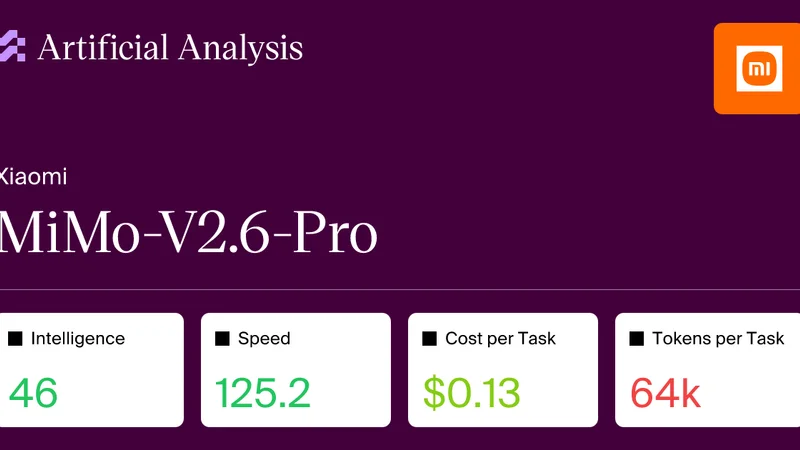
Image: Hacker News AI
Main Takeaway
Artificial Analysis evaluates Inception’s Mercury 2.5 across intelligence, speed, latency, context, and cost as comparisons with Xiaomi’s MiMo-V2.6-Pro broaden.
Jump to Key PointsSummary
What the analysis covers
Inception’s Mercury 2.5 is being evaluated across intelligence, price, speed, latency, context window, token use, and response time. Artificial Analysis presents the model through a comparative dashboard rather than a conventional product review, giving readers a way to weigh quality against operating cost and responsiveness. The evaluation also includes capability indexes covering model performance in specific tasks and industries.
The Mercury 2.5 page does not establish a single winning metric in the available coverage. Its value is the shared measurement framework, which places model quality alongside time to first token, output speed, and the time required to produce a 500-token response. That format matters for developers choosing between models with different performance and pricing profiles.
How performance is measured
Artificial Analysis separates several dimensions that are often compressed into one benchmark score. Output speed is measured in tokens per second, while latency records the seconds before the first token appears. End-to-end response time combines those factors with thinking time for reasoning models and estimates the time needed to produce 500 tokens.
The framework also tracks token use, cost, and context window. Those measures address different deployment pressures: token consumption affects bills, context capacity affects the size of inputs a model can handle, and latency shapes interactive user experiences. OpenRouter’s Mercury 2.5 comparison with MiMo-V2.6-Pro places the model in a direct selection context, while the Artificial Analysis pages supply the underlying categories.
Why MiMo-V2.6-Pro enters the comparison
Xiaomi’s MiMo-V2.6-Pro is the most prominent comparison point in the available coverage because it is described as topping open-weights models on the Artificial Analysis Intelligence Index. One report also places its cost at $0.13 per task, making price a central part of the discussion around its competitiveness.
That comparison changes how Mercury 2.5 is read. Developers are not assessing intelligence in isolation; they are weighing a proprietary model against an open-weights contender with a reported low task cost. VentureBeat’s headline frames MiMo-V2.6-Pro as outperforming DeepSeek, while other coverage focuses on its index position and pricing. Those claims concern Xiaomi’s model directly, but they raise the bar for every model assessed in the same marketplace.
What developers should compare
Developers evaluating Mercury 2.5 should treat quality, cost, and responsiveness as separate purchasing questions. A model with strong intelligence can still be a poor fit for a high-volume application if token pricing or end-to-end response time is unfavorable. Conversely, a fast and inexpensive model may fit interactive workloads even when another system leads on difficult reasoning tasks.
The available analysis gives teams a consistent checklist: compare intelligence indexes, inspect capability-specific results, review token use and pricing, then examine context length, output speed, first-token latency, and 500-token completion time. OpenRouter’s side-by-side page is especially relevant for teams considering Mercury 2.5 and MiMo-V2.6-Pro together. MiMo-V2-Pro appears in the broader Artificial Analysis catalog, reinforcing the platform’s role as a model comparison hub rather than a single-model benchmark.
The open-model pricing pressure
MiMo-V2.6-Pro’s reported $0.13 per task places cost at the center of competitive pressure among open-weights models. The figure gives buyers a practical reference point, although task definitions and usage patterns determine how meaningful any single per-task estimate is. Artificial Analysis’s inclusion of token use and cost helps connect benchmark performance to actual operating economics.
Mercury 2.5 therefore sits in a market where buyers increasingly compare intelligence with throughput and expense. Xiaomi’s model attracts attention for its index position, while Mercury 2.5 receives a structured assessment covering the same operational dimensions. The result is a more practical decision framework for teams that care about both model capability and the bill generated by production traffic.
What happens next
The next useful step for Mercury 2.5 is broader, comparable testing across capability indexes, pricing scenarios, and real application workloads. The current coverage establishes the evaluation categories and a direct comparison with MiMo-V2.6-Pro, but it does not provide a complete set of numerical Mercury 2.5 results in the available excerpts.
That leaves model selection dependent on the dashboard’s detailed measurements and the buyer’s workload. Teams building chat, coding, research, or agent systems will need to match task difficulty, context requirements, response-time targets, and request volume against those figures. As more models enter the same comparison system, including Xiaomi’s MiMo-V2-Pro family, standardized reporting will matter as much as headline benchmark rankings.
Key Points
Inception’s Mercury 2.5 receives a multidimensional evaluation covering intelligence, cost, speed, latency, and context.
Artificial Analysis measures Mercury 2.5 through capability indexes and end-to-end 500-token response time.
Xiaomi’s MiMo-V2.6-Pro reportedly tops open-weights models on Artificial Analysis’s Intelligence Index.
MiMo-V2.6-Pro is reported to cost $0.13 per task, intensifying price comparisons across AI models.
OpenRouter places Mercury 2.5 and MiMo-V2.6-Pro in a direct model comparison for developers.
Questions Answered
Inception Mercury 2.5 is being evaluated on intelligence, capability performance, token use, cost, context window, output speed, latency, and end-to-end response time. The framework estimates the time required to generate 500 tokens while accounting for first-token delay and reasoning time.
Mercury 2.5 is compared directly with Xiaomi MiMo-V2.6-Pro through Artificial Analysis and OpenRouter metrics. MiMo-V2.6-Pro receives attention for reportedly topping open-weights models on the Intelligence Index and costing $0.13 per task.
Artificial Analysis defines end-to-end response time as the seconds needed to output 500 tokens. The measure combines time to first token, thinking time for reasoning models, and output speed.
MiMo-V2.6-Pro’s reported $0.13-per-task cost gives developers a practical benchmark for evaluating Mercury 2.5’s economics. Buyers can compare that figure with token pricing, workload volume, and response-time requirements.
Developers should check Mercury 2.5’s intelligence results alongside capability indexes, cost, token use, context capacity, throughput, first-token latency, and 500-token response time. The best choice depends on the application’s quality, speed, and budget requirements.
Source Reliability
43% of sources are trusted · Avg reliability: 63
Go deeper with Organic Intel
Simple AI systems for your life, work, and business. Each one includes copyable prompts, guides, and downloadable resources.
Explore Systems