Liquid AI Launches LFM3 Family for Specialized Multimodal Models on a Shared 2B-Class Backbone
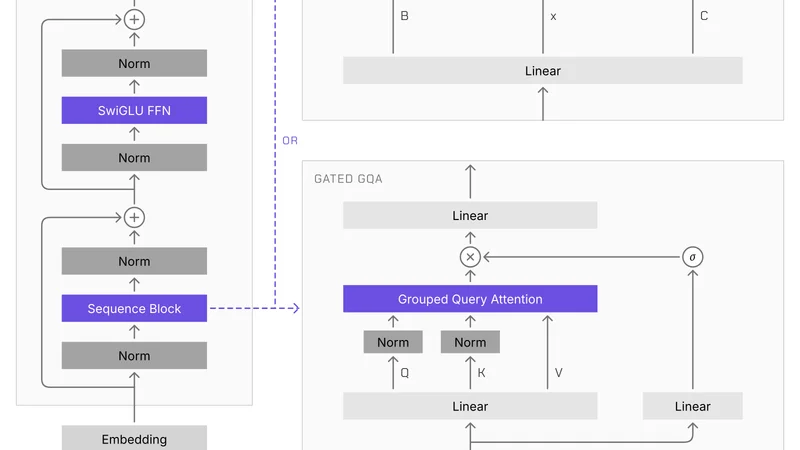
Image: Hugging Face Blog
Main Takeaway
Liquid AI launched LFM3, a family of 2B-class text, vision, audio, omni and decision models designed for single-GPU customization and deployment.
Jump to Key PointsSummary
Liquid AI’s LFM3 family
Liquid AI has introduced LFM3, a family of six roughly 2B-class models that share a common foundation across text, vision, audio, omni and decision tasks. The release is designed to let developers select a modality-specific checkpoint, fine-tune it on private data and deploy it close to the application rather than rely solely on a large hosted model.
The family is built from the LFM3-1.7B-Base checkpoint, a 1.73-billion-parameter text model that serves as the trunk for the post-trained variants. Liquid AI’s announcement positions the release as a starting point for specialized intelligence, while the repository-focused review emphasizes that the base checkpoint is separate from the instruction-tuned and multimodal models.
More capability per parameter
LFM3-1.7B is designed to deliver more capability with fewer parameters than Liquid AI’s earlier models. The company says its new tri-hybrid architecture and training recipe allow LFM3-1.7B to outperform LFM2.5-2.6B while using 35% fewer parameters.
That efficiency claim matters because the release targets local and constrained deployments. A smaller model reduces memory requirements, fine-tuning costs and serving overhead, although the available announcement excerpt does not provide benchmark tables or task-by-task comparisons. The repository analysis also flags the absence of a standalone benchmark presentation for LFM3-1.7B-Base, separating documented architecture and model lineage from independently established performance.
One backbone, several modalities
The central design choice is a shared backbone spanning multiple input and decision formats. LFM3 includes text, vision, audio, omni and decision models, with the omni model adding video input to the family. Developers can therefore begin with a common base and choose a model aligned with the data their application actually handles.
Multimodal systems generally combine modality-specific processing with a shared representation and language or decision generation. Industry explainers describe cross-modal alignment as a major technical bottleneck, particularly when paired image, audio, video and text examples are inconsistent. LFM3’s shared lineage addresses model-family consistency, but the launch details do not establish that it resolves the broader data-quality and alignment challenges facing multimodal systems.
What developers can do with it
LFM3 is aimed at developers building focused applications rather than a single general-purpose assistant. The stated workflow is practical: choose a model for text, images, audio, video or decisions, fine-tune it with domain data on a single GPU, then deploy it where the software runs.
That approach fits use cases such as document analysis, visual inspection, speech interfaces, sensor interpretation and embedded decision systems. Training programs and technical explainers describe multimodal development as a pipeline involving modality-specific preparation, alignment and instruction tuning. For teams adopting LFM3, the main work remains data curation, evaluation across input types and deployment engineering, even when the starting checkpoint is compact.
The open-model tradeoff
The release brings multimodal model development closer to teams that cannot justify training or serving very large systems. A 2B-class family can support experiments on more modest hardware, and a shared base can reduce the need to assemble unrelated models for each modality.
The tradeoff is that smaller checkpoints demand careful specialization. General capability, cross-modal reasoning and output reliability depend on training data, fine-tuning choices and evaluation design. Broader multimodal guidance also points to the cost of collecting aligned data and maintaining modality-specific encoders. LFM3’s value therefore rests on the combination of compact size, accessible customization and credible task performance, not parameter count alone.
What happens next
The next test for LFM3 is adoption outside the launch announcement. Developers will need reproducible benchmarks, model documentation, licensing details and deployment results across the text, vision, audio, omni and decision variants.
The release’s architecture and family structure provide a clear platform for experimentation, while the limited public benchmark information leaves performance claims to be tested by users. If the single-GPU fine-tuning workflow holds across practical workloads, LFM3 can give specialized applications a smaller alternative to general-purpose multimodal APIs. Community attention, including discussion on Hacker News, will help determine whether the family becomes a working developer platform or remains primarily a model release.
Key Points
Liquid AI launched LFM3, a shared-backbone family of six specialized multimodal models.
LFM3-1.7B reportedly exceeds LFM2.5-2.6B capability with 35% fewer parameters.
The family covers text, vision, audio, video-enabled omni and decision applications.
Developers can fine-tune LFM3 models on a single GPU using domain-specific data.
LFM3-1.7B-Base provides the 1.73-billion-parameter trunk for post-trained variants.
Questions Answered
Liquid AI LFM3 is a family of compact multimodal foundation models for specialized applications. It includes text, vision, audio, omni and decision variants built from a shared LFM3-1.7B-Base foundation.
Liquid AI LFM3 models are in the roughly 2B-parameter class, with LFM3-1.7B-Base containing 1.73 billion parameters. The compact size targets fine-tuning and deployment on more modest hardware.
Liquid AI says developers can fine-tune LFM3 models on a single GPU. The intended workflow is to select a modality-specific model, adapt it with domain data and deploy it where the application runs.
Liquid AI LFM3 supports text, vision, audio, video through its omni model and decision-oriented workloads. The family uses a shared backbone while providing separate models for different application needs.
Liquid AI LFM3 will need independent benchmarks, documentation and production testing across its model variants. Developer adoption will show whether its compact size and single-GPU customization deliver dependable results in real applications.
Source Reliability
43% of sources are unrated · Avg reliability: 50
Go deeper with Organic Intel
Simple AI systems for your life, work, and business. Each one includes copyable prompts, guides, and downloadable resources.
Explore Systems