Joby Flies First Electric Air Taxi Route Between JFK and Manhattan in Week-Long NYC Test
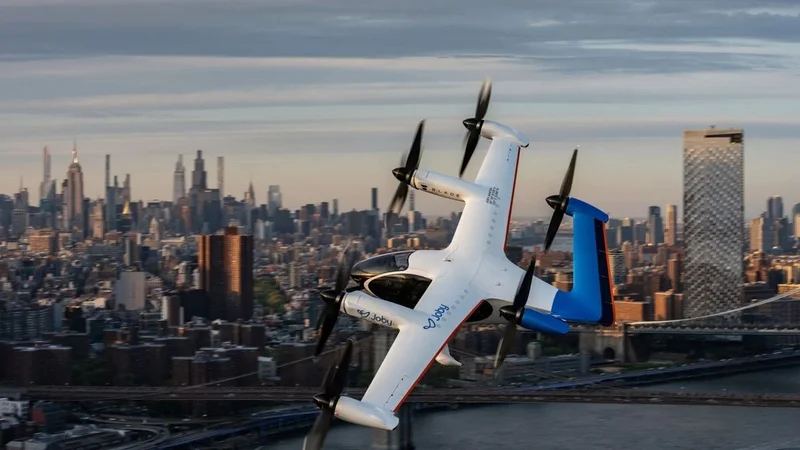
Image: Bloomberg AI
Main Takeaway
Joby Aviation launches week-long test flights of electric air taxis between JFK Airport and Manhattan heliport, marking first urban route demonstration in NYC.
Jump to Key PointsSummary
First electric air taxi flights over NYC skyline
Joby Aviation has begun a week-long test campaign flying its electric air taxis between John F. Kennedy International Airport and a Manhattan heliport, marking the first time an eVTOL aircraft has operated this high-profile urban route. The demonstration flights started this week and will continue for 10 days total, showcasing the company's zero-emission aircraft in New York's notoriously noise-sensitive airspace.
Technical specs behind the aircraft
Joby's electric air taxi is a five-seat aircraft (one pilot plus four passengers) that takes off and lands vertically like a helicopter but flies like a plane using tilt-rotors. The company claims it's 100 times quieter than traditional helicopters during takeoff and produces zero emissions. Flight time between JFK and Manhattan is approximately 7 minutes, compared to 45-60 minutes by car in typical traffic. The aircraft has a range of 150 miles and top speed of 200 mph.
Why New York matters for eVTOL adoption
New York represents the ultimate stress test for urban air mobility. The city has some of the strictest noise ordinances in the US and residents have historically fought helicopter operations. Joby's demonstration appears designed to prove the aircraft can operate without triggering noise complaints. The route choice is strategic: JFK-Manhattan is one of the world's busiest airport-city corridors, with millions of passengers making the journey annually. Success here could validate the entire eVTOL business model.
Regulatory pathway to commercial service
While these are test flights with company pilots and engineers, Joby has already received Part 135 air carrier certification from the FAA and is targeting 2026 for commercial operations. The company is part of the White House's Advanced Air Mobility initiative, which aims to integrate eVTOL aircraft into national airspace. New York operations would require additional approvals from local authorities and the Port Authority, which manages the region's airports.
What this means for urban mobility costs
Joby hasn't announced pricing yet, but industry analysts expect initial fares to run $100-200 per passenger for the JFK-Manhattan route, positioning it between premium car services and helicopter charters. The company aims to eventually reach price parity with Uber Black for similar distances. Each aircraft can carry four passengers, making economics more favorable than traditional helicopters. The electric propulsion also means lower operating costs long-term.
Competitive landscape heats up
Joby's NYC demonstration puts pressure on rivals like Archer Aviation, which has focused on Los Angeles and Miami markets, and Lilium, which is pursuing European certification. The company has raised over $2 billion from investors including Toyota and Delta Air Lines, giving it significant runway. However, Archer recently announced its own plans for NYC operations, suggesting the market could see multiple players competing on the same routes by 2027.
Infrastructure challenges ahead
While Joby can use existing heliports like the one near Hudson River, scaling commercial service requires infrastructure upgrades. The company needs charging stations, passenger terminals, and maintenance facilities. New York's limited heliport space could become a bottleneck. Joby has partnered with REEF Technology to convert parking garages into vertiports, but zoning and community approval remain hurdles for widespread deployment.
Public reception and noise concerns
Early response from Manhattan residents appears cautiously positive, with many surprised by how quiet the aircraft seems compared to traditional helicopters. However, community groups are already organizing to limit flight paths and operating hours. The success of this week's demonstrations could determine whether New York becomes a model for urban air mobility or a cautionary tale about NIMBY resistance. Joby's PR team has been conducting outreach to neighborhood associations throughout the test period.
Timeline for regular service
Based on current FAA timelines and Joby's certification progress, commercial flights could begin as early as 2026, starting with limited routes like JFK-Manhattan. The company plans to expand to LaGuardia and Newark airports by 2027, creating a three-airport network. Full-scale operations would require dozens of aircraft and multiple vertiports across the city. Weather limitations mean service will likely operate 300+ days per year, with traditional ground transport as backup.
Key Points
Joby conducts first-ever eVTOL flights between JFK Airport and Manhattan during 10-day test campaign
Electric aircraft is 100x quieter than helicopters and completes 7-minute flights vs 45-60 minute car journeys
Test flights target 2026 commercial launch as part of White House Advanced Air Mobility initiative
Route represents ultimate stress test for urban air mobility in noise-sensitive New York market
Service could initially cost $100-200 per passenger with eventual price parity to premium car services
Questions Answered
The electric air taxi completes the JFK-Manhattan route in approximately 7 minutes, compared to 45-60 minutes by car in typical New York traffic.
Joby is targeting 2026 for commercial operations, pending final FAA approvals and local regulatory clearances. The current flights are test demonstrations only.
Joby claims their electric air taxi is 100 times quieter than traditional helicopters during takeoff, which is crucial for operating in noise-sensitive urban areas like Manhattan.
While pricing hasn't been finalized, industry analysts expect initial fares of $100-200 per passenger, with long-term goals of reaching price parity with premium car services like Uber Black.
The test flights are using the Hudson River heliport on Manhattan's west side, which has existing helicopter infrastructure that can be adapted for eVTOL operations.
Joby's electric aircraft seats five people total: one pilot plus four passengers, making the economics more favorable than traditional helicopters that typically carry fewer passengers.
Source Reliability
50% of sources are trusted · Avg reliability: 67
Go deeper with Organic Intel
Simple AI systems for your life, work, and business. Each one includes copyable prompts, guides, and downloadable resources.
Explore Systems