Gemini Now Generates Ultra-Personal Images by Mining Your Google Photos
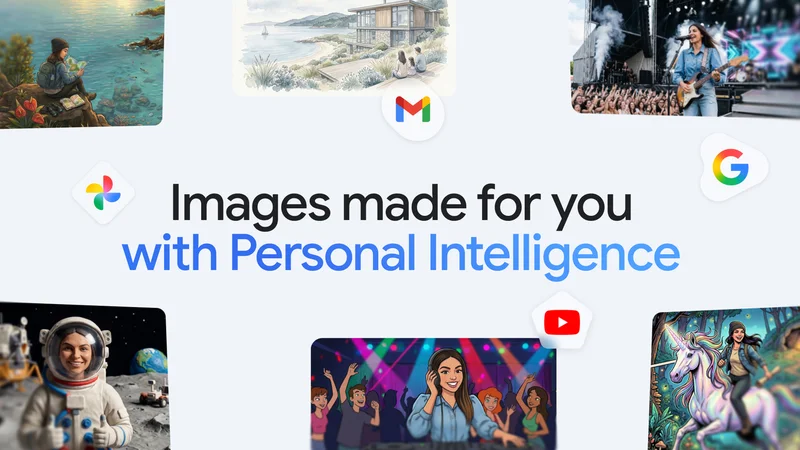
Image: Google AI Blog
Main Takeaway
Google flips the personalization switch: Gemini taps your photo library to create custom scenes of you, your pets, and your style without manual uploads.
Jump to Key PointsSummary
How the new feature actually works
Gemini's updated "Personal Intelligence" layer quietly reads your Google Photos library, calendar, and search history, then feeds that context into the new Nano Banana 2 image model. When you type "make me a birthday card," it already knows which family members to include, the kind of cake you usually buy, and even the color palette from your last party shots. No prompt engineering required. The system strips EXIF data and runs on-device face clustering before anything leaves your phone, according to Google.
Who gets it first and when
The rollout starts today for AI Plus, Pro, and Ultra subscribers on Android, with iOS and free-tier users queued for "later this quarter." Enterprise and EDU accounts are excluded entirely for now, presumably over privacy reviews. Expect a server-side switch, so no app update needed.
What you can (and cannot) ask for
Prompts that work: "Design my dream kitchen using my actual furniture," "Create a holiday card with my dog in a sweater," or "Show my kids as astronauts." Prompts that fail: anything involving nudity, violence, or identifiable third parties who appear rarely in your library. Google says the model will hallucinate faces for people it can't confidently match, so ex-partners might get a generic stand-in.
The privacy tightrope
Google swears raw photos never leave your device; only 256-dimension face embeddings and object tags ship to the cloud. Still, regulators in the EU and Illinois (home of strict biometric laws) are already circling. One mis-fired image of a child could ignite the same firestorm that hit Clearview AI. Meanwhile, rival Apple Intelligence keeps everything on-device, a fact Google quietly downplayed in its blog post.
Speed, quality, and the uncanny valley
Early testers report 2-4 second generation times on Pixel 9 Pro, roughly half what Imagen 3 took for generic images. Quality is "Instagram-ready" for close-ups but still trips on hands and text. The real magic is consistency: your face stays recognizable across fantasy scenes without the usual AI morphing.
What this means for creators and stock photo sites
Adobe and Shutterstock just felt a chill. Why buy a stock image of "woman laughing with salad" when Gemini can generate the same scene starring your actual coworker? Small design agencies could skip model releases entirely. On the flip side, expect a flood of hyper-personalized but legally murky content.
Enterprise play hiding in plain sight
Google Workspace admins can toggle the feature off today, but leaked roadmaps show a business tier next year that auto-generates marketing assets using a brand's photo archive. Imagine Coca-Cola creating Christmas ads featuring real customers pulled from their #ShareaCoke campaign. That's the real revenue bet.
What happens next
Google will spend the next month A/B-testing prompt filters, then open an API so third-party apps can request "personalized avatars" with one line of code. The company is also prototyping a "memory off-switch" that purges your context monthly, though executives admit most users will never find it.
Key Points
Gemini now auto-pulls from Google Photos to generate images featuring you, your family, and your actual belongings
Nano Banana 2 model creates consistent, recognizable faces across fantasy scenes without prompt engineering
Rollout starts today for paid Android users; free tier and iOS coming later this quarter
Google claims raw photos stay on device; only face embeddings sent to cloud for privacy
Feature poses direct threat to stock photo sites and model release requirements for small agencies
Questions Answered
No. Gemini automatically accesses your Google Photos library once you grant permission during setup.
Only people who appear frequently in your library. Infrequent faces get generic replacements to prevent misuse.
Google filters block nudity, violence, and identifiable third parties. Plus, the system won't generate images of people it can't confidently match to your library.
iOS support is planned for "later this quarter" according to Google, starting with paid subscribers.
Enterprise and EDU accounts are excluded entirely for now. Workspace admins can toggle the feature off for company devices.
Google is prototyping a "memory off-switch" that purges context monthly, though it won't be prominently featured in settings.
Source Reliability
67% of sources are highly trusted · Avg reliability: 80
Go deeper with Organic Intel
Simple AI systems for your life, work, and business. Each one includes copyable prompts, guides, and downloadable resources.
Explore Systems