Debt and Risky Bets Fuel South Korea and Taiwan's AI Stock Boom
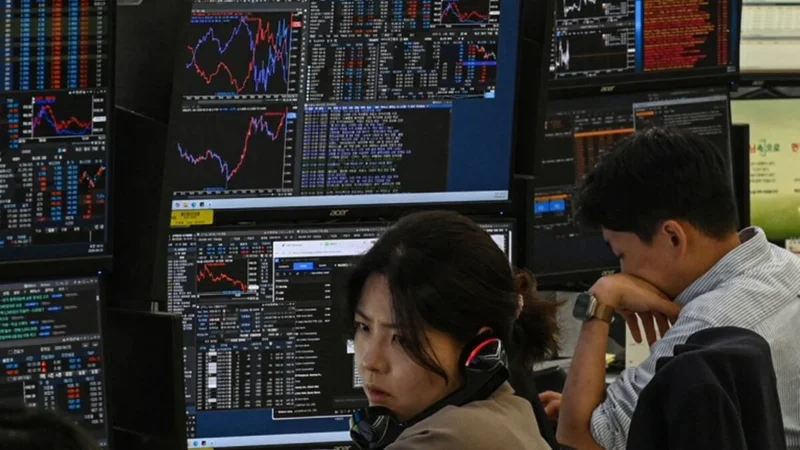
Image: Bloomberg AI
Main Takeaway
Taiwan and South Korea's stock markets surge on AI-driven rallies fueled by borrowed money and speculative bets.
Jump to Key PointsSummary
How debt powers the rally
Retail investors in Taiwan and South Korea are borrowing heavily to pour money into AI-linked stocks, amplifying one of the world's hottest market rallies. Bloomberg reports that Taiwanese investors have gone deep into debt to sustain a 100% stock rally, with margin lending hitting record levels as chip fever grips the island. The phenomenon mirrors South Korea's own surge, where individual traders have piled into semiconductor names and AI supply chain plays using leveraged accounts.
This borrowing binge has structural roots. Both markets feature concentrated equity cultures where a handful of tech giants, TSMC in Taiwan and Samsung plus SK Hynix in Korea, dominate indices. When AI demand lifted these stocks, passive index exposure became a leveraged bet on the technology's future. Investors didn't need to pick winners, they simply borrowed to buy more of what they already held. The result is a feedback loop where rising prices justify more borrowing, which drives prices higher still.
Why chip stocks dominate
Taiwan and South Korea have overtaken the UK in global market capitalization, according to Finance.yahoo, driven almost entirely by AI chip demand. TSMC manufactures the vast majority of advanced AI processors for NVIDIA, AMD, and others. Samsung and SK Hynix supply the high-bandwidth memory that feeds those chips. This isn't speculative positioning, these companies sit at irreplaceable nodes in the AI supply chain.
Yet concentration creates fragility. Oxford Economics notes that the macro impact of the AI boom in both economies now tracks semiconductor order cycles more closely than traditional GDP drivers. When NVIDIA announces new products or adjusts forecasts, entire national stock markets swing. Invesco's institutional research frames this as opportunity, highlighting Korea and Taiwan as primary beneficiaries of AI capital expenditure. The investment case is sound on paper, but the speed and scale of inflows have compressed what might have been a decade-long transition into mere months.
The growing economic divide
The AI riches aren't spreading evenly. The New York Times reports that the boom is fueling economic division within both societies, with tech workers and equity owners pulling away from wage earners in traditional industries. This isn't unique to Asia, but the speed of the divergence has been startling.
In Taiwan, semiconductor engineers now command salaries multiples of other professionals, while property prices in Hsinchu Science Park have detached from national averages. South Korea's chaebol structure amplifies the effect, Samsung and SK employees receive stock options and performance bonuses that compound the wealth gap with workers at smaller firms. The political implications are beginning to surface. Both governments have historically promoted tech nationalism, but the distributional consequences of AI concentration may force policy responses that complicate the investment thesis.
Regulatory scrutiny intensifies
Taiwan's financial regulators are now intervening as the stock market boom fuels excessive borrowing, Dailymotion reports. The Financial Supervisory Commission has reviewed margin lending rules and warned brokerages about risk disclosure. This marks a shift from the hands-off approach that characterized earlier phases of the rally.
South Korea's Financial Services Commission has taken similar steps, tightening loan-to-value ratios for certain equity-linked lending products. The oversight response follows a familiar pattern in emerging market finance, initial liberalization attracts capital, leverage builds, and regulators step in to prevent systemic risk. What's different this time is the global AI narrative that continues to pull foreign capital into both markets even as domestic authorities try to cool retail excess. The tension between local stability objectives and global investment flows will likely intensify if US interest rate cuts reignite risk appetite in late 2026.
What happens if AI demand cools
The margin debt structure creates asymmetric risk. Borrowers face forced liquidation if prices fall, which would accelerate declines. Oxford Economics modeling suggests that a 20% correction in AI-exposed stocks could trigger broader credit tightening in both economies, given the scale of securities-backed lending.
History offers limited guidance. The 2000 dot-com crash devastated Taiwan's market but Korea's chaebol-dominated structure proved more resilient. Today's leverage is more retail-driven and more internationally connected through ETFs and index funds. A sustained AI demand pause, perhaps from slower enterprise adoption or US export restrictions on China, would test whether the current valuations reflect durable competitive advantage or temporary capital flow dynamics.
The global investment implications
For international investors, the Korea-Taiwan AI trade has become impossible to ignore. Together they represent the clearest pure-play exposure to AI infrastructure buildout, more direct than NVIDIA itself, which must still source from these manufacturers. Invesco's institutional coverage emphasizes this structural advantage.
The risk is that the easy gains are behind us. Valuations now embed aggressive assumptions about AI demand through 2028. Any disappointment, on timing, competitive dynamics, or regulatory interference, would hit these markets disproportionately. The debt-fueled retail participation adds a volatility layer that institutional investors must navigate. For now, the inflows continue, but the composition of holders is shifting toward more sophisticated players who understand the leverage risks that local retail investors may not fully grasp.
Key Points
Taiwan and South Korea stock markets surge on AI-driven demand for semiconductors and chip manufacturing.
Retail investors borrow record amounts to fund leveraged bets on concentrated tech indices.
TSMC, Samsung, and SK Hynix dominate global AI supply chains at irreplaceable production nodes.
Taiwan and South Korea combined market cap surpasses UK as chip stocks attract global capital.
Economic inequality widens as AI wealth concentrates among tech workers and equity holders.
Questions Answered
Taiwan and South Korea stock markets are booming because their companies control critical AI hardware production. TSMC manufactures most advanced AI processors, while Samsung and SK Hynix supply essential high-bandwidth memory, making them direct beneficiaries of global AI infrastructure spending.
Taiwanese investors have gone deep into debt to sustain a 100% stock rally, with margin lending hitting record levels according to Bloomberg. The borrowing has reached scales that prompted financial regulators to review margin lending rules and warn brokerages about risk disclosure.
The AI stock boom is fueling economic division within both societies. The New York Times reports that tech workers and equity owners are pulling away from wage earners in traditional industries, with semiconductor engineers commanding salaries multiples of other professionals and property prices in tech hubs detaching from national averages.
Taiwan's Financial Supervisory Commission has reviewed margin lending rules and warned brokerages about risk disclosure. South Korea's Financial Services Commission has tightened loan-to-value ratios for certain equity-linked lending products as both countries try to prevent systemic risk from excessive leverage.
A slowdown in AI demand could trigger significant problems because of the high leverage involved. Oxford Economics modeling suggests a 20% correction in AI-exposed stocks could trigger broader credit tightening, and the margin debt structure means borrowers face forced liquidation if prices fall.
Source Reliability
50% of sources are highly trusted · Avg reliability: 78
Go deeper with Organic Intel
Simple AI systems for your life, work, and business. Each one includes copyable prompts, guides, and downloadable resources.
Explore Systems