Crypto Crime Turns Physical as Kidnappings, Wrench Attacks and Coercion Surge Worldwide
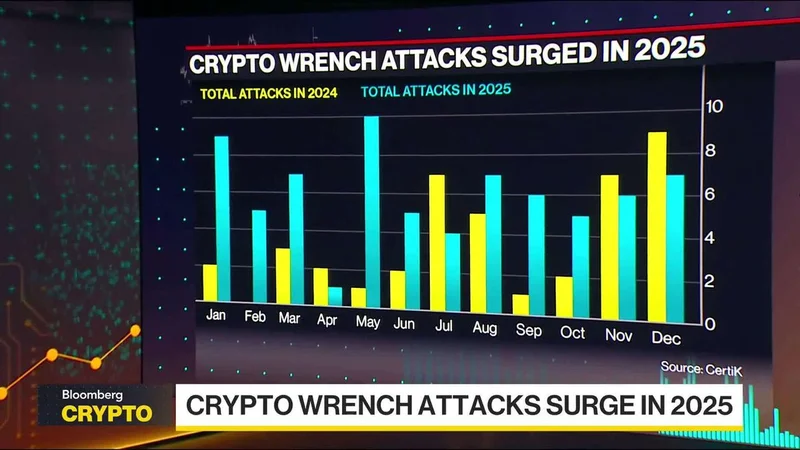
Image: Bloomberg AI
Main Takeaway
Crypto holders face rising physical violence including kidnappings and armed home invasions as criminals bypass digital security to steal private keys directly.
Jump to Key PointsSummary
How crypto crime turned physical
Cryptocurrency crime has shifted dramatically from screens to streets. Criminals now target individuals for their private keys through kidnappings, armed home invasions, and street assaults. Bloomberg reports that after a year of escalating attacks, the industry is scrambling to harden physical defenses. These are not hackers in hoodies but organized gangs using violence to extract digital wealth.
The mechanics are brutally simple. Unlike traditional bank heists, once attackers obtain private keys, the money moves irreversibly. Chainalysis notes over $2.17 billion stolen from crypto services in 2025 alone, with personal wallet compromises growing as a share of total ecosystem losses. TRM Labs documents so-called wrench attacks, named for the blunt instrument scenario of coercing key disclosure, escalating across France, the US, UK, and Canada. The pseudonymity that protects honest users shields criminals once transactions complete.
Why victims cannot call their bank
The fundamental architecture of cryptocurrency creates unique vulnerability. Hyperion Services explains there are no reversals, no transaction flags, no delay mechanisms, and no freezing of funds. Traditional banking moves of $5 million or more trigger cascading compliance checks. Crypto moves instantly and permanently.
This irreversibility attracts criminals who understand the technology better than many victims. Wikipedia's documentation of cryptocurrency and crime includes off-chain coercion to obtain private keys as an established criminal method. The very transparency and decentralization that make crypto revolutionary become weapons against holders. Crisis24 notes that from high-profile executives to casual holders, no one in the crypto community is truly immune. The security model assumes competent individual key management, but humans remain the weakest link.
The social engineering pandemic
Physical violence represents only one vector. Romance and investment scams have exploded in parallel. Hudson Intelligence documents cryptocurrency becoming the top payment method for romance scams by 2021, with a 2,500% increase in dollar losses over two years. These schemes flourished during pandemic isolation and have persisted.
Fox10 Phoenix reports Arizona victims losing life savings to crypto ATM scams, with one detective calling it the Wild West. New state legislation attempts to curb fraud through Bitcoin ATM transaction limits, but schemes persist. The common thread is coercion, whether psychological through manufactured intimacy or physical through direct threat. Criminals adapt faster than regulatory frameworks. Wealthbriefing observes that as digital platforms have hardened, attackers simply target the humans controlling the assets.
What the industry is doing now
The response remains fragmented and reactive. Bloomberg reports crypto conferences are substantially upgrading security after attacks and scams. Physical security firms like Toro Solutions now specialize where people, cyber, and physical security converge. The industry that built censorship-resistant money now confronts its physical corollary: violence-resistant custody.
Some exchanges and custodians are exploring multi-signature wallets, time-delayed withdrawals, and duress protocols. These add friction that criminals dislike. However, adoption remains uneven. Many holders of significant wealth lack personal security details or even basic operational security. The infrastructure of wealth protection lags years behind the infrastructure of wealth creation.
What happens to crypto adoption
The implications stretch beyond individual victimization. If holding cryptocurrency carries significant physical risk, adoption patterns shift. High-net-worth individuals may avoid self-custody entirely, ceding control to centralized custodians and defeating decentralization's core premise. Ordinary users face impossible security trade-offs.
TRM Labs warns that wrench attacks exploit vulnerabilities in human behavior and physical security, bypassing even robust digital safeguards. The industry faces an existential marketing problem: how to promote financial sovereignty while acknowledging that sovereignty makes holders targets. Chainalysis projects stolen funds could exceed $4 billion in 2025 if trends continue. That figure does not include unreported physical coercion cases, where victims may be reluctant to involve law enforcement or even admit holdings.
Where protection efforts are headed
Effective response requires rethinking both technology and behavior. Multi-party computation and social recovery wallets reduce single points of failure. Geographic privacy, once paranoid, becomes rational operational security. Some executives now use decoy wallets with limited funds for plausible compliance under duress.
Law enforcement faces structural challenges. Cross-border cryptocurrency tracing requires specialized capabilities many agencies lack. Victim reporting remains inconsistent. Fox10 Phoenix shows local police struggling with sophisticated scam operations. The gap between criminal sophistication and institutional response widens. Without systemic improvement in physical security infrastructure, insurance products, and law enforcement coordination, individual holders absorb risk the industry promised to eliminate.
Key Points
Physical crypto crime surges with kidnappings and wrench attacks targeting key holders worldwide
Over $2.17 billion stolen from crypto services in 2025, with $4 billion projected by year-end
Irreversible transactions eliminate recovery options that exist in traditional banking
Romance scams using crypto payments grew 2,500% in two years during pandemic isolation
Industry responds with upgraded physical security but lags behind threat evolution
Questions Answered
A wrench attack refers to physically coercing someone to reveal their private keys through violence or threat, named after the scenario of using a wrench to force disclosure. These attacks bypass digital security entirely by targeting the human holder.
Cryptocurrency transactions are irreversible with no delay mechanisms, transaction flags, or freezing options. Once private keys are obtained and funds transferred, there is no bank or authority to reverse the transaction.
Bloomberg reports that crypto conferences are substantially upgrading security measures after attacks and scams, though specific details of enhanced protocols remain limited in public reporting.
Cryptocurrency wealth is often pseudonymous but discoverable through lifestyle signals, concentrated in individual control, and extractable instantly without institutional safeguards once keys are obtained.
Source Reliability
44% of sources are established · Avg reliability: 58
Go deeper with Organic Intel
Simple AI systems for your life, work, and business. Each one includes copyable prompts, guides, and downloadable resources.
Explore Systems