Bloomberg’s Robot Checks Block AI Scrapers, APIs and Readers Across Finance’s Digital Front Door
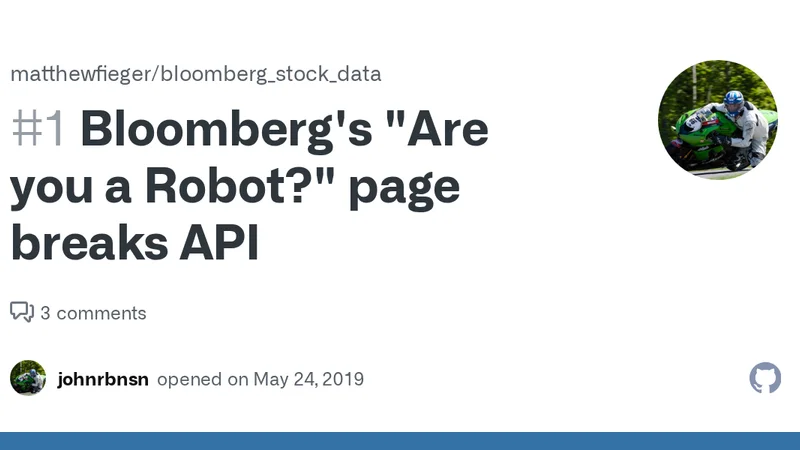
Image: Github
Main Takeaway
Bloomberg’s anti-bot checks are blocking readers, automated APIs and data tools, exposing a growing friction point between financial publishing and machine access.
Jump to Key PointsSummary
The access problem is the story
Bloomberg’s anti-bot system is blocking more than casual readers: it is also disrupting automated tools that request market data and financial articles. Multiple users have encountered a page asking them to confirm they are not robots, with JavaScript, cookies and a browser interaction required to continue.
The blockage affects distinct use cases. Bloomberg links circulated on Hacker News led to verification pages instead of article text, while a GitHub issue describes requests to Bloomberg’s historical chart endpoint being redirected to the same challenge. The result is a single access barrier shared by human readers, scrapers and programmatic clients, even though those users have different needs.
Why automated clients are affected
The verification page depends on browser behavior that basic HTTP clients don't reproduce. A scripted request can receive a challenge rather than the requested content, leaving applications without the data or page they were built to retrieve.
The GitHub report describes an API-style request for Apple stock chart data that stopped functioning after Bloomberg redirected it to a robot-check URL. The example uses Python requests and urllib, showing how older or unofficial integrations can fail when a publisher tightens traffic controls. Bloomberg’s page also asks visitors to permit JavaScript and cookies, requirements that distinguish a normal browser session from many data pipelines.
Finance faces a machine-access conflict
Financial publishers are balancing traffic protection, subscription controls and data licensing against the growing number of software clients that read, analyze or redistribute information. Bloomberg’s anti-bot wall reflects that conflict in a visible form: a system designed to filter abusive automation also catches legitimate research scripts and third-party tools.
The issue reaches beyond Bloomberg. A separate Bloomberg link about Goldman Sachs restricting traders and bankers from using some AI tools places the same access question inside a regulated financial institution. Banks are scrutinizing how AI systems handle confidential information, while publishers are scrutinizing how automated clients handle published information. Both cases show finance imposing tighter boundaries around machine-mediated workflows, though for different reasons.
AI growth raises the stakes
The pressure around automated access is increasing as AI systems consume larger volumes of web content and financial data. Bloomberg’s opinion coverage has also focused on stronger financial oversight for the AI investment boom, connecting rapid capital deployment with demands for clearer controls. Together, the links point to a financial sector adapting its defenses as AI becomes more embedded in markets, research and enterprise software.
That adaptation creates practical costs. Developers lose access to feeds, readers face extra friction, and companies must distinguish licensed use from scraping or abuse. The challenge page itself offers no visible path for an API client, while the GitHub report shows how a working integration can break without a change to the application’s code.
Robots become the next AI frontier
The broader AI conversation is also expanding from software agents to physical machines. Bloomberg has described humanoid robots as an emerging AI breakthrough, linking advances in machine intelligence to systems that operate in the physical world. That trajectory makes the phrase “Are you a robot?” more than a security prompt, even though the access problem here concerns software rather than humanoid machines.
For developers, the distinction matters. A robot-check page treats automated traffic as a category to challenge, while AI products increasingly depend on automated observation, retrieval and action. Bloomberg’s human verification barrier, Goldman’s restrictions on some AI tools and the industry’s interest in humanoid systems all reflect the same broad shift: machines are becoming active participants in workflows that once assumed a person sat behind every request.
What happens next
Bloomberg’s access controls will force developers and businesses to choose between browser automation, approved data products or alternative providers when direct requests fail. Reliable financial applications will need explicit licensing and stable interfaces rather than dependence on undocumented endpoints.
Publishers, meanwhile, face a design choice between broad blocking and more precise authentication. A challenge that stops malicious scraping can also interrupt legitimate research, accessibility tools and personal market dashboards. As AI systems and robotic platforms expand, that distinction will become harder to ignore.
Key Points
Bloomberg’s anti-bot checks are disrupting automated access to articles and market data endpoints.
Developers report Python requests being redirected from Bloomberg chart data to robot-verification pages.
The blocking reflects wider financial-sector controls around scraping, AI tools and confidential information.
Publishers and developers face rising pressure to establish authenticated, licensed machine-access pathways.
Bloomberg’s robotics coverage highlights how software agents and physical robots are expanding machine participation.
Questions Answered
Bloomberg is using an anti-bot verification page to screen unusual or automated traffic. The check requires browser features such as JavaScript and cookies, which can block scripts and basic data clients.
Bloomberg’s robot check can disrupt unofficial APIs and automated requests. A GitHub report describes requests for Bloomberg chart data being redirected to a verification page instead of returning market information.
Bloomberg market-data requests described in the GitHub issue stopped returning the requested chart data and instead received a robot-verification URL. The reported example involved an Apple stock data request made with Python.
Goldman Sachs is restricting traders and bankers from using some AI tools, while Bloomberg is restricting some automated access to its information. Both developments show financial organizations applying tighter controls to machine-mediated workflows.
Developers should use approved Bloomberg APIs, licensed data feeds or authenticated access arrangements. Reliance on undocumented endpoints can break when publishers change anti-bot protections.
Source Reliability
33% of sources are highly trusted · Avg reliability: 54
Go deeper with Organic Intel
Simple AI systems for your life, work, and business. Each one includes copyable prompts, guides, and downloadable resources.
Explore Systems